Synopsys and Ansys power the future of innovation—connecting silicon to systems.
-
-
Software gratuito per studenti
Ansys potenzia la nuova generazione di ingegneri
Gli studenti hanno accesso gratuito a software di simulazione di livello mondiale.
-
Connettiti subito con Ansys!
Progetta il tuo futuro
Connettiti a Ansys per scoprire come la simulazione può potenziare la tua prossima innovazione.
Customer Center
Supporto
Partner Community
Contatta l'ufficio vendite
Per Stati Uniti e Canada
Accedi
Prove Gratuite
Prodotti & Servizi
Scopri
Chi Siamo
Back
Prodotti & Servizi
Back
Scopri
Ansys potenzia la nuova generazione di ingegneri
Gli studenti hanno accesso gratuito a software di simulazione di livello mondiale.
Back
Chi Siamo
Progetta il tuo futuro
Connettiti a Ansys per scoprire come la simulazione può potenziare la tua prossima innovazione.
Customer Center
Supporto
Partner Community
Contatta l'ufficio vendite
Per Stati Uniti e Canada
Accedi
Prove Gratuite

Successful automotive designs require systematic methods to meet aggressive performance goals and compressed schedules.
Successful automotive designs require systematic methods to meet aggressive performance goals and compressed schedules.
Ansys Saber power electronics and system simulation software is used to design and verify the interaction of multiple technologies, such as electrical, mechanical, hydraulic, magnetic, and software. Designers create virtual prototypes of the system, including the wire harness, to reduce the number of design iterations and hardware prototypes. Far more tests and design variations are possible in this environment compared to hardware prototyping. Through a robust design methodology, system performance is immunized against variance in parameters. These methods have proven to reduce design cycle time and maximize performance and reliability.
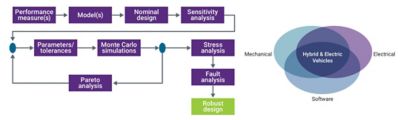
Robust design flow
Hybrid-Electric Vehicles
Reliable vehicle operation depends on successful integration and verification of all drivetrain component interactions under varying operational and environmental conditions. Given the extraordinarily complex nature of hardware and software controls in drivetrain design, engineers use robust design methods to characterize and verify the interaction of mechatronic systems. Saber software’s comprehensive modeling, simulation, and analysis capabilities are applied to improve system performance, reduce cost, and maximize reliability of these critical systems.
- Improve the complete design by analyzing at the system, sub-system, or vehicle level.
- Save time and eliminate errors by using models from an industry proven components library.
- Optimize cost, performance, and reliability with advanced stress, sensitivity, and statistical analyses.
- Model complete mechatronic systems using industry standard VHDL-AMS and MAST languages.
- Test the complete system earlier with hardware and software co-simulation.
- Increase analysis throughput with distributed simulations across multiple central processing units (CPUs).

Wire Harness and Electric System Design
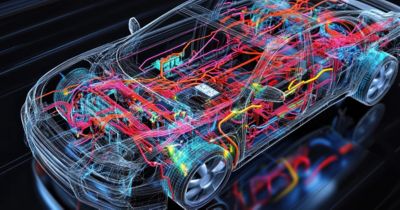
The wire harness forms the backbone of the entire electrical system of automobiles and aircraft. The correct and reliable implementation of the wire harness represents one of the most expensive and technically challenging aspects of vehicle systems design. SaberES Designer software provides proven design and verification capabilities in conjunction with the Saber Simulator to create correct-by-design wire harnesses. Designers can create schematic drawings and connectivity diagrams, export component and wire data, import geometry information from mechanical computer aided design (MCAD) tools, simulate electrical functions, create bundles with connector positions and generate data for manufacturing — all within an easy-to-use design tool.
Advantages of Saber software:
- Analyze electrical systems before layout and manufacturing to avoid system failure in production.
- Provide an integrated data flow for electrical system design from concept to manufacturing.
- Minimize data entry and manual checking tasks, automate data processing steps while maintaining data integrity.
- Integrate with popular 3D CAD tools, such as Catia V5, UGS, and Pro/E.
- Supports team and concurrent engineering working methods, saving valuable design time and maintaining data integrity.
- Verify hardware and software interaction with co-simulation.
- Provides an easy-to-use design editor.
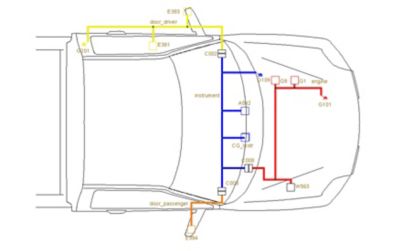
Harness architecture design
Functional Safety and ISO 26262
Saber software’s functional safety solution enables engineers to investigate thousands of fault-effects which can’t be handled using traditional methods such as prototyping. The high-level, fault-effect coverage and efficiency in fault-effect simulation are achieved by automating the analysis and result validation in Saber software.
ISO 26262 strongly recommends simulation for system-level and hardware-level verification. SaberRD and SaberES Designer software are ISO 26262 certified and support functional safety by fault effect analysis.
Advantages of Saber software:
- Investigation of fault effects and fault mitigation in a virtual way.
- Automation of simulation and validation of fault-behavior.
- Boost simulation throughput by multicore- and grid-computing support.
- Enables the development and verification of safety mechanism.
- Proving robustness of safety mechanism by considering component tolerances, temperature dependencies, aging-effects, parameter-drifts, and stress-levels.
Powernet
As electronic content in vehicles increases, so do the challenges in meeting this rising energy demand on the power network. Designers must create efficient power generation and distribution systems that perform reliably.
Design teams use robust design methodologies to manage complex energy generation and distribution problems, such as designing an alternator charging system or considering system and environmental variations that affect performance. Saber software’s comprehensive simulation, modeling resources, and analysis capabilities enable design teams to deploy robust design methods to meet the challenges of powernet design.
- Accurately size system components to match energy generation with corresponding consumption.
- Eliminate surprises in power network loading and distribution through early verification.
- Test the complete system earlier with hardware and software co-simulation.
- Save time and eliminate errors with industry-proven power model libraries.
- Enable design portability using industry standard VHDL-AMS and MAST languages.
- Maximize reliability with advanced sensitivity, statistical, and fault analyses.
- Increase analysis throughput with distributed simulations across multiple CPUs.
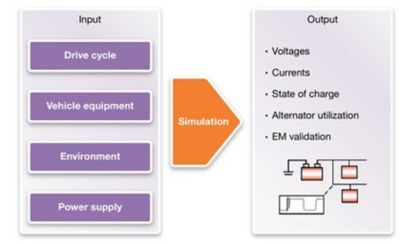
Saber simulation algorithms are specifically tuned for analyzing numerically stiff systems, a common and challenging characteristic of vehicle power networks.
In-Vehicle Networking
Advances in automotive design have been propelled by dramatic increases in electronic systems content. Numerous electronic systems must communicate with each other over a complex network which often contains multiple communication protocols, such as controller area network (CAN), local interconnect network (LIN), and FlexRay standards. These complexities add significant challenges to verifying the physical network layer.
With a traditional prototyping approach, it is impossible to build enough prototypes to adequately test even the most important variations of a network design. Virtual prototyping through simulation has become the proven solution for verifying data network reliability. Saber provides the comprehensive simulation and analyses capabilities needed to apply robust design methodologies to in-vehicle networks and ensure reliability.
- Verify network concepts and topologies early in the development cycle.
- Analyze specific network variants, including minimum versus maximum number of electronic control units (ECUs).
- Save time and eliminate errors with industry-proven IVN libraries.
- Include wire characteristics to analyze possible topology extensions.
- Enable design portability with VHDL-AMS and MAST language standards.
- Maximize reliability with advanced sensitivity, statistical, and fault analyses.
- Increase analysis throughput with distributed simulations across multiple CPUs.
Learn more about how Saber software can help with your electronic vehicle design.

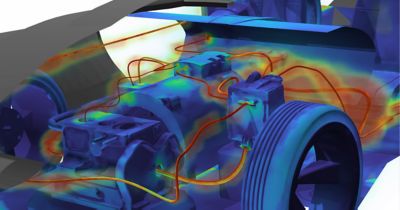
The Advantage Blog
The Ansys Advantage blog, featuring contributions from Ansys and other technology experts, keeps you updated on how Ansys simulation is powering innovation that drives human advancement.