Synopsys and Ansys power the future of innovation—connecting silicon to systems.
-
-
Software gratuito per studenti
Ansys potenzia la nuova generazione di ingegneri
Gli studenti hanno accesso gratuito a software di simulazione di livello mondiale.
-
Connettiti subito con Ansys!
Progetta il tuo futuro
Connettiti a Ansys per scoprire come la simulazione può potenziare la tua prossima innovazione.
Customer Center
Supporto
Partner Community
Contatta l'ufficio vendite
Per Stati Uniti e Canada
Accedi
Prove Gratuite
Prodotti & Servizi
Scopri
Chi Siamo
Back
Prodotti & Servizi
Back
Scopri
Ansys potenzia la nuova generazione di ingegneri
Gli studenti hanno accesso gratuito a software di simulazione di livello mondiale.
Back
Chi Siamo
Progetta il tuo futuro
Connettiti a Ansys per scoprire come la simulazione può potenziare la tua prossima innovazione.
Customer Center
Supporto
Partner Community
Contatta l'ufficio vendite
Per Stati Uniti e Canada
Accedi
Prove Gratuite

In today’s fast‑moving world of product development, optical systems are everywhere, from smartphone cameras and automotive lighting to cutting‑edge medical devices. Yet many companies face a familiar challenge: increasingly complex optical requirements paired with growing pressure to deliver faster and with fewer resources than ever.
For small engineering teams, that pressure can feel impossible to navigate. Designing high‑performance optics isn’t just about creativity — it demands precision, deep technical insight, and the ability to iterate quickly without sacrificing quality. Traditional workflows built around manual calculations or trial‑and‑error prototyping simply can’t keep up.
That’s where Ansys Zemax OpticStudio optical system design and analysis software is transforming what small teams can achieve.
Why Optical Design Has Become Harder — Especially for Small Teams
As optical systems become more sophisticated, the old approaches start to break down.
- Manual design methods are slow and make it hard to explore multiple concepts.
- Basic optical tools lack the advanced simulation power needed for complex modern systems.
- Physical prototypes are expensive and time‑consuming to build.
- Outsourcing core optical work can create communication gaps and slow iteration cycles.
Small teams feel these challenges the most. They need to innovate quickly — often while juggling other engineering responsibilities — but don’t always have access to large budgets, specialized roles, or extended development cycles.
OpticStudio software helps by giving small groups the same advanced simulation, optimization, and collaboration tools traditionally associated with large optical design departments.
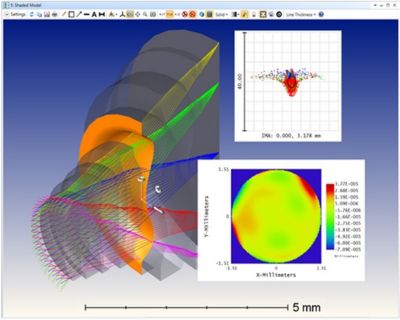
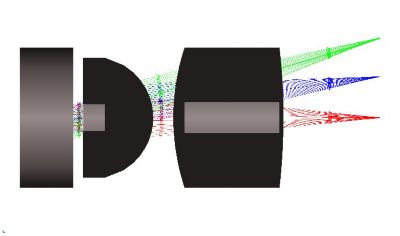
At left is a tolerance simulation of a composite surface in Ansys Zemax OpticStudio optical system design and analysis software. At right is a micro-objective design in Ansys Optics software.
A Modern Approach to Optical Design
OpticStudio software brings the entire optical design workflow into one integrated environment. Instead of jumping around among spreadsheets, computer-aided design (CAD) tools, and physical testing, engineers can model, simulate, optimize, and validate optical systems virtually and long before hardware ever hits the lab.
Here’s why that matters:
1. Design With Confidence Using Comprehensive Simulation
OpticStudio software’s physics‑based simulation engine lets engineers model lens systems, stray light behavior, tolerances, and performance across real‑world conditions. That means fewer prototypes and fewer surprises late in development.
For small teams, reducing trial and error isn’t just convenient but essential.
2. Iterate Faster With Automated Optimization
What used to take days of manual tweaking can now happen in minutes. OpticStudio software’s optimization algorithms automatically explore design variations and identify high‑performing solutions. Teams can test more ideas more quickly and with more precision.
This rapid iteration accelerates innovation while ensuring that designs stay manufacturable.
3. Catch Errors Early
With real‑time validation and tolerance analysis, engineers can catch potential issues early in the process, long before they reach downstream teams or manufacturing partners. That helps eliminate costly redesigns and reduces development risk.
4. Collaborate Seamlessly
OpticStudio software’s compatibility with other engineering tools — along with cloud‑enabled workflows — makes it easy for teams to share files, review designs, and keep projects moving even when distributed across locations or disciplines.
For small teams that rely on cross‑functional coordination, this creates a major boost in productivity and communication.
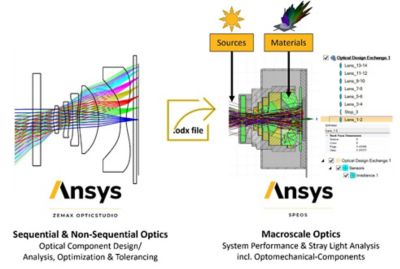
Stray light analysis in a smartphone camera via Optics solutions
Real Companies, Real Impact
Across industries, small engineering teams are using OpticStudio software to do big things:
- Nordson TEST & INSPECTION accelerated its tolerancing workflow by 25%, speeding time to market without increasing team size.
- Meopta created a unified optical workflow that improved consistency and productivity across diverse projects.
- UpNano incorporated OpticStudio software into its 3D lens prototyping process, helping customers make faster design decisions.
- Ferrari used Optics software to optimize advanced headlamp systems in a virtual environment, enabling rapid, cost-effective innovation.
- Optotune used OpticStudio tools to precisely test performance requirements for liquid lenses, ensuring reliability without excessive prototyping.
These stories highlight a consistent theme: With the right tools, smaller optical design teams can overcome resource limitations and deliver sophisticated, high‑performance solutions.
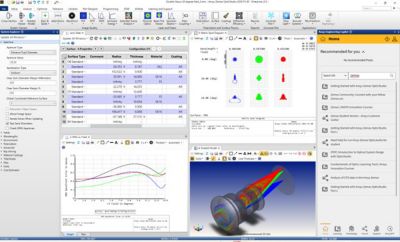
An integrated optics simulation workspace unifying lens design, tolerancing, performance analysis, and 3D visualization to accelerate high accuracy optical system development
Big Business Benefits
Investing in modern optical design software doesn’t just improve engineering efficiency — it lends meaningful value across the entire product development life cycle. With virtual prototyping and rapid iteration, teams can significantly shorten development cycles, helping products reach the market faster. These streamlined workflows also translate into lower costs, as fewer physical prototypes and reduced rework cut down on both material and labor expenses.
At the same time, advanced simulation capabilities ensure that optical designs consistently meet or even exceed performance targets. This elevated design quality enables companies to deliver more reliable, higher‑performing products. Modern tools also support scalable innovation, empowering teams to take on more complex projects without increasing headcount.
For organizations operating under tight budgets or intense market pressures, the combination of faster timelines, lower costs, and higher performance offers a powerful competitive advantage.
Small Teams Can Achieve Big Results
While optical engineering is becoming increasingly complex, the right tools can make the process far more manageable. By integrating simulation, optimization, tolerancing, and visualization into a single workflow, OpticStudio software empowers small teams to:
- Iterate faster
- Design smarter
- Reduce development risk
- Deliver high‑performance optical systems with confidence
You don’t need a large team to achieve exceptional results. You just need the right technology.
See what OpticStudio software can do for your team with a free trial.




The Advantage Blog
The Ansys Advantage blog, featuring contributions from Ansys and other technology experts, keeps you updated on how Ansys simulation is powering innovation that drives human advancement.