Case Study
“Using Ansys Mechanical APDL through the PyAnsys (PyMAPDL) interface allowed me to efficiently generate large, high-fidelity simulation datasets that were essential for training deep-learning–based structural digital twins. The ability to automate geometry creation, loading, meshing, and post-processing directly in Python significantly accelerated my research workflow and enabled systematic exploration of complex structural scenarios. Solutions from Ansys, part of Synopsys, made it possible to couple engineering simulation with modern machine learning (ML) methods, supporting both forward prediction and inverse digital twin updating validated against experimental measurements."
— Maral Zhiyanpour
PhD Candidate, Civil & Environmental Engineering, University of Virginia
Engineers use deep learning surrogate models built with convolutional neural networks (CNNs) and graph neural networks (GNNs) to create structural digital twins that rapidly predict how changes in loads or geometry affect structural response, eliminating the need to rerun full finite element analyses (FEA).
Training the models to predict key outputs, including von Mises stress and surface displacement from geometry, loading, and boundary conditions in 2D structures, requires datasets from large-scale engineering simulations., The digital twins are updated through an iterative CNN-based calculator framework and a diffusion-based inverse model. Accuracy is validated using digital image correlation experiments.
Challenges
Training deep-learning surrogate models for structural digital twins requires large, high-fidelity datasets that capture a wide range of geometries, loading scenarios, and boundary conditions. Obtaining such data experimentally is impractical at scale, making simulation a necessary data source. The simulation framework must therefore support accuracy, scalability, and automation. Ansys MAPDL, accessed programmatically through the PyAnsys™ pythonic access tool for Ansys software, enables automated generation of structural simulation datasets and direct integration with Python-based machine learning workflows.
Technology Used
Script-driven PyAnsys supports programmatic generation of structural samples across a range of geometries, materials, meshing strategies, and loading conditions, enabling the construction of large-scale simulation datasets. Its Python-based interface operates without reliance on a graphical user interface and can be integrated with standard scientific computing libraries such as NumPy and Pandas. This facilitates post-processing, visualization, and export of simulation results (e.g., CSV and. npy formats) for downstream use in deep-learning pipelines.
In this research, PyAnsys was used to perform repeatable, automated iteration over thousands of parametric configurations. Conducting an equivalent study using manual, GUI-driven simulation workflows would have required substantially greater time and effort.
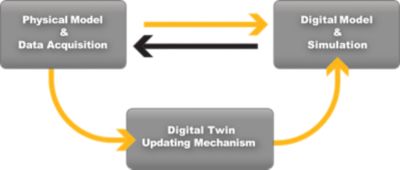
Conceptual overview of the structural digital twin framework, illustrating the interaction between physical data acquisition, numerical simulation, and data-driven digital twin updating mechanisms.
Engineering Solutions
- Engineering simulation generated large, high-fidelity datasets required to train deep-learning surrogate models, including CNNs, GNNs, and diffusion-based models for structural digital twins.
- Ansys Mechanical APDL, accessed through PyAnsys, enabled parametric definition of diverse geometries, material properties, meshing strategies, boundary conditions, and loading patterns, ensuring comprehensive dataset coverage.
- The Python-based workflow enabled automated extraction and storage of stress, strain, and displacement fields in grid-based and mesh-based. npy formats, which were directly compatible with ML training pipelines.
Benefits
- Engineering simulation enabled the generation of thousands of high-fidelity structural samples that would have been impractical to obtain experimentally.
- Automating simulations through PyAnsys reduced per-sample generation time from hours of manual setup to minutes, saving weeks of effort during dataset creation.
- Engineering simulation reduced data acquisition time by over 90%.
- Simulation-driven datasets allowed reliable training of CNN, GNN, and diffusion models, improving surrogate prediction accuracy and stability for digital twin updating.
- The ability to rapidly explore diverse geometries and loading scenarios significantly enhanced model generalization without additional experimental cost.
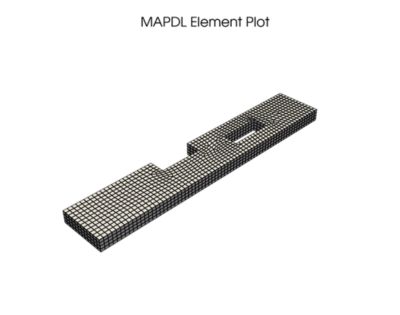
One representative sample from the digital twin dataset, generated using Ansys MAPDL and visualized through the PyAnsys (PyMAPDL) interface.
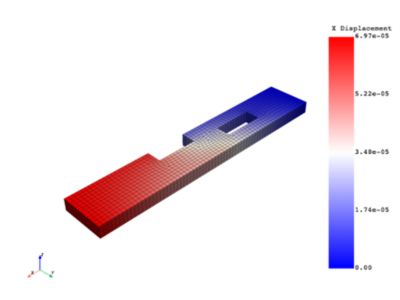
X-direction displacement field (m) of a representative structural sample, computed in Ansys MAPDL and visualized via PyAnsys, with one end fixed and load applied at the opposite end.
现在就开始行动吧!
如果您面临工程方面的挑战,我们的团队将随时为您提供帮助。我们拥有丰富的经验并秉持创新承诺,期待与您联系。让我们携手合作,将您的工程挑战转化为价值增长和成功的机遇。欢迎立即联系我们进行交流。