
Aerodynamic resistance, though often associated with high-speed sports such as cycling, has emerged as an influential factor in long-distance running. At marathon speeds, the air's resistance against a runner's body, while relatively low, still demands significant energy over extended distances that can potentially lead to additional fatigue preventing the runner from winning or finishing the race. This subtle yet persistent force increases with speed, and is further affected by the runner's body position, group dynamics, and external factors. Research in this area has expanded the understanding of how airflow impacts runners, revealing that drag forces can be manipulated to conserve energy. By strategically positioning themselves within formations, runners can mitigate the effects of aerodynamic resistance, achieving greater efficiency.
Advanced simulation tools enabled researchers at Heriot-Watt University, in collaboration with Ansys, part of Synopsys, to model and quantify these effects, highlighting the often untapped potential of aerodynamics to optimize long-distance running. Through deliberate approaches to manage air resistance, elite and recreational runners can maximize their potential during long-distance events.
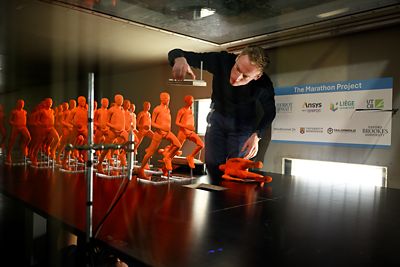
Project team member aligning the models in the wind tunnel (Copyright: Heriot-Watt University)
The Role of Running Formations
Strategically arranged running formations can significantly influence energy efficiency by managing aerodynamic drag. As a solo runner, runners naturally push the air as they move forward, creating an increase in air pressure in front of them (red in the image to the right) and a small void of air behind them (blue in the image to the right). Even when running side by side, both runners face the same aerodynamic pressures. When running in a single-file line, the front runner still experiences a pressure increase, but the air that the second runner pushes fills the small air void behind the front runner, reducing the resistance by up to 5%.
When runners align in tightly packed groups, the leading athletes break the air, creating a path of lower resistance for those following. This phenomenon not only benefits the runners at the back, but also slightly reduces drag for the front runner due to air being pushed forward by trailing runners. Effective formations, such as single-file or staggered configurations, optimize airflow around the group, enabling athletes to expend less energy to maintain their speed. These effects are amplified in larger groups, where the collective arrangement further diminishes air resistance. Optimal positioning within such formations ensures that runners experience less drag, preserving energy that can be crucial during critical race segments.
Research led by Professor Bert Blocken, Professor of Aerospace Engineering (Aerodynamics) at Heriot-Watt University, has uncovered substantial benefits of aerodynamic strategies in marathon running. Using Ansys Discovery 3D product simulation software to generate the male and female runner geometries, and Ansys Fluent fluid simulation software to create high-fidelity computational fluid dynamics (CFD) simulations validated by wind tunnel testing, the study investigated the effects of group formations on air resistance. Results showed that runners positioned within optimized group configurations could reduce aerodynamic drag by as much as 90%. This significant reduction enables athletes to conserve more energy over the course of a race, leading to potential time gains of 30-40 seconds.
Notably, these gains arise not only from drafting but also from the combined aerodynamic advantages across the entire group. By evaluating different formations and spacing arrangements, the research highlighted the benefit of precise positioning to achieve maximum drag reduction. This comprehensive study, which included up to 45-runner configurations, represents one of the most thorough investigations in marathon aerodynamics to date, and demonstrates how airflow management can elevate athletic performance on long-distance courses.
“We cannot replicate every race condition precisely,” said Professor Blocken. “What we can do is clearly demonstrate which aerodynamic strategies provide the greatest benefit — and how athletes can position themselves to conserve energy and maximize performance over long distances.”
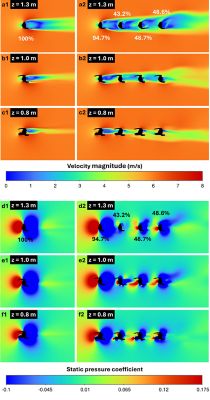
Computational fluid dynamics (CFD) simulations created using Ansys Fluent software show the improved aerodynamics of a single-file formation compared to solo running. Pressure is shown as red, while the void of air behind the runners is shown as blue. (Copyright: Heriot-Watt University)
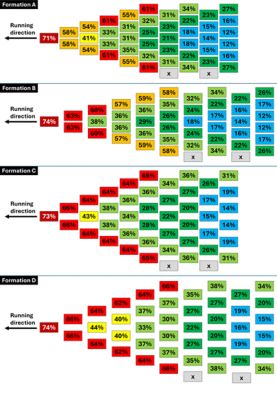
Results of the computational fluid dynamics (CFD) simulations: Percentage drag of every runner in formations A, B, C, and D, compared to the drag of an isolated runner running at the same speed. (copyright: Heriot-Watt University)
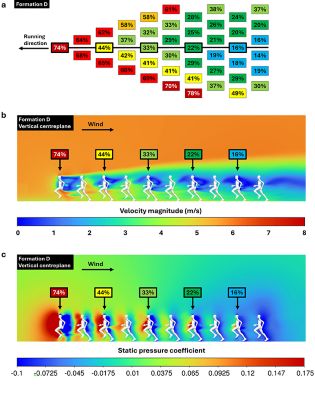
(Left) Results of the computational fluid dynamics (CFD) simulation for formation D: (a) percentage drag of every runner, compared to the drag of an isolated runner running at the same speed; (b) contours of 3D velocity magnitude in the vertical center plane with indication of percentage drag for the runners in the centerplane; (c) same for static pressure coefficient. (Video) Contours of air speed experienced by the 45 runners in the vertical center plane, for less dense formation D (Copyright: Heriot-Watt University)
By reducing aerodynamic drag, runners can experience significant time improvements, potentially altering the competitive landscape of marathon racing. For athletes positioned optimally within a group, drafting alone can save 20 to 30 seconds over the course of a marathon. In scenarios where even external factors aligned, total time reductions approached 30 to 40 seconds. With the current world record at 2:00:35, these aerodynamic enhancements bring the possibility of officially breaking the two-hour marathon barrier in an official race within reach.
Additional Factors: Clothing and Hairstyles
Small adjustments in clothing and hairstyle can significantly influence aerodynamic drag during a marathon. Tight fitting garments minimize the surface area exposed to airflow, reducing resistance compared to loose clothing. Similarly, hairstyles play a role in optimizing airflow; for instance, runners with shorter hair or wearing aerodynamic headwear experience less drag compared to those with voluminous hairstyles. Wind tunnel studies have quantified these effects, showing that hairstyle variations alone can lead to an 8.7% difference in drag. Although such changes might seem negligible in isolation, they compound over the course of a race, particularly in long-distance events like marathons. Aerodynamic clothing, designed to align closely with the body's contours, has already gained traction in professional sports for its performance benefits. These subtle yet impactful factors, when combined with strategic group running tactics, create opportunities to save valuable seconds and maximize energy efficiency.
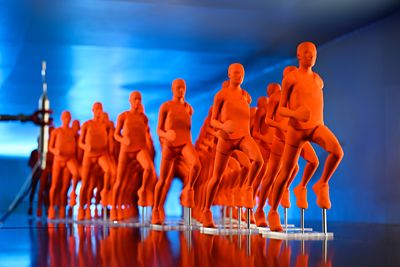
Forty-five quarter-scale runner models were studied on an elevated sharp-edge plate in a wind tunnel. (Copyright: Heriot-Watt University)
Broader Implications for All Runners
The insights gained from aerodynamic studies extend beyond professional athletes, offering valuable strategies for recreational runners to enhance their efficiency and performance. Drafting techniques, commonly employed by elite runners, can be easily adopted by amateur athletes to reduce air resistance and conserve energy during races. By running within a group and maintaining a strategic position, even casual runners can experience noticeable reductions in the effort required to sustain their pace.
By integrating these aerodynamic principles into training and race-day strategies, runners can better manage their energy reserves and achieve more effective pacing. Whether preparing for a competitive event or a personal fitness milestone, the ability to minimize resistance provides a tactical advantage that can enhance both performance and enjoyment of the sport. Aerodynamic techniques, while rooted in high-performance research, offer practical benefits for anyone looking to improve their running experience.
Learn how Discovery and Fluent software helped determine the effects of aerodynamics on marathon running by reading the full study.

Just for you. We have some additional resources you may enjoy.
“What we can do is clearly demonstrate which aerodynamic strategies provide the greatest benefit — and how athletes can position themselves to conserve energy and maximize performance over long distances.”
— Professor Bert Blocken, Heriot-Watt University

The Advantage Blog
The Ansys Advantage blog, featuring contributions from Ansys and other technology experts, keeps you updated on how Ansys simulation is powering innovation that drives human advancement.