
Strolling along a city street, you may notice something moving overhead and look up to see what’s there. Maybe there’s a bird soaring between two buildings or an airplane in the distance. Perhaps there’s a drone over the city park or a news helicopter observing traffic. While these are common sights today, the skies of tomorrow will contain even more possibilities.
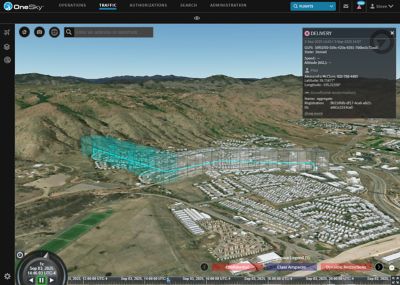
An overview of a flight route showing terrain and buildings
“There are many new air vehicles and operators that need to share the airspace, from drones and air taxis to new commercial operators in the stratosphere like high-altitude platforms (HAPs), new supersonic commercial aircraft under development, and rapidly expanding commercial space operations,” says Bob Hammett, CEO of OneSky.
To share the airspace with these air vehicles — which will vary widely in applications, operators, and goals — a cooperative, extensible, digital traffic management system is required. “That was really the vision for OneSky,” says Hammett, “realizing that operations from low altitude to space need to be harmonized to enable safe, equitable access for all of these operators.”
Today, OneSky seeks to follow this vision and achieve its goal to “harmonize the sky” by developing extensible advanced air mobility (AAM) and uncrewed traffic management (UTM) technology. Customers rely on OneSky’s work to succeed in important missions involving uncrewed vehicles, including using drones for public safety, fire response, search-and-rescue missions, wildlife conservation, infrastructure inspection, agriculture, and drone delivery.
Through their work, OneSky hopes to provide all airspace users with safe, efficient, and scalable access to the skies above.
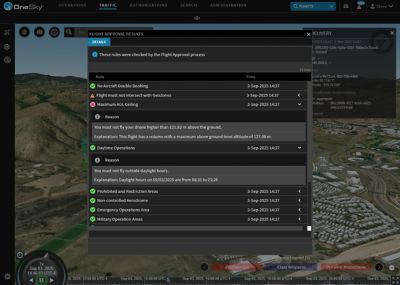
A navigation image showing details like altitude ceiling and the daytime hours for operation
Developing a Safe, Reliable UTM System
As the aerospace and defense (A&D) industry continues to grow and evolve, especially with technological advancements such as autonomous systems taking to the skies, creating a scalable and compliant UTM system becomes increasingly imperative, yet challenging. A new traffic management system is required, but creating this requires overcoming a few large hurdles.
For example, “the current air traffic management system will not scale up to the number of drones anticipated and will not scale down to the altitudes that these drones will be operating at, as the current communication, navigation, radar, and other surveillance systems were not designed to perform at low altitudes,” says Hammett. Because these systems can be ineffective during low-altitude operations around buildings and in urban landscapes, they will need to be improved to ensure safety. Other challenges in urban airspace deployment include fostering community acceptance and distributing flights in the airspace to minimize both noise and visual pollution.
Developing a concept of operation (ConOps) for new UAS operations provides insights into flights, and risk mitigation poses another hardship. An appropriately rigorous ConOps must cover all possible risks involved in a mission, including air, ground, and operational.
Further, when autonomous technology is introduced, things only get trickier since traditional engineering and validation methods struggle to scale with autonomy, airspace complexity, and regulatory requirements.
Despite these challenges, OneSky is undeterred on its path forward. “OneSky and our partners are delivering a cooperative, extensible, digital traffic management system to enable uncrewed air vehicles to operate safely in the airspace alongside more traditional air vehicles,” says Hammett. To help make this vision a reality, OneSky is teaming up with Ansys, part of Synopsys, to achieve their goal of safe, integrated skies.
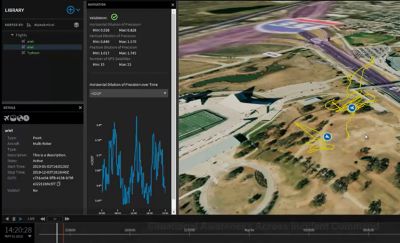
Efficiently Developing a ConOps and Accelerating Certification, Compliance, and Risk Mitigation
Ansys’ collaboration with OneSky helps overcome some of the major challenges in creating a safe and scalable UTM system. For instance, this combining of forces enables the creation of well-defined ConOps that align objectives, environmental constraints, and system behaviors before entering real-world deployment.
Through this collaboration, OneSky offers real-time simulation and risk management solutions for ConOps, including:
- Digital mission engineering to create a ConOps in four dimensions, which enables stakeholders to better understand and contribute to robust missions
- UTM and AAM airspace simulations to model dynamic airspace environments and integrate real-time constraints
- Regulatory airspace compliance to validate operational plans against evolving rules, urban AAM regulations, and military airspace restrictions
- Operational safety validation to use real-world airspace services data to quantify air and ground risk, refine collision avoidance, develop strategic and tactical deconfliction strategies, and ensure flight path safety assessments
Meanwhile, Ansys provides mission-level digital engineering and virtual testing capabilities, including:
- High-fidelity physics-based simulations to model vehicle aerodynamics, sensor accuracy, propagation, and propulsion efficiency
- Autonomous system validation to test AI-driven decision-making, sensor fusion, and control architecture in mission-level scenarios
- Virtual prototyping to simulate navigation, perception, and communication capabilities before real-world testing
- Multi-agent and AAM simulations to evaluate coordinated unmanned aerial vehicles (UAV) operations, airspace deconfliction, and operational safety
In addition to ConOps, one of the biggest hurdles for unmanned and autonomous aerospace deployment is ensuring compliance with the Federal Aviation Administration (FAA), European Union Aviation Safety Agency (EASA), and other aviation authorities. As autonomy levels rise, the difficulty in achieving safety verification and validation (V&V) also increases. Here, OneSky and Ansys combine forces to face this challenge.
For their part, OneSky provides essential safety analyses and real-time operational compliance and airspace risk assessment, such as:
- An aviation safety management system (SMS) to offer a structured, organization-wide approach to managing safety risks, including procedures, practices, and policies designed to identify hazards and mitigate risks
- Dynamic airspace risk modeling to assess how real-time weather, air traffic, and ground infrastructure impact UAV and urban air mobility (UAM) operations
- Beyond visual line of sight (BVLOS) and UAM certification readiness to ensure compliance with emerging global standards and evolving regulations
- Live airspace safety integration to combine real-world air traffic monitoring with Ansys’ digital validation to continuously refine operational safety
Meanwhile, Ansys software enables AI-driven safety validation and risk mitigation, such as through:
- Software-in-the-loop (SiL) and hardware-in-the-loop (HiL) simulations to validate real-time aircraft performance under regulatory constraints
- Failure mode and effects analysis (FMEA) to predict how sensor failures, GPS signal loss, and communication drops impact mission safety
- Autonomous AI compliance testing to verify AI-driven decision-making aligns with legal, ethical, and regulatory requirements
To help achieve mission success, OneSky uses Ansys solutions such as Ansys Systems Tool Kit (STK) digital mission engineering (DME) software. “OneSky uses the Ansys DME software to model concept of operations with our customers and understand the safety case to ensure safe air and ground risks,” says Hammett. “We also use the DME Components Libraries to leverage the rich dynamic analytics and algorithms developed and operationally proven out by AGI (Ansys Government Initiatives). … The DME Libraries provide us with a rich toolbox of analytics and algorithms that are proven, validated, operationally deployed, and ready now. This saves us the time, effort, and risk of building it ourselves.”
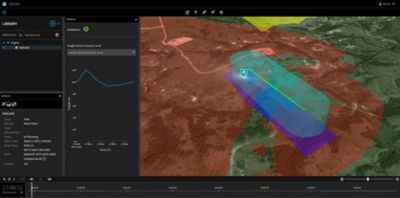
Bridging the Two: A Unified Compliance Strategy
At its core, Ansys’ collaboration with OneSky helps power an end-to-end simulation and compliance framework, which enables aerospace developers to design, test, and validate unmanned and autonomous systems in both digital and real-world airspace environments before deployment.
A few specific advantages of merging OneSky’s real-time airspace compliance solutions with Ansys’ industry-leading digital engineering tools are:
- Accelerating FAA and EASA certification through digital safety validation
- Virtually testing autonomous aircraft in real-world airspace conditions before deployment
- Achieving end-to-end compliance readiness that ranges from digital twin simulations to live operational safety
Integrating real-world airspace simulation and high-fidelity digital engineering reduces certification delays, lowers compliance costs, and ensures operational safety across the entire AAM and UAV development life cycle. It empowers aerospace leaders to design, test, and deploy unmanned and autonomous systems with confidence — all before vehicles ever leave the ground.
And this is only the start. Looking to the future, “we expect that digital engineering will prove valuable as we increase our use of AI in addressing challenges like conflict detection, trajectory prediction, automated rerouting, and dynamic airspace management,” says Hammett.
As for the future of OneSky’s work, Hammett sees it aiding the deployment of air taxis and other AAM vehicles. “Many of the same UTM technologies will be leveraged and enhanced to meet the needs of AAM. In addition, new technologies for traffic flow management will be deployed,” says Hammett. “OneSky has already been working with AAM original equipment manufacturers (OEMs) and their future operators in planning for the technology needed for operating fleets of these vehicles.”
Learn more about the AAM industry by checking out the e-books, video, and articles available at Navigating the Future: Autonomous Systems for A&D.

Just for you. We have some additional resources you may enjoy.
“We expect that digital engineering will prove valuable as we increase our use of AI in addressing challenges like conflict detection, trajectory prediction, automated rerouting, and dynamic airspace management.”
— Bob Hammett, CEO, OneSky



The Advantage Blog
The Ansys Advantage blog, featuring contributions from Ansys and other technology experts, keeps you updated on how Ansys simulation is powering innovation that drives human advancement.