Synopsys and Ansys power the future of innovation—connecting silicon to systems.

Advanced air mobility (AAM), a sector of the aerospace industry that incorporates support for next-generation technologies, has the potential to completely revolutionize transport. However, this will be possible only with a similar revolution in aircraft design.
AAM will require a whole new kind of aircraft: one that is powered by electricity, has vertical takeoff and landing (VTOL) capabilities, incorporates varying levels of autonomy, and can successfully navigate situations in which aircraft separation can be measured in feet rather than miles. Designing aircraft that combine so many new technologies will be difficult enough, but on top of those technological challenges are the complexity and uncertainty of AAM flight profiles and missions. This means that performance requirements for AAM vehicles remain in flux.
In contrast to AAM, traditional aircraft vehicle design is based on the evolution of existing designs and missions. First, traditional aircraft design starts with considering requirements. Design concepts must be evaluated for estimated viability and weight to fulfill requirements based on historical data for similar designs, and making incremental adjustments and revisions leads to improvement in the technology. From an initial concept and baseline weight, a design proceeds to address subcomponents such as aerodynamics, propulsion, payload, and structure. Designers must also make certain trade-offs to meet weight limits and mission requirements.
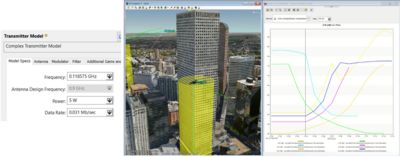
Ansys Systems Tool Kit (STK) digital mission engineering (DME) software can be used to define a basic transmitter attached to a vehicle and to analyze transmitter performance in an urban environment during a flight.
Uncovering Challenges in AAM Design
Designing eVTOL aircraft is a difficult task due to relatively new and immature technology, complex flight modes, and the limited availability of proprietary performance data. First, the electric vertical takeoff and landing (eVTOL) vehicles on which AAM will be built are new technology without historical data. This means it is hard to form an initial baseline for aircraft sizing. Further, the rapid development of these technologies means there isn’t a stable baseline to define basic design parameters.
Additionally, aircraft design is often coupled. For example, an increase in carrying weight may require a larger engine or wing, which further increases the overall weight of the aircraft. Without historical data to help determine reasonable design points and requirements, designers may make designs that are either overaggressive and unobtainable or too conservative and uncompetitive.
Innovating in the Unknown
The difficulty of dealing with multiple new technologies is compounded by unknown operational models. Air vehicle performance in cruise, climb, speed, and distance, which are typically based on historical operating models, are used to determine requirements and form the foundation of aircraft design. However, AAM presents entirely new challenges for defining business models and profitable operations. Several of these challenges, including airspace management, noise levels, efficient trajectories, available landing zones, and communication coverage, were discussed in our earlier blog "Advanced Air Mobility: Using DME To Understand Complex Mission Challenges."
Complicating matters further is that the feasibility of still-developing technology influences some of these operational decisions. Unlike traditional aircraft development, we only have speculation as to airspace structure and profitable operating models for AAM. Hence, we are left with a paradox of coupled uncertainties in desired operations and design possibilities.
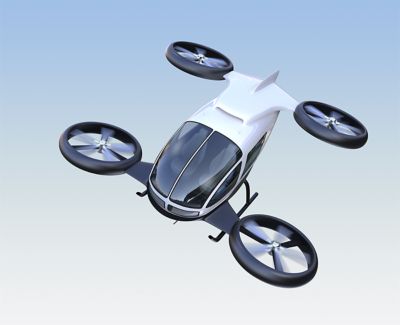
The challenges of AAM vehicle design are clearly apparent in the wide range of proposed designs. Commercial aircraft design reached an optimal layout more than three decades from the Wright brothers’ first flight. At an airport, the only obvious difference in airliner design (other than overall size) is whether the two engines are located on the tail or under the wings. AAM designs, as seen in the figure below, are very diverse: multirotor, tiltrotor, tilt-wing, and lift+cruise configurations are all in development by multiple companies.
In addition to aircraft vehicle design — such as the structure, airfoil shape, and propulsion system — we must also consider mission systems design. Mission systems are not necessary for flight, but they enable aircraft to safely fulfill the flight’s purpose. These systems include communication, navigation, surveillance (CNS) systems, and avionics. As with air vehicles, AAM aircraft face several challenges. For example, to support NASA’s vision for hundreds of simultaneous operations over a single metropolitan area, AAM aircraft will need much more complex CNS and data management systems than typical for current aircraft to ensure safe flight and situational awareness, even in urban areas with complex electromagnetic (EM) environments.
Bridging Design and Operations With Simulation
Ansys Systems Tool Kit (STK) digital mission engineering (DME) software enables a new approach that helps address these challenges. As previously discussed, STK software can represent many of the complexities of the AAM mission environment digitally. Building a complete digital mission model enables engineers to easily evaluate a range of operational assumptions and quantify performance parameters under those conditions. STK software enables a new, agile approach to aircraft design in the face of mission uncertainty and technological change.
STK software can augment aircraft design in the open system and mission design environment of eVTOL and AAM. Ansys examined three notional aircraft that represent the range of potential eVTOL designs: a multirotor, a tiltrotor, and a lift+cruise concept.
For these designs, only a simplified set of mission variables was considered:
- The range, either long (80 km) or short (20 km)
- The vertical climb required for an uncongested area of 100 ft or a congested area of 500 ft
Noise requirements in terms of minimum altitudes based on expected noise generation were also evaluated. STK software’s mission environment was used to quickly evaluate the energy used for each concept under different mission and design assumptions. In this case, each design has an ideal application: long range uncongested, short range uncongested, or short range congested.
This example shows how you can quantify mission- and business-relevant performance for different new technologies and see the mission assumption under which those technologies are most effective. You can easily expand the simple mission parameters into larger and more complex factors. STK software’s existing Python application programming interface (API) — as well as other Ansys tools like Ansys ModelCenter model-based systems engineering (MBSE) software and Ansys optiSLang process integration and design optimization software — facilitate trade studies and sensitivity analyses for different design parameters against multiple operational assumptions. This enables aircraft designers to make informed design and technology investment decisions. It also aids potential operators in determining design requirements for their vehicles across a wide range of operational and design variables.
Solving Challenges With DME Software
Mission systems present a challenge because of the anticipated stronger demands on these systems, and the lack of established guidelines on CNS requirements requires design flexibility as well. DME software can help manufacturers, regulators, and operators determine what these requirements should be by modeling the urban EM environment and different CNS subsystem designs in tandem. In the image below, STK software can be used to define a basic transmitter attached to a vehicle to analyze transmitter performance in an urban environment during a flight.
Defining transmitters and tracing EM performance for signal-to-noise ratio (SnR) along routes for individual or groups of aircraft will enable infrastructure, aircraft, and regulation design to prevent flight in CNS dead zones. It will also ensure sufficient communications and situational awareness for all AAM players as the skies become more crowded.
Keeping up with eVTOL design and AAM operation involves many obstacles, but it is also an opportunity for new development approaches that revolutionize air transport and air design. DME software is a key part of an agile, digital design process that will allow all aspects of eVTOL to be designed around safe, effective, and profitable AAM operations.



The Advantage Blog
The Ansys Advantage blog, featuring contributions from Ansys and other technology experts, keeps you updated on how Ansys simulation is powering innovation that drives human advancement.