Synopsys and Ansys power the future of innovation—connecting silicon to systems.
-
-
Software gratuito per studenti
Ansys potenzia la nuova generazione di ingegneri
Gli studenti hanno accesso gratuito a software di simulazione di livello mondiale.
-
Connettiti subito con Ansys!
Progetta il tuo futuro
Connettiti a Ansys per scoprire come la simulazione può potenziare la tua prossima innovazione.
Customer Center
Supporto
Partner Community
Contatta l'ufficio vendite
Per Stati Uniti e Canada
Accedi
Prove Gratuite
Prodotti & Servizi
Scopri
Chi Siamo
Back
Prodotti & Servizi
Back
Scopri
Ansys potenzia la nuova generazione di ingegneri
Gli studenti hanno accesso gratuito a software di simulazione di livello mondiale.
Back
Chi Siamo
Progetta il tuo futuro
Connettiti a Ansys per scoprire come la simulazione può potenziare la tua prossima innovazione.
Customer Center
Supporto
Partner Community
Contatta l'ufficio vendite
Per Stati Uniti e Canada
Accedi
Prove Gratuite
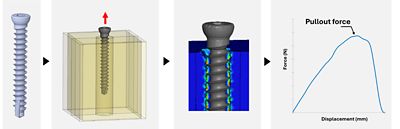
In 2024, Numalogics had just released Endpoint™, a cloud-based app that uses advanced computational modeling to virtually replicate traditional mechanical testing of orthopedic screws. Since then, Endpoint™ has been Food and Drug Administration (FDA)-qualified through the Medical Device Development Tools (MDDT) program. This achievement marks the first FDA qualification of a mechanical test for an orthopedic device, setting a new precedent for virtual testing in regulatory approvals and opens the door for faster and cheaper in silico testing.
Designed to predict the axial pullout strength of metallic bone screws, Endpoint™ eliminates the need for time-intensive physical prototypes. Developed in collaboration with Sawbones and powered by high-fidelity finite element analysis (FEA) from Ansys, part of Synopsys, the tool integrates seamlessly into the design process, offering manufacturers a streamlined approach to assess screw performance under standardized testing conditions. By incorporating American Society for Testing and Materials (ASTM) standards, Endpoint™ ensures compatibility with regulatory guidelines, giving manufacturers confidence in its accuracy and relevance.
Seal of Approval
The journey to FDA approval for Endpoint™ required rigorous validation to ensure the tool’s reliability to predict the pullout strength of bone screws. Central to this process was aligning the simulation model with ASTM F543 standards, which outlines the methods for determining axial pullout strength in orthopedic screws. By replicating this standardized mechanical test virtually, Endpoint™ proved its capacity to deliver results consistent with physical testing in Sawbones’ 20 PCF rigid polyurethane foam, a material commonly used by ASTM standards for orthopedic evaluations for its mechanical properties similar to trabecular bone.
Numalogics conducted an extensive validation study, comparing simulation outputs with experimental pullout test results from real orthopedic screws. This process involved collaborating with manufacturers to access both physical samples and precise computer-aided design (CAD) files and testing these screw designs. Through these comparisons, Endpoint™ demonstrated a high degree of accuracy, further solidifying its credibility as a surrogate for physical testing.
“When you do experiments, there’s a lot of variability, notably for screw pullout,” says Julien Clin, scientific director at Numalogics. “So, if you compare two screws but you do the experiment on different days, the conditions, like temperature, humidity, etc., have changed, and it affects your results. With simulation, it’s deterministic. The conditions are always the same, de facto leading to consistency of results.”
Adherence to the FDA’s computational modeling guidelines was another critical step. Numalogics implemented robust verification and validation methodologies, following the ASME VVUQ 40 standard, including sensitivity analyses and uncertainty quantification, to address potential variabilities in input parameters and testing conditions. These efforts ensured that the tool met the stringent requirements of the FDA’s MDDT program.
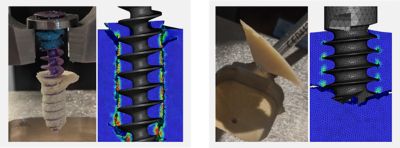
Two distinct modes of failure observed during experimental testing and the corresponding screw pullout model prediction
Numalogics created a comprehensive solution by integrating a suite of Ansys software to develop the advanced simulations at the heart of Endpoint™.
- Ansys SpaceClaim 3D CAD modeling software was used to prepare screw test geometries for simulation, ensuring compatibility with the FEA workflow.
- Ansys Mechanical structural simulation software facilitated structural model setup, enabling accurate representation of the screw and foam interaction during pullout testing.
- For the explicit simulations required to capture the complex failure behavior of the foam material, Ansys LS-DYNA nonlinear dynamics structural simulation software provided the precision and computational power needed to achieve reliable results.
“One big advantage of Ansys is that it’s well known by the FDA,” says Clin. “When you submit a file to the FDA, you also have to verify your finite element software. But as the FDA knows Ansys, and Ansys has a solid and rigorous quality system, this verification process is straightforward.”
To enhance efficiency and streamline processes, Numalogics leveraged automation tools like a dedicated ACT software extension, which simplified repetitive tasks, such as model generation and result processing. Post-processing and visualization were handled using PyAnsys, enabling the team to efficiently extract critical data and present it in a clear, standardized format. This automation not only reduced manual effort but ensured the consistency of outputs across simulations.
“That’s one of the great forces of the Ansys suite,” says Clin. “All these tools to automate things. It’s really, really good for people like us who want to develop an automated workflow.”
Impact on Medical Device Development
The adoption of tools like Endpoint™ revolutionizes how orthopedic device manufacturers approach design and validation. Virtual testing enables faster iteration cycles earlier in the product development process, meaning that development teams can evaluate screw designs without the delays associated with physical prototyping and experimentation. This streamlined process minimizes time to market and resources spent on prototype creation and physical testing while enabling more thorough exploration of the design space to optimize performance.
“Endpoint™ can be used as a surrogate for physical testing,” says David Benoit, simulation specialist in advanced computational methods at Numalogics. “Screw manufacturers don’t have to go through prototyping each design that they want to test, which is a process that can take multiple weeks per design iteration. Using Endpoint, orthopedic screw manufacturers may iterate very fast to reach an optimal design this way.”
Additionally, simulation-based testing reduces the variability inherent in physical experiments, offering more consistent, reproducible results under standardized conditions. With Endpoint’s™ ability to deliver regulatory-relevant evidence, manufacturers can more effectively align their development workflows with submission requirements, avoiding potential delays in bringing products to market. By incorporating advanced computational modeling, companies can focus on innovation and precision, ultimately enhancing the reliability and performance of their devices.
Future Directions and Innovations
Numalogics is exploring new opportunities to expand the capabilities of virtual testing tools in medical device development. Building on the success of Endpoint™, the team is working on additional applications that go beyond screw pullout testing, aiming to address a broader range of standardized implant evaluation scenarios. These efforts include developing simulations tailored to other ASTM and ISO testing standards, which would enable a more comprehensive evaluation of medical devices under various mechanical and biofidelic conditions, such as screw toggling.
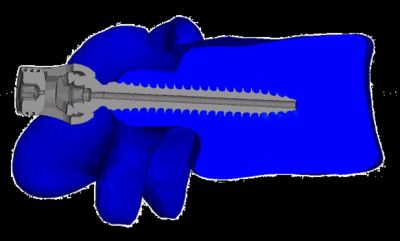
Simulation of a screw inserted into a vertebra undergoing cyclic physiological plowing loading
The company is also prioritizing the integration of patient-specific modeling techniques to support clinicians in pre-operative planning. By incorporating patient imaging data, these tools could provide predictive insights into how implants interact with individual anatomical structures, enabling customized surgical strategies. This advancement has the potential to improve surgical outcomes and reduce risks, creating a more personalized approach to medical care without ever compromising patient safety.
These initiatives reflect Numalogics’ commitment to driving innovation in the medical device industry while maintaining alignment with regulatory standards. By pushing the boundaries of what virtual testing can achieve, the company is not only enabling faster, more efficient product development but setting the stage for advancements that could redefine the role of simulation in healthcare.
Learn more about how Ansys can help with your medical device needs.

Just for you. We have some additional resources you may enjoy.
“That’s one of the great forces of the Ansys suite. All these tools to automate things. It’s really, really good for people like us who want to develop an automated workflow.”
— Julien Clin, scientific director, Numalogics
The Advantage Blog
The Ansys Advantage blog, featuring contributions from Ansys and other technology experts, keeps you updated on how Ansys simulation is powering innovation that drives human advancement.