Synopsys and Ansys power the future of innovation—connecting silicon to systems.
-
-
Software gratuito per studenti
Ansys potenzia la nuova generazione di ingegneri
Gli studenti hanno accesso gratuito a software di simulazione di livello mondiale.
-
Connettiti subito con Ansys!
Progetta il tuo futuro
Connettiti a Ansys per scoprire come la simulazione può potenziare la tua prossima innovazione.
Customer Center
Supporto
Partner Community
Contatta l'ufficio vendite
Per Stati Uniti e Canada
Accedi
Prove Gratuite
Prodotti & Servizi
Scopri
Chi Siamo
Back
Prodotti & Servizi
Back
Scopri
Ansys potenzia la nuova generazione di ingegneri
Gli studenti hanno accesso gratuito a software di simulazione di livello mondiale.
Back
Chi Siamo
Progetta il tuo futuro
Connettiti a Ansys per scoprire come la simulazione può potenziare la tua prossima innovazione.
Customer Center
Supporto
Partner Community
Contatta l'ufficio vendite
Per Stati Uniti e Canada
Accedi
Prove Gratuite
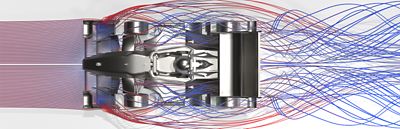
The eForce Prague Formula Team, a standout competitor in the world of Formula Student (FS) racing, has made remarkable strides in engineering and innovation. Operating out of the Czech Technical University in Prague, this team combines creativity with technical expertise and advanced simulation to build high-performance vehicles for some of the most competitive motorsport events.
The team brings together students from a wide range of technical backgrounds, including mechanical and automotive engineering, aerospace engineering, and industrial design. This mix of expertise helps the team tackle complex vehicle development challenges — such as aerodynamics and thermal management — from multiple angles. With each member contributing their own skills and goals, the team pushes to raise the bar with every competition.
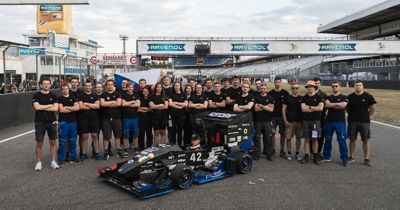
Team eForce at Formula Student Germany (FSG)
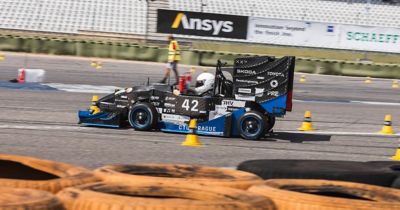
The eForce car at FSG
Through the advanced simulation capabilities provided by Ansys, part of Synopsys, and with support from the Ansys Student Team Partnership and Ansys Select Channel Partner, TechSoft, eForce has refined every aspect of their design and manufacturing process. The team even developed a custom-built computational fluid dynamics (CFD) automation tool that gives the team a competitive advantage by streamlining workflows, optimizing designs, and improving efficiency across critical components such as aerodynamics, cooling, and structural integrity. These efforts have enabled eForce to achieve significant milestones in vehicle performance and competition results.
From Concept to Competition
While initially focused on combustion, the team has since transitioned to electric and autonomous technologies. As with other Formula Student teams, eForce operates on a yearly development cycle, designing a new car for each season. Design and concept development occur during the winter semester, which includes post-season testing and aerodynamic development using an array of simulation tools. Manufacturing begins in the summer semester, with most parts produced in-house to gain hands-on experience, including carbon fiber components. Then, the car is completed with plenty of time to allow for extensive testing before competing in three to four European races during the summer. After the race season and collecting judges’ feedback, the team takes a short break before starting the next development cycle.
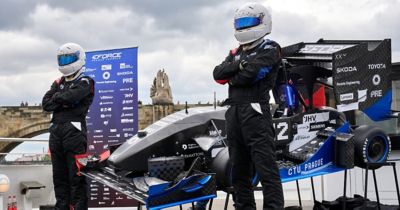
The CTU.25 at rollout on the Vltava River
The team has achieved strong competitive success, with its last hybrid car becoming the most successful in team history, earning two overall first-place finishes along with multiple podiums. In 2024, the team secured third place overall in the Electric Vehicle class at Formula Student Germany, and in 2025, third place in the Driverless class. Currently ranked 10th worldwide in Formula Student, the eForce team is focused on building on this momentum and aiming even higher in future seasons. Throughout the year, the team attends numerous events and exhibitions, including having their 2024-25 season car (CTU.24) shown at last year’s EXPO in Japan.
A crucial part of the precision and efficiency of this year-round workflow is the extensive integration of Ansys tools. For aerodynamic design and cooling system optimization, Ansys Fluent fluid simulation software enables rapid iteration and exploration of complex design spaces. The software’s capabilities, such as setting boundary conditions and material properties with minimal effort, enable the team to tackle ambitious aerodynamic and thermal challenges effectively. “Its robust yet user-friendly options to set boundary conditions save us a lot of time and … allow us to explore even wild ideas such as equipping a motor rotor with blades for internal cooling,” says Filip Müller, group leader of aerodynamics and chassis for eForce.
The team optimizes brake discs using Fluent software to model heat dissipation and then integrates the results into Ansys Mechanical structural finite element analysis (FEA) software.
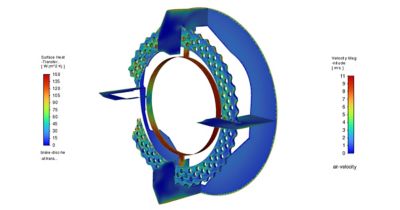
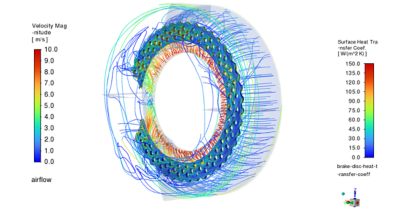
Simulations of brake disc cooling shown in Ansys Mechanical structural finite element analysis (FEA) software
For structural optimization, Mechanical software plays a key role in refining components like uprights and brake discs. Using topology optimization, the team reduced the weight of drivetrain assembly components while meeting the strict mechanical performance criteria of the Formula Student competition.
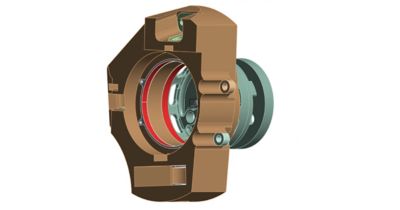
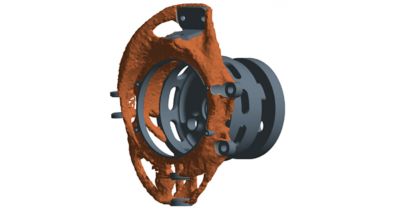
Upright before and after topological optimization in Mechanical software
The Ansys Motor-CAD dedicated electric motor design tool for multiphysics simulation enables the team to create detailed thermal models of their motors, facilitating the evaluation of heat losses and cooling configurations under various operating conditions. This functionality supports informed decision-making in motor design, which is critical for performance and reliability on the track.
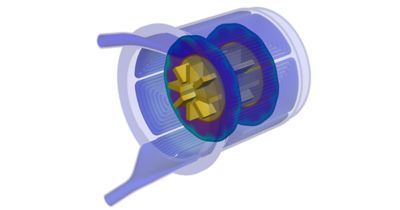
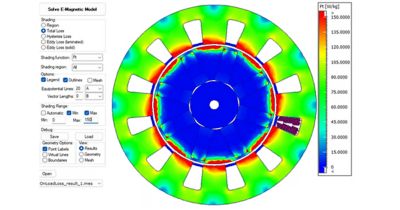
Motor cooling visualization (left) and motor loss distribution (right) in the Ansys Motor-CAD dedicated electric motor design tool for multiphysics simulation
Finally, Ansys Ensight simulation data visualization software revolutionizes post-processing with its advanced visualization capabilities. With Ensight software, the team reduces the time required for tasks such as generating high-resolution line integral convolution (LIC) slices, thereby enhancing their ability to analyze and communicate simulation results.
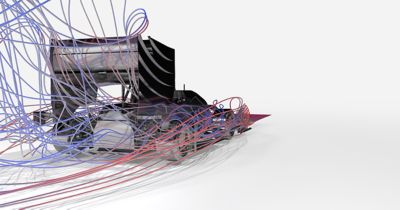
Ansys Ensight simulation data visualization software post-processing
Design — But Make It Faster
Simulation has significantly reduced development time and cost by minimizing the need for physical prototyping and expensive wind tunnel testing, saving hundreds of hours each season. Beyond aerodynamics, simulation tools enable rapid design iteration and optimization across drivetrain and suspension systems, enabling the team to achieve performance targets with far less physical testing, time, and expense.
However, it’s the shift from CPU- to GPU-based simulations that has further accelerated the team’s aerodynamic analysis, cutting runtimes from about seven hours to two while improving workflow efficiency. “We wanted to take automation a step further, eliminating the manual process of uploading models and assigning zones,” says Müller.
The development of the customized GPU workflow began about three years ago when the aerodynamics team set out to fully automate their simulation process. Existing solutions required students to manually load models and configure settings, slowing things down. To remove these barriers, the team built a custom graphical user interface (GUI) using PyFluent software. This enabled users to upload a design and start a simulation with just a few clicks. With built-in default settings, users can easily adjust options without touching any code.
As needs grew, the workflow was enhanced to include cooling simulations for radiators and fans, which could be turned on or off directly in the interface and required no manual setup. “Eventually, the automation became so efficient that the human operator became the limiting factor,” Müller explains. “To address this, we implemented an automated queuing system, allowing users to batch process simulations.”
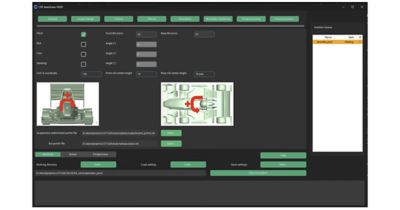
Automatization graphical user interface (GUI) parametrization
This automation not only handles errors gracefully but also maximizes hardware utilization by running different simulation stages in parallel. Another key improvement addressed how vehicle designs were handled. Instead of uploading an entire car model — which was time-consuming — the system was updated to allow users to swap in only the parts that changed, dramatically reducing setup time. Additional features were later added to simulate real-world driving conditions, such as cornering and changes in vehicle position, all without requiring complex design models.
There is no doubt that eForce didn’t just integrate simulation; they harnessed it and made it their own. Müller states that in the future, the team is looking into integrating PyMechanical functions to speed up overall simulation processes. This could include automatic post-processing or meshing setup.
Overcoming Challenges With Partnerships
Advancement is not without its challenges. eForce faced bottlenecks in post-processing and in building a parametric model with a moving suspension for cornering simulations. However, the team credits their TechSoft partnership with playing a critical role in both drivetrain and CFD development. With regular, hands-on support, the team saw an improvement in simulation quality and efficiency.
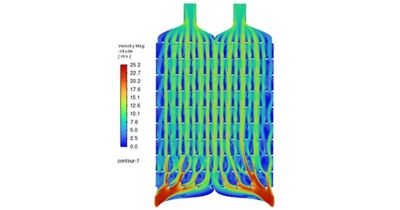
An accumulator cooling airflow visualization
“A tangible result of this collaboration is the success of our drivetrain group. Thanks to advanced Ansys tools, we achieved a 15% weight reduction in the assembly while maintaining all required mechanical properties,” says Müller.
In CFD, TechSoft’s experts also provide guidance on Fluent simulations and actively support the team in exploring new software capabilities, even in areas where the team has limited prior experience.
Racing Ahead: From Competition to Career
Looking ahead, the team plans to deepen its use of simulation to push performance even further. Future efforts for the team include designing a custom electric motor through advanced electromagnetic modeling and optimization, improving printed circuit board (PCB) reliability through virtual testing of thermal and mechanical stresses, and refining a custom gearbox lubrication system to reduce wear, losses, and heat. Together, these initiatives highlight how simulation continues to serve as a foundation for faster iteration, smarter design decisions, and innovation across the entire vehicle.
Just as important, Formula Student is shaping the team members’ paths beyond the competition. Whether pursuing careers in automotive and industrial design, nuclear engineering, aerospace, motorsport, or other emerging industries, each eForce student is carrying forward the skills, mindset, and ambition developed through the team’s hands-on engineering experience with simulation.
Discover how an Ansys Student Team Partnership can support your team with the tools, resources, and expertise to push performance further.

Just for you. We have some additional resources you may enjoy.
“A tangible result of this collaboration is the success of our drivetrain group. Thanks to advanced Ansys tools, we achieved a 15% weight reduction in the assembly while maintaining all required mechanical properties.”
— Filip Müller, group leader of aerodynamics and chassis, eForce Prague Formula Team
The Advantage Blog
The Ansys Advantage blog, featuring contributions from Ansys and other technology experts, keeps you updated on how Ansys simulation is powering innovation that drives human advancement.