Synopsys and Ansys power the future of innovation—connecting silicon to systems.
-
-
Software gratuito per studenti
Ansys potenzia la nuova generazione di ingegneri
Gli studenti hanno accesso gratuito a software di simulazione di livello mondiale.
-
Connettiti subito con Ansys!
Progetta il tuo futuro
Connettiti a Ansys per scoprire come la simulazione può potenziare la tua prossima innovazione.
Customer Center
Supporto
Partner Community
Contatta l'ufficio vendite
Per Stati Uniti e Canada
Accedi
Prove Gratuite
Prodotti & Servizi
Scopri
Chi Siamo
Back
Prodotti & Servizi
Back
Scopri
Ansys potenzia la nuova generazione di ingegneri
Gli studenti hanno accesso gratuito a software di simulazione di livello mondiale.
Back
Chi Siamo
Progetta il tuo futuro
Connettiti a Ansys per scoprire come la simulazione può potenziare la tua prossima innovazione.
Customer Center
Supporto
Partner Community
Contatta l'ufficio vendite
Per Stati Uniti e Canada
Accedi
Prove Gratuite

Augmented reality (AR), virtual reality (VR), and mixed reality (MR) are no longer emerging technologies — they are becoming foundational platforms for how we design, train, collaborate, and interact with digital information. What began as consumer entertainment has evolved into spatial computing, with real adoption across manufacturing, healthcare, defense, architecture, data centers, and autonomous systems.
Over the last few years, advances in display optics, sensing, compute, and AI have pushed AR/VR from novelty to necessity. But one enabling technology continues to define whether these systems succeed or fail at scale: eye tracking.
Eye tracking measures eye position, gaze direction, pupil size, and movement dynamics. In modern AR/VR systems, it does far more than detect where a user is looking — it enables performance, comfort, realism, and efficiency across the entire device stack.
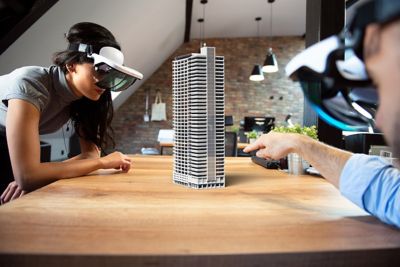
How the Human Gaze Now Powers Spatial Computing
Global technology leaders continue to invest heavily in eye‑tracked AR/VR because gaze is the most natural and efficient human interface. In 2026, eye tracking underpins:
- Foveated rendering, where high resolution is applied only where the eye is focused
- Lower latency interaction, enabling more responsive spatial experiences
- Reduced power and thermal loads, essential for lightweight, all‑day wearables
- Natural user input, replacing controllers with gaze‑based interaction
Modern headsets rely on eye tracking not just for interaction, but to optimize the optical system itself. By understanding how the eye resolves detail — high acuity in the fovea, lower resolution in peripheral vision — developers can dramatically reduce computational demand without sacrificing visual fidelity.
This reduction in compute directly impacts headset size, weight, heat dissipation, and battery life — all of which are critical barriers to enterprise and consumer adoption.

Solving Visual Discomfort With Smarter Optics
Despite major advances, visual comfort remains one of the hardest challenges in AR/VR system design. A persistent issue is the vergence‑accommodation conflict (VAC) — when the eye’s convergence angle and focal distance do not match.
In next‑generation headsets, eye tracking is essential to solving this problem. By knowing exactly where a user is focusing, optical systems can dynamically adjust focal planes, tune depth cues, or drive multifocal optics.
The result:
- Reduced eye strain and fatigue
- Longer session times
- Improved realism and depth perception
Eye tracking also enables gaze‑driven control, allowing users to interact with digital content intuitively, a capability already central to modern enterprise and industrial AR workflows.
Interestingly, the human eye can be used to control an AR/VR device. In the Microsoft HoloLens 2, for example, a user’s eye-gaze input can rapidly and effortlessly deliver a contextual input signal that can influence and shape their own holographic experience.
Designing Eye‑Tracked AR/VR Systems at Scale
As AR/VR devices move toward mass production, optical design challenges intensify. Headsets must deliver:
- Larger fields of view
- Higher resolution
- Smaller form factors
- Tighter manufacturing tolerances
At the same time, space for eye‑tracking cameras, illuminators, and sensors continues to shrink, while performance expectations rise.
Meeting these constraints requires an end‑to‑end, physics‑based optical workflow that spans component design through human perception.
An End‑to‑End Optical Workflow for AR/VR Innovation
Ansys enables AR/VR teams to design, simulate, and validate eye‑tracked optical systems with confidence before committing to hardware.
Ansys Speos CAD integrated optical and lighting simulation software simulates full‑system optical performance, including field of view, contrast, stray light, and what the user actually perceives through the headset.
Ansys Lumerical FDTD advanced 3D electromagnetic FDTD simulation software and STACK provide electromagnetic‑level simulation of displays, sensors, waveguides, thin films, and diffractive structures critical to modern AR optics.
Ansys Zemax OpticStudio optical system design and analysis software delivers high‑fidelity lens, camera, and eye‑tracking system design, including realistic optimization, tolerancing, and ghost image analysis.
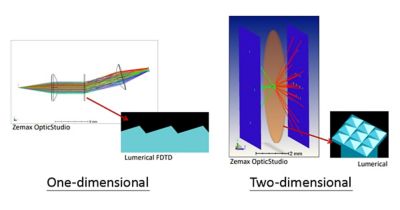
For waveguide‑based AR designs, Lumerical and OpticStudio softwares work together to simulate gratings and propagate images through the complete optical chain.
For VR pancake optics, Lumerical software accurately models curved polarizers, wave plates, and multilayer optical components.
Once performance targets are met, Speos software’s reverse ray tracing simulates how different users — with different eye positions and pupil sizes — will perceive the final image, closing the loop between design and real‑world experience.
Designing With Manufacturing Reality in Mind
“An eye‑tracking system usually contains three parts: a light source, lens, and sensor,” explains Michael Cheng, lead application engineer in the optical group at Ansys, part of Synopsys. “Using Ansys software within a unified workflow allows teams to optimize performance and tolerance early — helping avoid costly redesigns and surprises during manufacturing.”
That predictability is critical. AR/VR success depends not only on innovation, but on scalable, manufacturable, and reliable optical design.
See What’s Possible With Ansys Optics
As spatial computing moves from early adoption to deployment at scale, eye tracking remains the key to unlocking immersive, comfortable, and efficient AR/VR systems.
Learn more about Ansys software solutions for AR/VR on the Ansys Optics page, or explore our resources on designing and optimizing optical components with OpticStudio software.

The Advantage Blog
The Ansys Advantage blog, featuring contributions from Ansys and other technology experts, keeps you updated on how Ansys simulation is powering innovation that drives human advancement.