Case Study
-
-
Software gratuito per studenti
Ansys potenzia la nuova generazione di ingegneri
Gli studenti hanno accesso gratuito a software di simulazione di livello mondiale.
-
Connettiti subito con Ansys!
Progetta il tuo futuro
Connettiti a Ansys per scoprire come la simulazione può potenziare la tua prossima innovazione.
Paesi e regioni
Customer Center
Supporto
Partner Community
Contatta l'ufficio vendite
Per Stati Uniti e Canada
Accedi
Prove Gratuite
Prodotti & Servizi
Scopri
Chi Siamo
Back
Prodotti & Servizi
Back
Scopri
Ansys potenzia la nuova generazione di ingegneri
Gli studenti hanno accesso gratuito a software di simulazione di livello mondiale.
Back
Chi Siamo
Progetta il tuo futuro
Connettiti a Ansys per scoprire come la simulazione può potenziare la tua prossima innovazione.
Customer Center
Supporto
Partner Community
Contatta l'ufficio vendite
Per Stati Uniti e Canada
Accedi
Prove Gratuite
“Designing light-related parts is a process of infinite learning and endless possibilities. Software like Ansys Speos and Ansys optiSLang offers such a wide variety of options for analysis that it might be that I get to learn something new about light guide design every day, every time I open my computer to do my job.”
— Gerardo Morales
Interior Light Design and Simulation Engineer, Volvo Cars
Interior lighting is an important element in shaping in-vehicle user experiences. Volvo approaches optical design with a focus on solutions that are both decorative and functional, seamlessly blending in with a variety of interior styling surfaces. The application of light guides, or optical devices that help guide light to different locations, is valuable in providing light throughout the cabin. Their material properties, geometries, and reflective interactions are factored into many of Volvo’s optical design decisions.
Challenges
To understand light guide performance within the context of an entire vehicle cockpit requires hours of exploration through iterative testing. Against the backdrop of an industry defined by rapidly shrinking timelines and budgets, Volvo’s goal was to significantly boost testing efficiency and design optimization during development.
"Our key optical performance goal for a light guide, in most cases, is to achieve a balanced light extraction according to the specific purpose it is desired to solve," says Ranga Raju Mohanapu, illumination simulation engineer at Volvo Cars. “This, in combination with determining the most optimal mechanical design and best possible packaging in the context that surrounds the components, represents a good integration challenge."

Pictured: Volvo ES90
Engineering Solutions
Volvo looked to Ansys Speos software and Ansys optiSLang software to optimize its light guide design, ensuring maximum efficiency and visual appeal. Speos software enabled the detailed evaluations needed to assess light behavior subject to different materials and conditions, while optiSLang software was key in automating Volvo’s entire workflow. By integrating these tools, Volvo enhanced light guide functionality and design flexibility, saving valuable time and resources in the process.
“If you are in doubt and you want to test some stuff, then Ansys Speos software is a good complement for you to understand certain factors,” says Morales. “For me, sometimes design decisions may come down to an offset. Does it need to be bigger or smaller? Should I put it in the beginning, in the middle, or in the end? But if we have a tool that can help us reach an understanding in design decisions like these, it affirms the way we see them at this stage.”
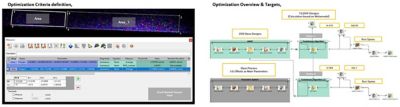
Optimization loop setup. (Pictured left) Example target with two areas in which ´Area´ is intended not to have light, and ‘Area 1’ is intended to concentrate most of the light. (Pictured right) Diagram of the optimization flow overview.
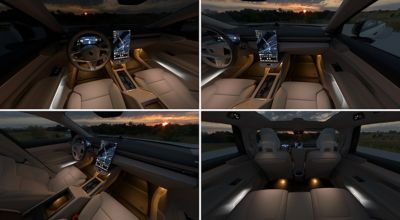
To fulfill a design intent requires meeting multiple criteria during program development. Engineers are tasked with checking their designs in context and understanding how they work in combination with other light sources in the vehicle.
Benefits
Leveraging optiSLang software’s parametric system and coupling it with Speos software resulted in an automated workflow that enabled Volvo engineers to:
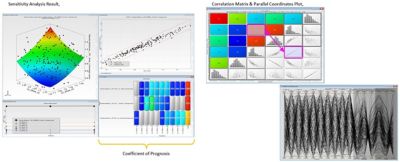
Example of the data received during Sensitivity Analysis of the process, where multiple options for detailed summaries are available for the user to understand the influence of the selected parameters to be studied.
- Efficiently evaluate hundreds of design iterations overnight — an otherwise impossible feat if done manually
- Significantly reduce manual testing time, enabling up to 300 light guide designs and simulations in a single day compared to just six to eight iterations per day previously
- Improve the precision and quality of Volvo’s interior lighting designs through automated sensitivity analysis and streamlined optimization workflows
- Achieve balanced light extraction and minimize unwanted light leakage in light guide design to ensure design uniformity and functional performance
- Enhance collaboration across teams with actionable insights, thus reducing design cycle time while meeting Volvo’s optical design and functionality standards
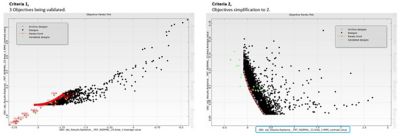
Summary of the opti-mization analysis of the process where the total computed designs are put together in a Pareto Plot as per the criteria defined, and the validat-ed designs for the user to assess and choose from.
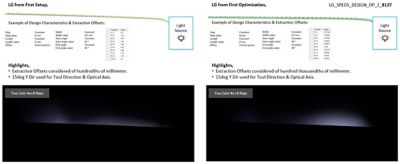
From initial example where the areas are defined, this image cap-tures test results of one of the optical designs from the optimization process that fulfills the requirements for an area with less or no light and an area of mostly con-centrated light.
Cominciamo
Se devi affrontare sfide di progettazione, il nostro team è a tua disposizione per assisterti. Con una vasta esperienza e un impegno per l'innovazione, ti invitiamo a contattarci. Collaboriamo per trasformare i tuoi ostacoli ingegneristici in opportunità di crescita e successo. Contattaci oggi stesso per iniziare la conversazione.