Case Study
-
-
Software gratuito per studenti
Ansys potenzia la nuova generazione di ingegneri
Gli studenti hanno accesso gratuito a software di simulazione di livello mondiale.
-
Connettiti subito con Ansys!
Progetta il tuo futuro
Connettiti a Ansys per scoprire come la simulazione può potenziare la tua prossima innovazione.
Paesi e regioni
Customer Center
Supporto
Partner Community
Contatta l'ufficio vendite
Per Stati Uniti e Canada
Accedi
Prove Gratuite
Prodotti & Servizi
Scopri
Chi Siamo
Back
Prodotti & Servizi
Back
Scopri
Ansys potenzia la nuova generazione di ingegneri
Gli studenti hanno accesso gratuito a software di simulazione di livello mondiale.
Back
Chi Siamo
Progetta il tuo futuro
Connettiti a Ansys per scoprire come la simulazione può potenziare la tua prossima innovazione.
Customer Center
Supporto
Partner Community
Contatta l'ufficio vendite
Per Stati Uniti e Canada
Accedi
Prove Gratuite
“Ansys CFD simulation allowed our team to push our design and iteration skills to a whole new level. With simulation, we were quickly able to evaluate designs across a wide range of metrics. We often used features in Ansys that allowed us to evaluate flow turbulence intensity early on in the development instead of evaluating designs based on drag to help facilitate long-term performance gains.”
— Jack Metcalfe, Design Engineer, Unity Racing
STEM Racing, formerly F1 in Schools, is a competition of fine margins in which teams are separated by thousandths of a second on the racetrack. Any minor improvement on a car can correspond to a huge jump on the leaderboard. Because of this, the Unity Racing student team used simulation to optimize aerodynamic performance and wheel rigidity to reduce friction. Through simulation, the team produced the seventh-fastest car globally in the competition. The team also gained valuable real-world skills in computational fluid dynamics (CFD) and finite element analysis (FEA), preparing them for jobs in the industry.
Challenges
To push the speed limits of the car design, Unity Racing leveraged simulations to minimize aerodynamic drag, balance aerodynamics to minimize race instabilities, and ensure structural stability under high deceleration forces. One challenge the team encountered was a significant discrepancy between simulation and wind tunnel data, which stemmed from initial input errors. By refining ambient conditions — such as temperature, humidity, and air pressure — the team achieved greater alignment between simulated and real-world results.
Surface pressure data was used to calculate the forces acting on each component to guarantee structural integrity under race conditions. A safety factor of 1.5 was applied to provide a contingency margin. These forces were then fed into FEA simulations to assess displacement, ensuring designs remained within an acceptable flex range. Any designs exceeding this threshold required further refinement to enhance structural stability without compromising aerodynamic performance.
Simulation enabled Unity Racing to rapidly iterate and refine their design with confidence, knowing that each iteration represented a tangible improvement. A software solution was needed to accurately replicate wind tunnel flow characteristics while offering a cost-effective and efficient alternative to building expensive physical prototypes.
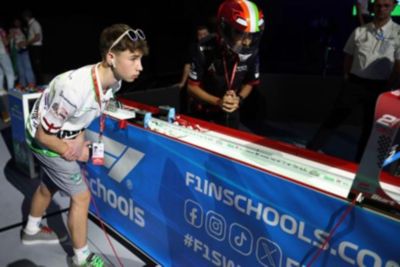
Driver Billy Fields prepares to drive Unity Racing’s car in the STEM Racing World Finals.
Engineering Solutions
A range of result visualizations, such as isosurfaces and cut plots, enabled both major design changes and fine-tuned refinements, with each contributing to greater overall efficiency. Cut plots provided valuable insight by enabling the team to evaluate component performance in cross-sections. This was especially useful when iterating on side pod designs, as it enabled them to visualize velocity changes in flow stagnation regions created by wheel visibility regulations.
By analyzing cut plots along the wheel centerline, the students gained a clearer understanding of how airflow interacted with these regions. Additionally, cut plots parallel to the track surface revealed the flow behavior around the exterior of the pod, helping them determine whether the Coandă effect was being fully utilized to minimize flow separation and divert air away from the wheels to reduce drag.
Without simulation, design iterations would have been significantly slower, as manufacturing times far exceeded the computation times of simulation models.
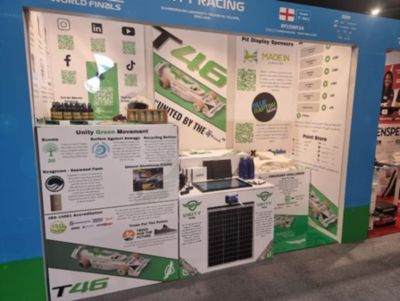
2024 STEM Racing World Finals pit display
Benefits
Through engineering simulation, Unity Racing reduced their average drag coefficient by over 80%, significantly improving their track time from 1.286 to 1.103 seconds. This difference helped them secure seventh place globally. Using a diverse range of visualization tools, including isosurfaces and cut plots, enabled precise, localized refinements and helped the team realize critical marginal gains.
One of the most crucial aerodynamic components of the car is the front wing and nose cone, as these dictate airflow over the rest of the car. Initially, the nose cone produced a turbulent wake that disrupted downstream airflow, negatively affecting performance. By optimizing the wing design with varying height, chord length, and positioning, the team was able to better manage airflow, leading to a drastic reduction in drag and smoother flow across the car.
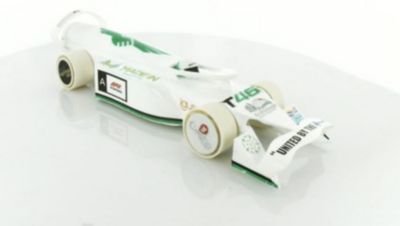
Unity Racing’s World Finals car
Another breakthrough was the introduction of a central under channel, a critical feature in balancing the car’s aerodynamics. By refining the aspect ratio of the internal convex surface on the underside of the car body, the team strategically shifted the center of pressure. This reduced pitching moments and enhanced overall flow characteristics. Additionally, in regions of high turbulence and low kinetic energy, Unity Racing integrated bleed veins to diffuse high-energy airflow, which accelerated vortex dissipation and minimized flow stagnation in key areas.
Cominciamo
Se devi affrontare sfide di progettazione, il nostro team è a tua disposizione per assisterti. Con una vasta esperienza e un impegno per l'innovazione, ti invitiamo a contattarci. Collaboriamo per trasformare i tuoi ostacoli ingegneristici in opportunità di crescita e successo. Contattaci oggi stesso per iniziare la conversazione.