Synopsys and Ansys power the future of innovation—connecting silicon to systems.
-
-
Accédez au logiciel étudiant gratuit
Ansys donne les moyens à la prochaine génération d'ingénieurs
Les étudiants ont accès gratuitement à un logiciel de simulation de classe mondiale.
-
Connectez-vous avec Ansys maintenant !
Concevez votre avenir
Connectez-vous à Ansys pour découvrir comment la simulation peut alimenter votre prochaine percée.
Espace client
Support
Communautés partenaires
Contacter le service commercial
Pour les États-Unis et le Canada
S'inscrire
Essais gratuits
Produits & Services
Apprendre
À propos d'Ansys
Back
Produits & Services
Back
Apprendre
Ansys donne les moyens à la prochaine génération d'ingénieurs
Les étudiants ont accès gratuitement à un logiciel de simulation de classe mondiale.
Back
À propos d'Ansys
Concevez votre avenir
Connectez-vous à Ansys pour découvrir comment la simulation peut alimenter votre prochaine percée.
Espace client
Support
Communautés partenaires
Contacter le service commercial
Pour les États-Unis et le Canada
S'inscrire
Essais gratuits
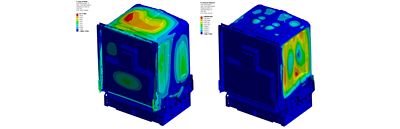
While household appliances may seem to fade into the background as trusted staples of our everyday lives, the innovative design choices that enable them to achieve their goals and stand out in a highly competitive, multibillion-dollar industry are anything but banal.
Rising demands for energy efficiency, noise reduction, enhanced robustness, and better quality, paired with the need for cost competitiveness, makes designing and developing household appliances difficult. Adding to this challenge is the inherent competitiveness of the household appliance market, which is a mix of established brands and innovative newcomers that are all contending for their share of an estimated $735.8 billion market in 2026.
Hisense Europe, which brings together global brands — Gorenje, ASKO, and Hisense — and their development in Europe as well as local brands — such as ATAG, Pelgrim, Mora, and Körting — is a leader in this competitive market. Wondering how Hisense Europe has stayed ahead? The company’s “legacy is built on a foundation of continuous engineering evolution,” says Blaž Starc, head of the Numerical Simulations and Acoustics group in the Predevelopment department at Hisense Europe.
Hisense Europe’s vision is to simplify life for its customers by becoming the world’s foremost design-driven home appliance innovator. “We pride ourselves on leading the way with advanced, intelligent manufacturing,” Starc says.
Today, Hisense Europe uses its innovative design and development practices to offer an incredibly diverse range of product categories, including cooking (for example, developing the next generation of induction hobs), dishwashing (for instance, creating state-of-the art dishwashers with new functionalities), laundry (such as designing the next generation of tumble dryers), cooling, and integrating big data with advanced appliance monitoring systems throughout their designs.
Starc’s team — which he calls a “multidisciplinary dream team” — is composed of experts in structural dynamics, fluid dynamics, and electromagnetics. Their backgrounds enable them to contribute directly to everything from the design and optimization of these core products to building a dedicated noise, vibration, and harshness (NVH) laboratory from the ground up.
These accomplishments are imperative to driving the future of Hisense Europe. “We aren't just making incremental updates; we are designing the future of the smart home,” says Starc.
Of course, redesigning the future of so many products in such a competitive market isn’t easy. As a result, the Hisense Europe team turns to Ansys, part of Synopsys, simulation solutions to elevate its processes.
How Simulation Drives Innovation and Sustainability at Hisense Europe
“Ansys simulation solutions are a vital part of our engineering tool kit,” says Starc. “Advanced simulation allows us to transition from traditional ‘trial and error’ physical prototyping to predictive, virtual engineering. This not only saves immense amounts of time and material but also lets us explore highly innovative design spaces we otherwise couldn't.” For example, with simulation the team can analyze new, innovative designs and perform otherwise challenging or impossible resource-intensive tasks in a virtual environment. As Starc puts it, simulation helps with “pushing the boundaries of what is physically possible.”
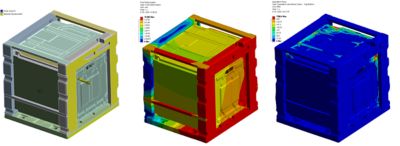
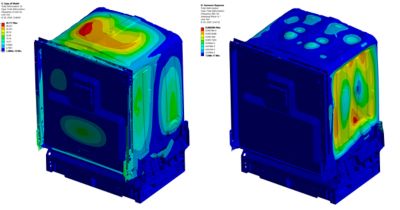
Simulation results of an oven transport simulation, which show horizontal compression, boundary conditions, total deformations, and equivalent von Mises stresses
Another core benefit of Ansys products “lies in (their) broad multiphysics capabilities,” says Starc. “The engineering behind modern appliances is astonishingly complex.” As a result, multiphysics analyses are imperative for accurately studying and optimizing these products.
As for how these multidisciplinary products are used to design and optimize household appliances, Starc shared three areas that highlight his team’s impact:
1. Dishwashers and washing machines
Ansys solutions helped Starc’s team lead the predevelopment of Hisense Europe’s new line of next-generation, state-of-the-art ASKO washing machines. The team used the static, modal, harmonic, and rigid-body motion features in Ansys Mechanical structural finite element analysis software to analyze what Starc calls the “chaotic dynamic forces, (which are) comparable to extreme centrifugal forces” generated by a washing machine spinning 10 kg of wet laundry at 1,600 rpm.
The Hisense Europe team was also able to build a highly accurate dishwasher digital twin by combining experimental data with Mechanical software’s structural and acoustics tools. “This allowed us to predict and mitigate noise generation digitally, resulting in an optimized appliance with a fraction of the physical prototypes normally required,” says Starc.
2. Ovens and induction hobs
Starc and his team used Mechanical software, paired with Ansys optiSLang process integration and design optimization software, to optimize the high-temperature enameling process for oven cavities. “This drastically reduced the potential for thermal damage to ovens during mass production and over the product's lifespan in the end user's home,” says Starc. As a result, the team was able to significantly improve durability and quality. And this wasn’t all either. Since the oven development process involves extremely high temperatures — the manufacturing enameling process can rise to 830 degrees Celsius, for instance — the team used Ansys Fluent fluid simulation software to help manage these temperatures and ensure safe, effective cooling systems.
Induction hobs, meanwhile, have their own challenges to conquer, including requiring “highly complex electromagnetic simulations to account for millions of variable combinations,” says Starc. To address this, the team used the Ansys Maxwell advanced electromagnetic field solver, combined with optiSLang software.
3. Tumble dryers
As part of the ASKO tumble dryer design process, Starc and his team used Mechanical software to “redesign the motor and compressor mounts, virtually eliminating vibration transfer to the bottom and housing and significantly reducing noise,” he says. “Simultaneously, we used Fluent software to redesign the internal airflow channels, achieving vastly improved aerodynamic performance and efficiency without needing to increase the fan revolutions per minute.”
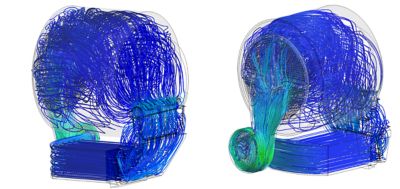
Airflow velocity streamlines in a tumble dryer
The Hisense Europe team also relied on Ansys Discovery 3D product simulation software throughout its work. “We continuously evaluate the market for the best, most competitive solutions, and Ansys currently provides excellent tools for many of the challenges we face,” says Starc. “It offers, I would say, top-class performance on the market.”
Achieving this performance was aided by Hisense Europe’s partnership with SIMTEC, an Ansys Select channel partner. Being able to collaborate with a local team of high-level technical experts on complex physics problems accelerated Hisense Europe’s R&D and problem-solving processes. In fact, “the collaboration with SIMTEC has been exceptionally beneficial and serves as a true strategic partnership rather than just standard software support,” says Starc. “This collaboration translates directly into faster time to market for our innovations, as well as staying informed about improved existing and new products within the Ansys portfolio.”
Simulation, Sustainability, and Looking to the Future
By strategically implementing simulation into its design and development processes, Hisense Europe has experienced a “phenomenal” return on investment, shares Starc. These returns include:
- Achieving a massive noise reduction of 6 dB(A) in its next-generation ASKO washing machines. “In acoustic terms, this means the sound power is cut by roughly 75%, resulting in a dramatically quieter home environment for the user,” says Starc.
- Improving the overall oven manufacturing process product lifespan and generating savings costs in scraps by using virtual optimization to reduce the damage rates caused by the high-temperature enameling process.
- Accelerating its induction hob R&D pipeline by using predictive tools from Ansys to develop new technology while successfully meeting aggressive time-to-market deadlines.
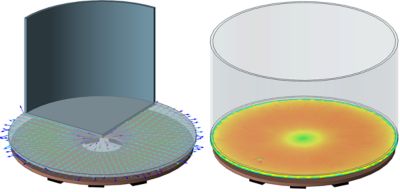
Simulation results showing the distribution of magnetic field and Ohmic losses at the bottom layer of a pot during induction-based cooking
Simulation solutions also help Hisense Europe work toward companywide goals, such as sustainability. “Advanced simulation is at the very core of this sustainability mission,” says Starc. “Simulation allows us to optimize fluid dynamics for better water and air efficiency, reduce the weight of materials without sacrificing structural integrity, and drastically cut down the physical waste previously associated with building multiple physical prototypes.” With Ansys solutions, Hisense Europe can simulate its products before moving on to physical prototyping, more efficiently creating appliances that are eco-friendly with low energy consumption, low noise, and high durability.
As a result of this focus, Hisense Europe recently received the platinum award for the annual EcoVadis assessment, which is a leading corporate sustainability assessment. This places Hisense Europe “in the top 1% of the more than 150,000 companies assessed worldwide for sustainability and responsible business practices,” Starc explains.
Looking to the future, Starc notes that Hisense Europe’s products will only become smarter, more highly integrated, and increasingly sustainable — all of which will make the company’s work more complex. To achieve this growth and design such complicated products in its competitive market, “you have to go with simulation. … There's no other option,” says Starc. “By continuously providing competitive, state-of-the-art software and maintaining the excellent technical support we enjoy with SIMTEC, Ansys helps ensure our R&D teams have access to high-performing solutions that make both engineering and economic sense.”
Interested in learning more about how simulation can help innovators enhance and optimize consumer goods? Head this way to discover simulation’s role in accelerating consumer goods product development and manufacturing.

Just for you. We have some additional resources you may enjoy.
“Advanced simulation allows us to transition from traditional ‘trial and error’ physical prototyping to predictive, virtual engineering.”
— Blaž Starc, head of the Numerical Simulations and Acoustics group, Predevelopment department, Hisense Europe
The Advantage Blog
The Ansys Advantage blog, featuring contributions from Ansys and other technology experts, keeps you updated on how Ansys simulation is powering innovation that drives human advancement.