Synopsys and Ansys power the future of innovation—connecting silicon to systems.
-
-
Accédez au logiciel étudiant gratuit
Ansys donne les moyens à la prochaine génération d'ingénieurs
Les étudiants ont accès gratuitement à un logiciel de simulation de classe mondiale.
-
Connectez-vous avec Ansys maintenant !
Concevez votre avenir
Connectez-vous à Ansys pour découvrir comment la simulation peut alimenter votre prochaine percée.
Espace client
Support
Communautés partenaires
Contacter le service commercial
Pour les États-Unis et le Canada
S'inscrire
Essais gratuits
Produits & Services
Apprendre
À propos d'Ansys
Back
Produits & Services
Back
Apprendre
Ansys donne les moyens à la prochaine génération d'ingénieurs
Les étudiants ont accès gratuitement à un logiciel de simulation de classe mondiale.
Back
À propos d'Ansys
Concevez votre avenir
Connectez-vous à Ansys pour découvrir comment la simulation peut alimenter votre prochaine percée.
Espace client
Support
Communautés partenaires
Contacter le service commercial
Pour les États-Unis et le Canada
S'inscrire
Essais gratuits
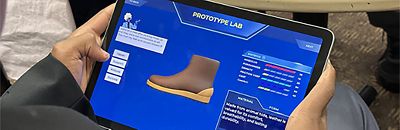
Created by a team of CMU grad students, an interactive game focused on footwear design introduces middle and high school students to simulation-driven product development.
STEAM careers — integrating science, technology, engineering, arts, and mathematics — offer high wages, strong growth, and rising global demand. But the U.S. faces significant readiness gaps in preparing students for these jobs.
The Entertainment Technology Center (ETC), a multidisciplinary graduate program at Carnegie Mellon University (CMU), is committed to addressing this urgent challenge. Through outreach efforts, students and faculty at the ETC have provided over 18,000 middle and high school students with STEAM educational opportunities.
In the fall 2025 semester, a team of five enterprising ETC students — with expertise spanning programming, art, user interface design, production, and storytelling — created Kicks Lab. This innovative learning experience uses footwear — a familiar, everyday object — as an entry point to help younger students experience product development, engineering, and testing firsthand.
With access to industry-leading Ansys Discovery 3D product simulation software through the Ansys Academic Program — as well as expert technical support from Ansys, part of Synopsys — the Kicks Lab team developed an interactive game that introduces younger students to the basics of product development. The game walks them through a series of design decisions, materials selections, and engineering trade-offs that directly influence product appearance, cost, manufacturability, safety, comfort, and performance.
“Most middle school students have probably never heard the phrase ‘product development,’ so they don’t see it as a potential career path,” explains Charles Johnson , assistant teaching professor at ETC and faculty adviser to the Kicks Lab team. “But sneakers? That’s something that’s ubiquitous in their lives. So, if you can use footwear to demystify product design and engineering and make those topics relevant to their own lives, you might spark younger kids to say, ‘Hey, maybe this is something I could do.’”
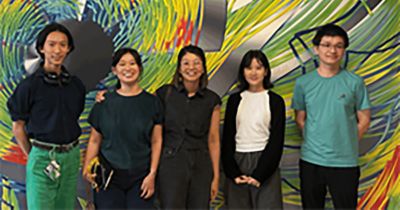
The Carnegie Mellon University (CMU) Entertainment Technology Center (ETC) Kicks Lab team includes, from left to right, Skye Gao, Elizabeth “Libby” Egan, Samantha Lai, Jiwon Park, and Xiwei “Steven” Wang.
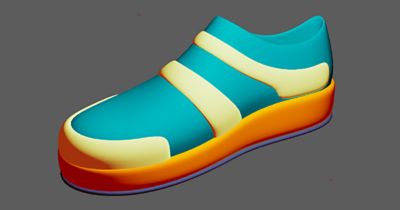
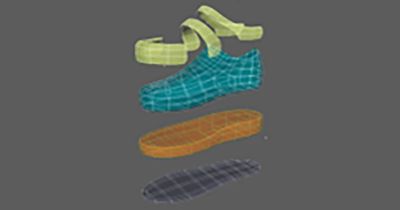
Experts at Ansys, part of Synopsys, worked with the Kicks Lab team to make the game not only colorful and fun but an accurate representation of modern product development processes powered by simulation software.
Stepping Up to the Challenge: A Collaborative Effort
Johnson was the ideal faculty member to mentor the grad students in Kicks Lab, having previously led development and innovation for Adidas North America, Crocs, and Puma SE. His goal was to lead the Kicks Lab team in creating a design experience that was fun and accessible but also captured the scientific rigor and testing protocols of real-world product development.
“The game imagined by the Kicks Lab team wasn’t just focused on simulation — it was meant to span the whole product development process and pipeline,” Johnson says. “But I felt strongly that simulation had to be a big part of it because it’s a standard industry practice. And I knew we had to bring Ansys in because Ansys software is best in class.
“When I first approached Ansys with the idea of using its software as the foundation for a game, I expected them to look at me like I was crazy,” Johnson recalls. “But Ansys has a culture of innovation that meshed perfectly with this project. They have an Academic Program created specifically to get software into students’ hands. They were all in.”
Chris Hawkins, a technologist and Ansys Fellow, provided key support for the Kicks Lab project. Hawkins has been intimately involved in the early-stage development of many Ansys product and platform initiatives, such as Ansys Mechanical structural finite element analysis software, the Ansys Workbench simulation integration platform, and, most recently, Discovery software.
“Early on, we decided in collaboration with the Kicks Lab team that Ansys Discovery would be the perfect fit for young students who are completely green to engineering,” Hawkins notes. “It’s an integrated, intuitive environment where it’s easy to make changes, see their impact, and keep adjusting. The simulation sort of responds immediately when you redraw a shape or pick a new material.”
With Discovery software chosen as the platform, Ethan Thompson joined the team. The North America team lead for Discovery software, Thompson combines deep software expertise with hands-on experience in product development and engineering simulation.
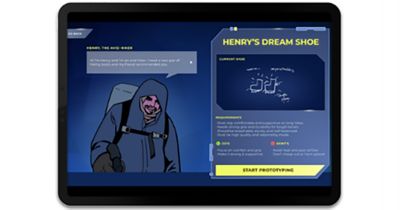
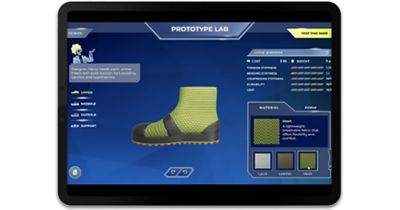
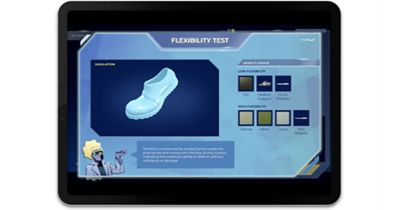
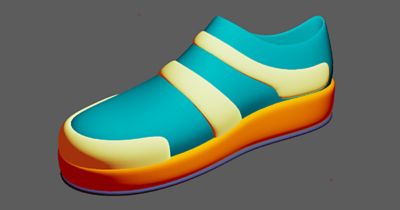
Kicks Lab players begin by meeting their customer, who has specific preferences and requirements for a shoe. Then they make a series of decisions about construction, materials, and design features to meet those needs. Once configured, the shoe design is tested using industrial-grade virtual simulation technology, with Ansys Discovery 3D product simulation software as the foundation.
“Ansys Discovery supports easy exploration, iteration, and informed decision-making — even for nonspecialists in simulation,” Thompson emphasizes. “We didn’t want students to get bogged down in training or overwhelmed by large, complex problems. But we wanted the science and rigor to be there working behind the scenes.”
For Hawkins and Thompson, the custom Discovery configuration had to strike a delicate balance. “We wanted our budding engineers to have a lot of creative freedom. We wanted them to choose from multiple shoe shapes, designs, and materials. We wanted it to be realistic,” Hawkins states. “But I think our first version had about 36 million possible combinations. I can’t remember the exact number. But it was clearly too much.”
“It was somewhere in the tens of millions, like 20 million or 30 million,” confirms Thompson. “We had far too many permutations. Those numbers can get large quickly. But in the end, we gave students plenty of choices and meaningful trade-offs while also keeping the game fast-moving and fun.”
Johnson and his students were also happy with the ultimate balance between education and entertainment. The team worked to combine the Discovery backbone with colorful graphics, engaging characters, a clear storyline, and a consumer-like interface that young students would immediately feel comfortable using.
“The Kicks Lab team hosted multiple ‘test days’ where they invited local students in to use the game. We saw a lot of comfort, a lot of creativity, and a lot of confidence. It was an ‘aha’ moment for students as they realized how their own design choices could affect a real-world outcome,” Johnson says. “I think the final version of the game, which was developed over the 15-week fall 2025 semester, is very realistic in terms of representing the product development pipeline while still remaining entertaining and accessible.”
While the game is not yet widely deployed, you can play it yourself at the Kicks Lab website.
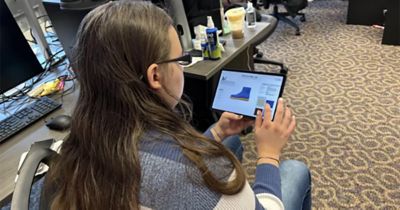
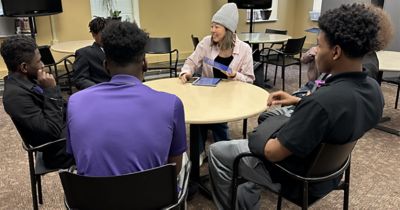
At various points in the semester, the Kicks Lab team invited middle and high school students to attend “test days.” These young users provided valuable feedback on technical features and functionality, as well as the game’s aesthetics and narrative storyline.
Shaping the Future, One Student at a Time
For Hawkins and Thompson, it was gratifying to engage with graduate students at CMU’s ETC on educational game design while also potentially impacting thousands of younger students.
“The goal is to broaden access to STEAM thinking, support hands-on interdisciplinary learning, use simulation to empower creativity, and bridge engineering, design, and human impact,” Hawkins points out. “Because we share those goals with the ETC, I can’t imagine a better example of the Ansys Academic Program at work, delivering real-world benefits and empowering a new generation of product developers.”
“Every student everywhere deserves exposure to STEAM, even when resources are scarce and traditional classrooms fall short,” says Johnson. “Every student deserves the chance to see themselves as an innovator. We’re grateful to Ansys for sharing that belief — and committing so much time and effort to STEAM education through the Ansys Academic Program.”
Whether you’re a student, educator, or researcher, discover how Ansys Academic can help bring real-world simulation into your work.

Just for you. We have some additional resources you may enjoy.
“Every student everywhere deserves exposure to STEAM, even when resources are scarce and traditional classrooms fall short.”
— Charles Johnson, assistant teaching professor, Entertainment Technology Center, Carnegie Mellon University, and faculty adviser, Kicks Lab team

The Advantage Blog
The Ansys Advantage blog, featuring contributions from Ansys and other technology experts, keeps you updated on how Ansys simulation is powering innovation that drives human advancement.