Quick Specs
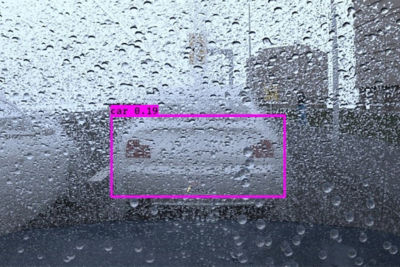
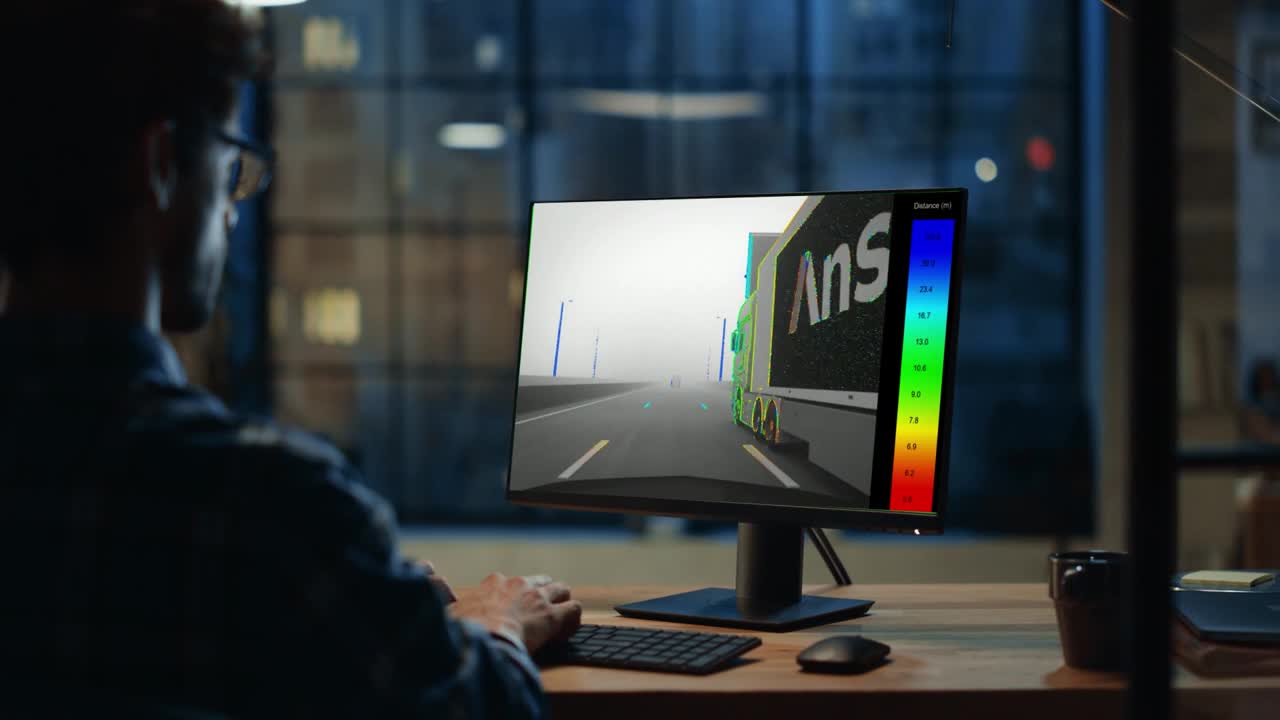
Ansys Speos utilizes non-sequential raytracing and realistic material models for physics-based optical simulation, modeling light behavior and human vision to deliver accurate virtual prototyping and system-level performance validation.
Ansys donne les moyens à la prochaine génération d'ingénieurs
Les étudiants ont accès gratuitement à un logiciel de simulation de classe mondiale.
Concevez votre avenir
Connectez-vous à Ansys pour découvrir comment la simulation peut alimenter votre prochaine percée.
Les étudiants ont accès gratuitement à un logiciel de simulation de classe mondiale.
Connectez-vous à Ansys pour découvrir comment la simulation peut alimenter votre prochaine percée.
Simulate, validate, and optimize optical performance in real environments using physics-based light modeling and human vision analysis before building physical prototypes.
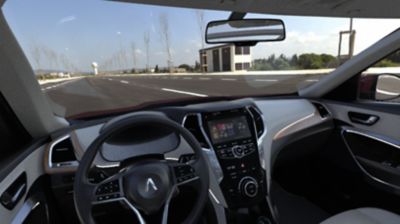
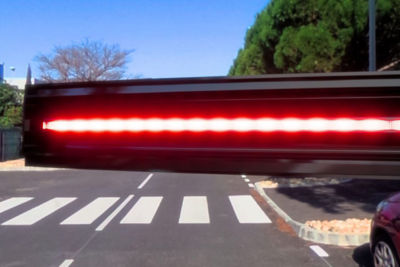
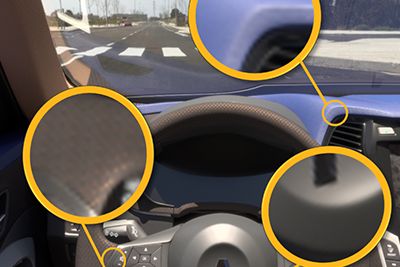
Ansys Speos is a light simulation software tool that designs and validates optical parts, lighting systems, and sensors. It models how light interacts with lenses, materials, and environments, and simulates human vision and camera sensors to predict illumination, image quality, glare, defects, and system performance before physical prototyping.
Ansys Speos delivers an intuitive and comprehensive user interface, enhanced productivity with use of GPUs for simulation previews and easy access to the Ansys multiphysics ecosystem.
Ansys Speos utilizes non-sequential raytracing and realistic material models for physics-based optical simulation, modeling light behavior and human vision to deliver accurate virtual prototyping and system-level performance validation.
Mars 2026
Bénéficiez de flux de travail de conception optique plus fluides grâce à des outils qui facilitent la simplification, l'intégration et l'optimisation. Ansys Speos 2026 R1 vous permet de créer des conceptions précises plus rapidement et plus efficacement que jamais auparavant.
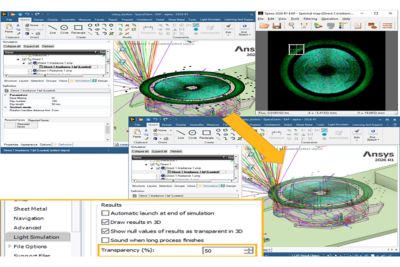
Des tâches quotidiennes plus simples et plus intuitives ! Les améliorations clés incluent des menus contextuels pour la sélection multiple, un accès simplifié aux sources et aux capteurs, une transparence de simulation améliorée, des animations de rayons et une orientation paramétrique du soleil pour les sources ambiantes. Conçues pour les ingénieurs optiques, ces fonctionnalités garantissent un flux de travail plus fluide et des informations plus claires.
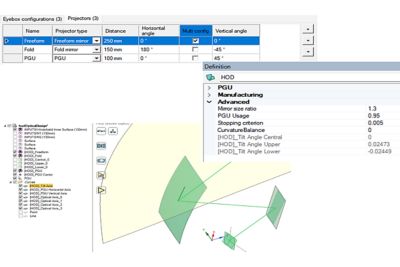
Les améliorations apportées à la fonctionnalité de conception des composants optiques permettent d'accéder à de nouveaux paramètres, offrant ainsi une plus grande flexibilité de conception. Les concepteurs peuvent optimiser efficacement leurs conceptions en fonction de cibles photométriques, avec des composants de forme libre et des contraintes de style.
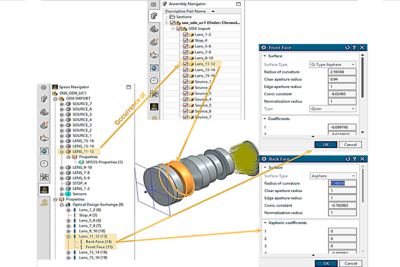
L'échange de données ODX (échange de conception optique) entre OpticStudio et Speos est désormais disponible pour Siemens NX. Cette intégration permet un échange de données fluide entre OpticStudio et Speos, permettant un transfert précis de la géométrie de l'objectif dans un logiciel de CAO pour une conception optomécanique et une analyse de la lumière parasite efficaces.
Lorem Ipsum has been the industry's standard dummy text ever since the 1500s, when an unknown printer took a galley of type and scrambled it to make a type specimen book. It has survived not only five centuries
Virtual optical design improves safety, performance, and development efficiency.
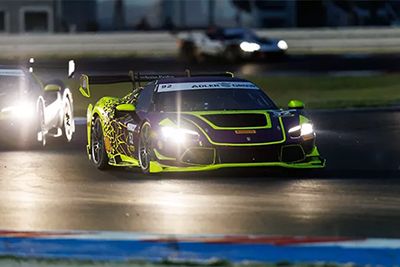
With advanced optical simulation tools, Ferrari designs and tests intelligent headlamp systems in virtual environments, reducing costs, improving safety, and accelerating development timelines
Ferrari partnered with Ansys to develop advanced high-definition headlamp systems using virtual optical simulation. By leveraging tools such as Speos, Zemax OpticStudio, and AVxcelerate Headlamp, engineers can model lighting behavior, test performance in realistic night-driving scenarios, and validate safety requirements without costly physical prototypes. The simulation environment enables rapid iteration, glare analysis, and driver-focused visibility optimization across varying conditions. This digital workflow streamlines development, reduces reliance on weather-dependent testing, and improves system quality. As a result, Ferrari significantly lowered headlamp development costs while enhancing performance, safety, and innovation in both road and racing vehicles.
Lorem Ipsum has been the industry's standard dummy text ever since the 1500s, when an unknown printer took a galley of type and scrambled it to make a type specimen book. It has survived not only five centuries
Commencez votre version d'essai gratuite de 30 jours de Speos
SPEOS CAPABILITIES
Ansys Speos delivers advanced multiphysics optical design and simulation by integrating optical, structural, and thermal simulations for accurate real-world performance prediction. Its capabilities include precise sensor and perception modeling, optimized illumination system design, realistic material and surface optics, and rapid design exploration. Designers can validate optical drift, efficiency, and detection reliability across cameras, LiDAR, and lighting systems, ensuring robust system-level performance before manufacturing and minimizing physical prototyping.
Ansys Speos optical design software uniquely simulates a system’s optical performance and evaluates the final illumination effect, based on human vision.
Preuve
SPEOS RESOURCES & EVENTS
Discover how Ansys simulation accelerates adaptive headlamp development, reduces physical prototyping, optimizes on-road performance, and streamlines global safety compliance for safer, smarter vehicle lighting.
Join our exclusive webinar, exploring AxF support for more realistic optical simulations through precise material appearance data integration and validation.
Watch now to explore Ansys Optics advanced stray light analysis using Ansys Zemax OpticStudio and Ansys Speos to identify, diagnose, and mitigate performance-degrading optical artifacts.
34% of an engineer's time is spend in searching for simulation data. This video highlights how such challenges can be solved with Ansys Minerva and make engineers more productive.
Reduce the complexity involved in simulation projects, allow team members to work harmoniously to save time and ensure best practices consistently across the projects.
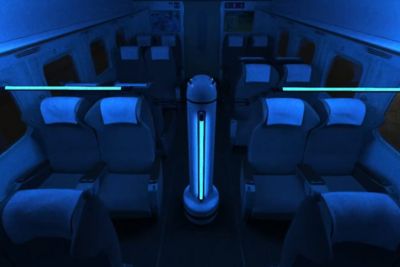
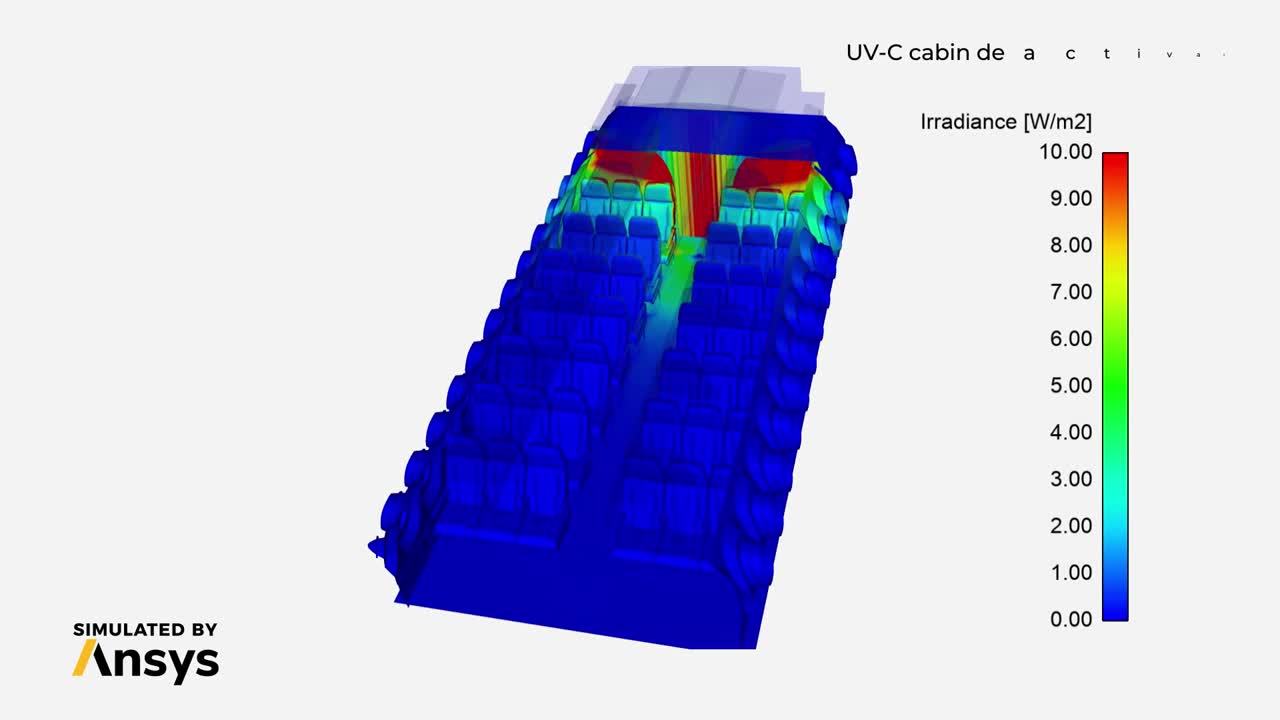
Supplementing, or potentially replacing, manual disinfection of surfaces with an automatic ultraviolet (UV) light treatment system can increase the certainty that any presence of the virus is deactivated. Simulation can be used to design UV light treatment systems for various environments and to ensure sufficient doses of UV light are delivered to deactivate viruses.
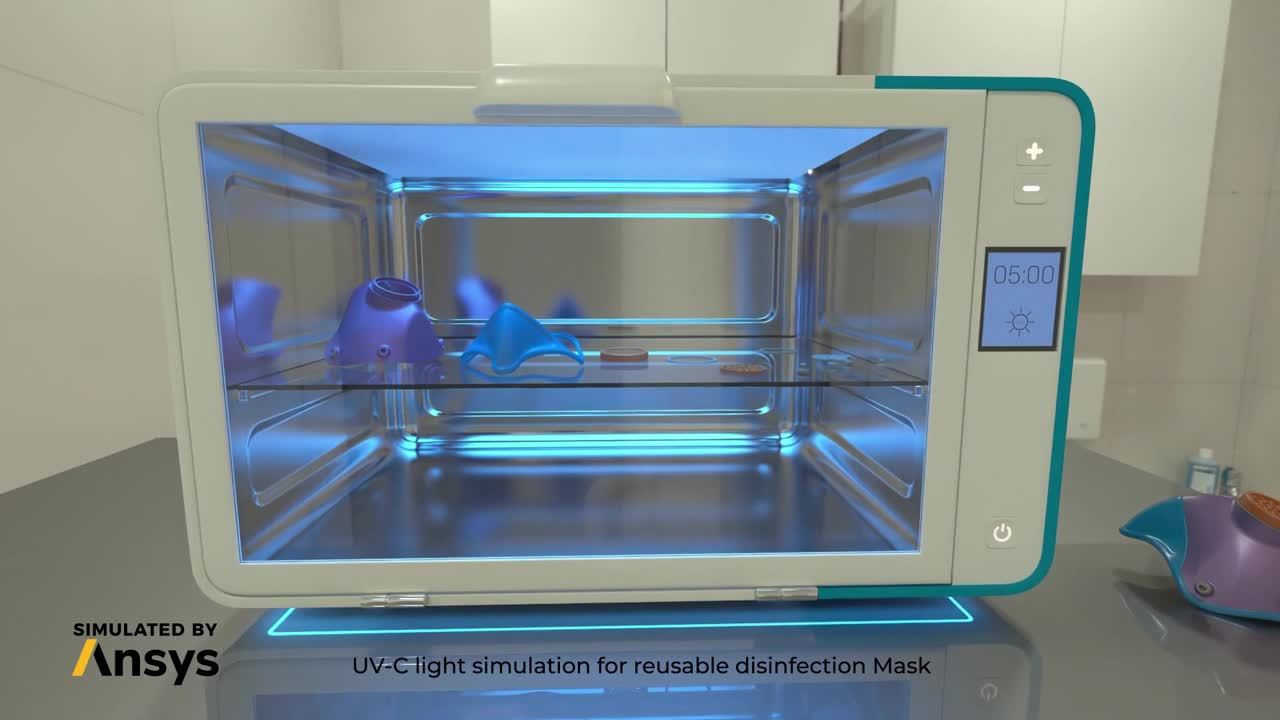
Time effective UV decontamination of worn masks is a promising solution to prevent the shortage of clean masks for healthcare workers. Simulation enables sterilizer designers to ensure that each potentially contaminated personal protective equipment (PPE) surface will receive the necessary dose of UV irradiation.
Ansys SPEOS delivers an intuitive and comprehensive user interface, enhanced productivity with use of GPUs for simulation previews and easy access to the Ansys multiphysics ecosystem. Watch this video to learn how you can experience light simulation for optical system optimization and design validation within a multiphysics environment.
Have you heard about Ansys Speos! This Optical Simulation software lets you see Optical Simulation in a New Light!
Learn how you can perform Optical simulations from anywhere you are with Ansys SPEOS in Ansys Cloud. You can even check on the simulation’s progress using your cell phone, all with complete security. Combine your optical simulations with other solutions such as Ansys Mechanical, Ansys Fluent and Ansys optiSLang for streamlined, comprehensive simulation results.
Ansys Speos delivers an intuitive and comprehensive user interface that can reach 75% time savings on development time of products, avoiding optical deformation and image distortion.
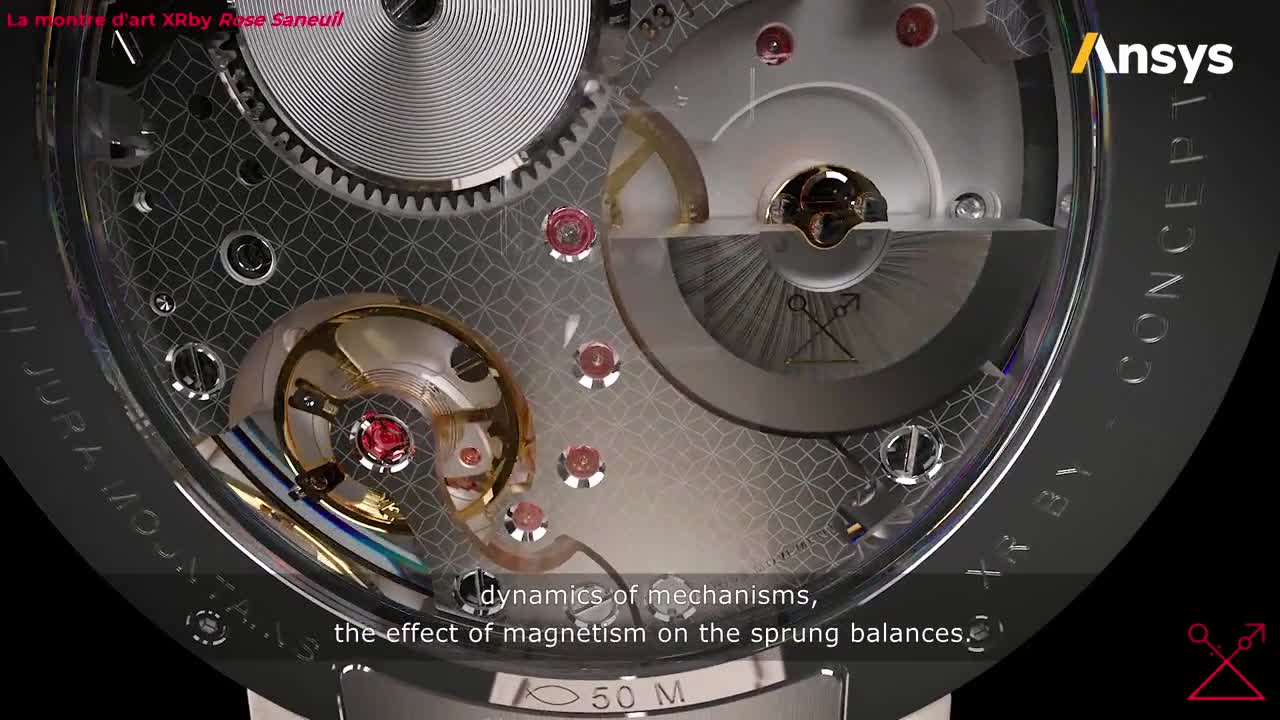
Watch this video to learn how the watchmaking startup XRby uses Ansys Speos to develop watch dials and to know how the light will interact with the materials.
Il est essentiel pour Ansys que tous les utilisateurs, y compris les personnes en situation de handicap, puissent accéder à nos produits. En tant que tel, nous nous efforçons de respecter les exigences en matière d’accessibilité basées sur le US Access Board (section 508), les règles d’accessibilité des contenus Web (WCAG) et le format actuel du modèle d’accessibilité volontaire des produits (VPAT).
Si vous êtes confronté à des défis d'ingénierie, notre équipe est là pour vous aider. Forts de notre expérience et de notre engagement en faveur de l'innovation, nous vous invitons à nous contacter. Collaborons pour transformer vos obstacles techniques en opportunités de croissance et de réussite. Contactez-nous dès aujourd'hui pour entamer la conversation.