Synopsys and Ansys power the future of innovation—connecting silicon to systems.
-
-
Accédez au logiciel étudiant gratuit
Ansys donne les moyens à la prochaine génération d'ingénieurs
Les étudiants ont accès gratuitement à un logiciel de simulation de classe mondiale.
-
Connectez-vous avec Ansys maintenant !
Concevez votre avenir
Connectez-vous à Ansys pour découvrir comment la simulation peut alimenter votre prochaine percée.
Espace client
Support
Communautés partenaires
Contacter le service commercial
Pour les États-Unis et le Canada
S'inscrire
Essais gratuits
Produits & Services
Apprendre
À propos d'Ansys
Back
Produits & Services
Back
Apprendre
Ansys donne les moyens à la prochaine génération d'ingénieurs
Les étudiants ont accès gratuitement à un logiciel de simulation de classe mondiale.
Back
À propos d'Ansys
Concevez votre avenir
Connectez-vous à Ansys pour découvrir comment la simulation peut alimenter votre prochaine percée.
Espace client
Support
Communautés partenaires
Contacter le service commercial
Pour les États-Unis et le Canada
S'inscrire
Essais gratuits

The next time that you are in a stadium, a large venue, or even the supermarket, look up. Chances are that “eyes in the sky” are surveying the area through discreet (and sometimes not-so-discreet) security cameras. Public venues rely on these cameras to provide crisp visuals in many different atmospheres, sometimes at difficult angles. Whether in the darkness of a concert venue or intense sunlight at an outdoor stadium, visual quality cannot be compromised. These surveillance cameras use advanced optics to gather light from a defined field of view and focus a sharp image onto a sensor, which then converts the light into digital information to produce video.
Designing optics for commercial security systems is a complex process that demands precision and ingenuity. One of the biggest challenges is balancing performance with practicality. For instance, security cameras must capture high-quality images without excessive power consumption or overly complex designs. As the demand for enhanced security grows, there’s a constant need to push the boundaries of resolution and clarity while keeping production costs manageable.
How a Security Camera Works
Security cameras can be classified by their signal type (analog versus IP) and viewing capability (fixed versus pan-tilt-zoom, or PTZ). Analog cameras transmit video signals over coaxial cables and offer a lower image resolution, whereas IP cameras transmit data using an IP address and provide higher-resolution images. Many IP cameras on the market today also support additional features like real-time remote monitoring and motion sensing to improve coverage.
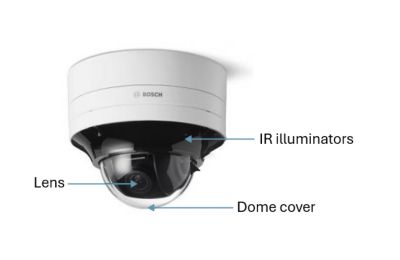
An overview of the main optical components in KEENFINITY cameras. Photo credit: KEENFINITY.
Fixed and PTZ cameras each have pros and cons based on the area they are monitoring. Fixed dome cameras are stationary and useful for capturing narrower locations, such as hallways and entrances, while PTZ dome cameras can be repositioned by an operator in real time to follow specific subjects or capture different locations. Because of this, PTZ cameras are helpful in monitoring wider, more dynamic areas.
Perfecting Today’s “Eyes in the Sky” Using Simulation
Simulation technology has become a game changer in balancing cost, size, and quality in video surveillance systems. By virtually modeling how light interacts with lenses and other optical components, simulation enables designers to explore different configurations and predict how designs will perform in real-world conditions. This approach not only accelerates the design process but reduces reliance on costly physical prototypes.
KEENFINITY, a spinoff of Bosch Security and Safety Systems, is a security and communications technology company with deep expertise in these complex systems. Focusing on IP cameras, KEENFINITY leverages simulation to improve its optical designs. Integrating high-fidelity optical tools like Ansys Zemax OpticStudio optical system design and analysis software and Ansys Speos CAD integrated optical and lighting simulation software has enabled the company to tackle some of the most intricate challenges in creating optics for modern security systems.
Shaping Next-Generation Security Imaging With Simulation
To overcome the challenges of designing advanced optical systems for security cameras, KEENFINITY has embraced Ansys Optics simulation tools as a critical part of its workflow. These tools enable the company to approach the design process with precision and efficiency, especially when addressing the intricate requirements of nighttime imaging and low-light environments.
OpticStudio software, a key part of its tool kit, helps KEENFINITY fine-tune its infrared (IR) illumination systems. IR illumination is vital in modern security cameras because it enables clear imaging in conditions in which visible light is insufficient. Using OpticStudio software, KEENFINITY can replicate how light behaves as it passes through lenses and interacts with other optical elements. This capability enables company engineers to test and adjust designs in a virtual environment, exploring different configurations without needing physical prototypes.
“These simulations will go in our workflow exactly when we are about to choose those lens components, so very early in the stages of camera development,” says Manuel Sarmento, optical engineer at KEENFINITY.
KEENFINITY leverages the power of OpticStudio software and Speos software to accurately model camera performance. By creating a digital twin of the company’s camera test laboratory in Speos software, KEENFINITY can conduct comprehensive virtual tests to evaluate critical parameters, such as resolution, field of view (FOV), and optical distortion. This approach also enables the company to simulate how its cameras will perform across a full spectrum of lighting conditions, from bright outdoor environments to dimly lit interiors.
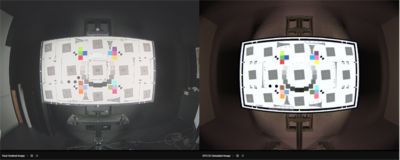
Ansys Speos CAD integrated optical and lighting simulation software is used to create a digital twin of the camera test laboratory. The image on the left shows a real camera output while the image on the right displays the corresponding Speos simulation. Photo credit: KEENFINITY.
With Speos software, engineers at KEENFINITY can quickly recreate real-life scenes at a 1-1 scale, including accurate illumination conditions, and then position their proprietary camera designs to analyze the final image.
KEENFINITY is enhancing its simulation capabilities even further by integrating Speos software. “Currently, we are using Speos software to simulate images for a new camera project, taking into direct consideration the feedback from clients that we have collected. These are clients that may use their cameras in airports, supermarkets, prison cells, or parking lots,” says Sarmento.
One of the most valuable aspects of Speos software for KEENFINITY is its ability to simulate real-world scenarios. For instance, KEENFINITY can model how its cameras perform across various lighting conditions, from bright outdoor settings to dark interiors. These simulations provide detailed insights into how designs will behave once deployed, helping anticipate and resolve potential issues before manufacturing begins.
“This is a tremendous advantage toward our goal of hearing and designing our cameras in a way that goes toward what the clients want,” says Sarmento.
Driving Precise, Rapid Product Development
The material and component library in OpticStudio software has also proven to be a powerful resource for KEENFINITY. Optical engineers are able to select the most appropriate materials for their lenses and other optical components, ensuring that their designs deliver optimal performance. Combined with the platform’s optimization tools, this feature helps KEENFINITY refine design parameters to strike the ideal balance among performance, efficiency, and cost.
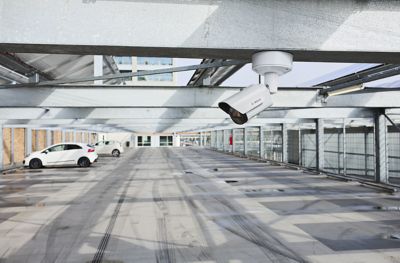
The DINION 5100i IR, a high-performance surveillance camera designed for outdoor monitoring. Photo credit: KEENFINITY.
In addition to IR illumination, KEENFINITY uses Ansys Optics tools to address challenges related to stray light, lens distortion, and focus. By simulating distortion patterns and testing corrective measures, the company ensures that its cameras produce sharp, accurate images. These design adjustments would be far more time-consuming and expensive to achieve through physical prototyping alone.
Another significant advantage of OpticStudio software is its ability to evaluate trade-offs. For example, designing lenses that capture more light can improve image clarity, but it might also increase costs or affect the size of the camera. OpticStudio software provides a clear picture of these performance and cost balances, enabling the KEENFINITY team to make informed decisions that align with overall product goals.
“In project development, months could be saved by derisking the image quality of a camera earlier. Then you would go into production right away, for example, or much sooner,” says Manuel.
The Future of Security Imaging: Sharper Than Ever
Fueled by the revolutionizing powers of simulation, companies like KEENFINITY are designing optical systems with unprecedented precision and efficiency. With Ansys Optics tools, engineers can explore and refine designs better in virtual environments, reducing reliance on costly, time-consuming prototyping.
The integration of advanced simulation tools holds immense potential to drive innovation in the security optics industry. As technologies evolve, these tools will continue to help engineers push boundaries, from improving image clarity to optimizing camera size and efficiency. Simulation paves the way for more intelligent and reliable security systems that ensure safety and adaptability.
Learn how Ansys Optics accelerates the design of next-gen miniaturized imaging systems.

“These simulations will go in our workflow exactly when we are about to choose those lens components, so very early in the stages of camera development.”
— Manuel Sarmento, optical engineer, KEENFINITY


The Advantage Blog
The Ansys Advantage blog, featuring contributions from Ansys and other technology experts, keeps you updated on how Ansys simulation is powering innovation that drives human advancement.