Synopsys and Ansys power the future of innovation—connecting silicon to systems.
-
-
Accédez au logiciel étudiant gratuit
Ansys donne les moyens à la prochaine génération d'ingénieurs
Les étudiants ont accès gratuitement à un logiciel de simulation de classe mondiale.
-
Connectez-vous avec Ansys maintenant !
Concevez votre avenir
Connectez-vous à Ansys pour découvrir comment la simulation peut alimenter votre prochaine percée.
Espace client
Support
Communautés partenaires
Contacter le service commercial
Pour les États-Unis et le Canada
S'inscrire
Essais gratuits
Produits & Services
Apprendre
À propos d'Ansys
Back
Produits & Services
Back
Apprendre
Ansys donne les moyens à la prochaine génération d'ingénieurs
Les étudiants ont accès gratuitement à un logiciel de simulation de classe mondiale.
Back
À propos d'Ansys
Concevez votre avenir
Connectez-vous à Ansys pour découvrir comment la simulation peut alimenter votre prochaine percée.
Espace client
Support
Communautés partenaires
Contacter le service commercial
Pour les États-Unis et le Canada
S'inscrire
Essais gratuits
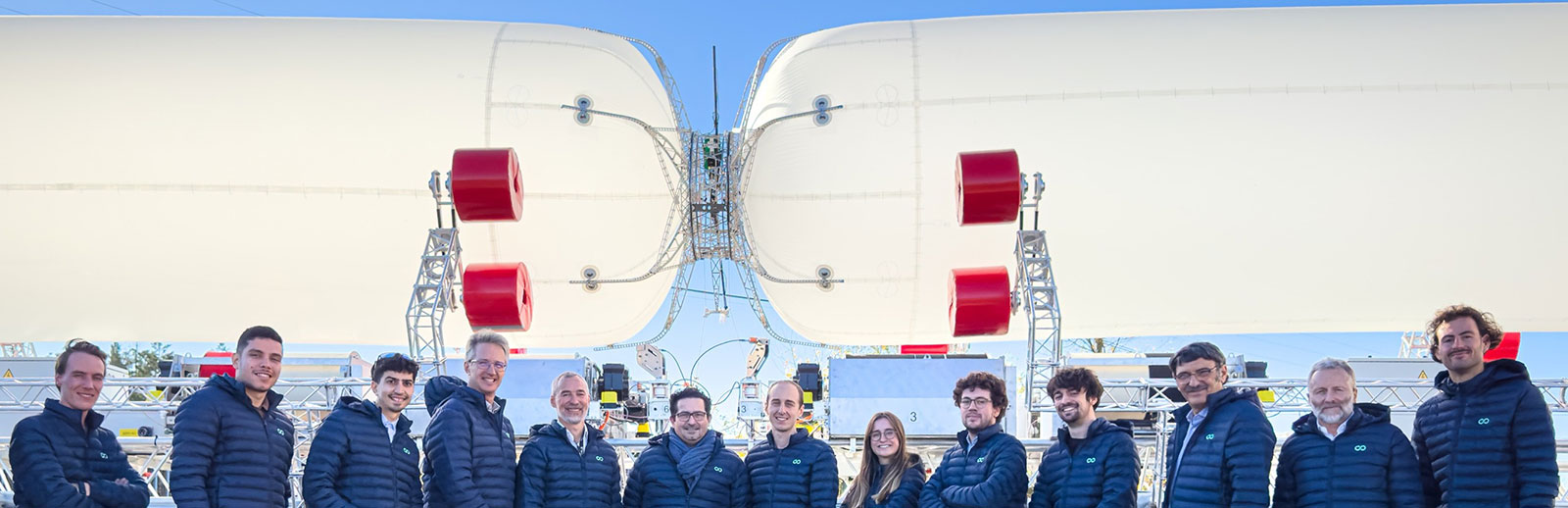
The focus on sustainable energy alternatives is at an all-time high, and companies around the world are working on innovative new ways to meet this demand. Wind Fisher is transforming wind energy generation by targeting the untapped potential of high-altitude winds. Unlike conventional wind turbines limited to ground-level currents, Wind Fisher’s system is designed to operate in higher-altitude environments where winds are stronger and more consistent. At the heart of its approach is the MAG, a cylindrical, lighter-than-air structure that generates lift through its rotation, converting wind forces into energy. This design minimizes ground infrastructure needs while optimizing energy capture, offering a practical solution to space and material limitations faced by traditional renewable systems. The innovation lies in rethinking how wind energy can be harnessed, leveraging physics to enhance efficiency and reliability.
“Our vision is to produce renewable electricity for the lowest cost of any competing technology,” says Garret Smith, co-founder of Wind Fisher. “We want to get down to €10 per megawatt hour. And we do that by harnessing wind energy from higher altitude, where wind is more powerful and more consistent. On top of that, our system uses 10 times less raw material than a wind turbine. Overall, we double the productivity, with respect to a traditional wind turbine, and we do it for a lot less cost.”
It’s a Bird, It’s a Plane — No, It’s a Balloon
Wind Fisher’s approach uses the Magnus effect, where the rotation of the cylindrical balloon creates lift through pressure differences in the surrounding airflow. This design diverges from conventional wind turbines, avoiding reliance on large blades, and instead focuses on a simpler, more robust structure. The cylindrical wings excel in providing consistent aerodynamic performance, even in unpredictable or gusty conditions, as their shape naturally mitigates overloading caused by sudden changes in wind speed. Additionally, this stability minimizes mechanical wear, contributing to greater system longevity and reliability.
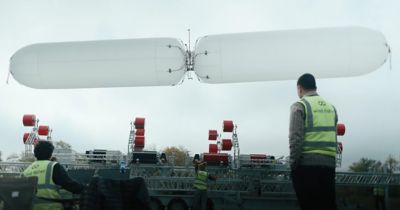
Each MAG system has two components: the ground station and the balloon. The helium-filled balloon is strapped to the ground station and, once released, floats up to 300 to 500 meters (1,000 to 1,600 feet). The cables that attach the balloon to the ground station not only keep the balloon from floating away but engage the spinning effect.
“What happens is, because our cylindrical wing is spinning in the sky, the wind flows around it faster on one side and slower on the other. This difference in speed creates a pressure differential acting as a strong pushing force on the wing. The wing is therefore pulling on the cables, and this pull is converted to electricity in the ground station.” says Smith.
The ground systems consist of two 6-meter (20-foot) containers, which is four times less of a footprint than conventional wind turbines and 70% less than solar power. The MAG system takes up only 72 square meters to produce 1 megawatt of power, whereas a solar farm would need roughly 49,000 square meters to produce the same amount of energy. And that’s only if the weather is cooperating.
“In France, the average capacity factor for a wind turbine is 30%, and for a solar panel it’s around 10% to 15%,” says Smith. “Our system is around 60%: For the same installed power, we produce twice as much energy as a traditional wind turbine and four times more than a solar panel. So it takes less space, it’s less expensive, and it does a better job.”
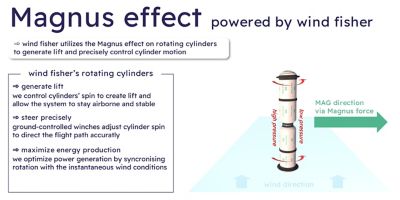
Simulating High-Altitude Wind Power
Wind Fisher integrates advanced simulation tools to drive the development and refinement of its high-altitude wind energy systems. By employing Ansys, part of Synopsys, software accessed through the Ansys Startup Program, the company can model aerodynamic performance with precision, enabling it to evaluate numerous design configurations in a virtual environment. This capability is essential for a project as ambitious as capturing energy at higher altitudes, where conditions are more complex and challenging to predict.
“We’re not reinventing the mechanics,” explains Smith. “We’re reinventing the physics, and that’s why Ansys is very important for us.”
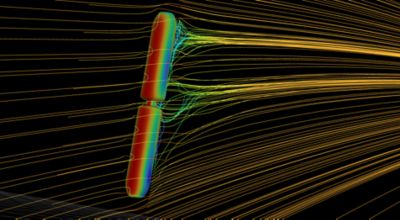
Fluid simulation in Ansys Fluent software
After completing a benchmark study among Ansys and two other simulation companies, Wind Fisher decided that Ansys was its ticket to success. Smith attributes some of this decision to the fact that a few of its engineers had already used Ansys software in their previous studies and jobs — but also because it needed to move fast.
“As a startup, we need to be able to act fast with believable data,” says Smith. “Open-source is great, but you don’t save any time or money. You just have more control. And we decided that we wanted more speed, and therefore Ansys was at the top of the list.”
The team uses Ansys Discovery 3D product simulation software, Ansys Fluent fluid simulation software, and Ansys optiSLang process integration and design optimization software to facilitate detailed analyses of the cylindrical wings’ performance under varying conditions, such as wind speed, pressure changes, and structural stress. This virtual testing process provides valuable data that directly informs design choices, enabling the team to identify optimal configurations while reducing reliance on physical prototypes.
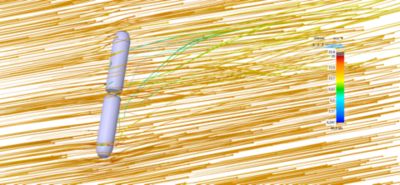
MAG simulation in Ansys Discovery 3D product simulation software
Beyond design optimization, simulations are pivotal in addressing unique challenges, such as operating in environments with high Reynolds numbers. These conditions are characterized by turbulent flow dynamics that are difficult to replicate through conventional methods. By using Ansys simulation software and collaborating with 4CAD Group, who structured the simulation process, Wind Fisher ensures that its systems are engineered for efficiency and durability, even in extreme scenarios.
In addition, the ability to run simulations on high-performance computing platforms, including graphics processing unit (GPU)-based solutions, enhances the speed and fidelity of these analyses. This rapid iteration cycle accelerates development timelines while minimizing the risks and costs typically associated with trial-and-error approaches in prototyping.
“Simulation really provides the return on investment by preventing you from going down the wrong track,” says Smith. “Ansys is the perfect tool for that because we get answers in weeks compared to months the same simulations took using other software.”
Wind Fisher’s advancements in using high-altitude wind energy showcase a forward-thinking approach to addressing modern energy needs. By pushing beyond conventional wind power technologies, the company demonstrates how innovative designs and advanced simulations can unlock previously inaccessible energy sources.
As the energy sector continues to face increasing demand for cleaner, more reliable solutions, Wind Fisher’s work underscores the importance of exploring new technological frontiers. Its progress serves as inspiration for renewable energy advancements, offering a glimpse into how reimagined methodologies and engineering precision can contribute to a more sustainable future.
Learn more about how the Ansys Startup Program can help your startup get off the ground.

Just for you. We have some additional resources you may enjoy.
“Simulation really provides the return on investment by preventing you from going down the wrong track. Ansys is the perfect tool for that because we get answers in weeks compared to months the same simulations took using other software.”
— Garret Smith, co-founder, Wind Fisher
The Advantage Blog
The Ansys Advantage blog, featuring contributions from Ansys and other technology experts, keeps you updated on how Ansys simulation is powering innovation that drives human advancement.