Synopsys and Ansys power the future of innovation—connecting silicon to systems.
-
-
Accédez au logiciel étudiant gratuit
Ansys donne les moyens à la prochaine génération d'ingénieurs
Les étudiants ont accès gratuitement à un logiciel de simulation de classe mondiale.
-
Connectez-vous avec Ansys maintenant !
Concevez votre avenir
Connectez-vous à Ansys pour découvrir comment la simulation peut alimenter votre prochaine percée.
Espace client
Support
Communautés partenaires
Contacter le service commercial
Pour les États-Unis et le Canada
S'inscrire
Essais gratuits
Produits & Services
Apprendre
À propos d'Ansys
Back
Produits & Services
Back
Apprendre
Ansys donne les moyens à la prochaine génération d'ingénieurs
Les étudiants ont accès gratuitement à un logiciel de simulation de classe mondiale.
Back
À propos d'Ansys
Concevez votre avenir
Connectez-vous à Ansys pour découvrir comment la simulation peut alimenter votre prochaine percée.
Espace client
Support
Communautés partenaires
Contacter le service commercial
Pour les États-Unis et le Canada
S'inscrire
Essais gratuits
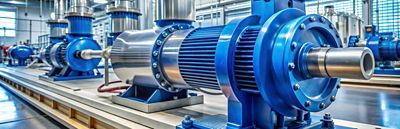
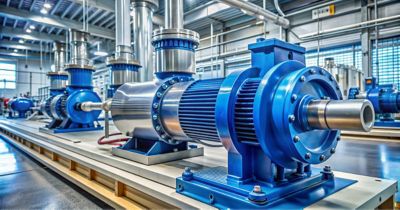
Pumps are deemed essential equipment in nearly every industry, from manufacturing and healthcare to energy and automotive. Two major pump types exist: positive displacement (PD) pumps, which trap and force liquid, and dynamic pumps, also known as kinetic pumps, which are powered by impeller movement. Each category includes variations, such as centrifugal pumps — one of the most widely used dynamic pumps, with a global market size of $44.9 billion in 2025, projected to reach $74.78 billion by 2034, according to Fortune Business Insights.
PD pumps move fluid by trapping it and forcing it out, making them effective for thick, high-viscosity fluids. Centrifugal pumps, on the other hand, rely on a rotating impeller to increase pressure, which is more effective for thinner, low-viscosity fluids. Consequently, centrifugal pumps are pivotal to sewage systems, water treatment systems, chemical processing, pharmaceutical manufacturing, and oil and gas installations.
To manage liquids precisely and efficiently across varied flows and pressures, the design of centrifugal pumps requires more data and variables than PD pumps. This presents challenges for original equipment manufacturers (OEMs), including cost of prototyping and design cycle time. Ansys, part of Synopsys, offers solutions that combine multiphysics simulation, optimization, and artificial intelligence (AI) to help OEMs overcome these design challenges and increase efficiency.
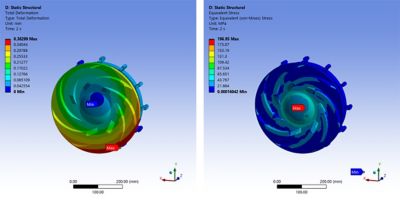
Simulations in Ansys Mechanical structural finite element analysis (FEA) software help engineers assess the deformation and stress impacting the impeller of a centrifugal pump.
Improve Pump Design Workflows
Key components of centrifugal pump design include how many stages it has, impeller construction, bearing configuration (for example, overhung or between bearings), orientation, and driver mounting. Impellers endure cyclic fatigue from pressure fluctuations and centrifugal forces, which can lead to failures, particularly at vane-to-shroud junctions in closed impellers. Over-design increases weight and forces, while under-design risks failure. The goal is to use current designs as a reference to improve safety, endurance, and performance.
One challenge that OEMs face during product improvements is converting complex geometries into simulation-ready models, such as those from legacy designs, scanned prototypes, worn or damaged parts, or as-manufactured parts. Synopsys Simpleware 3D image processing software provides this value. Simpleware software specializes in transforming 3D scan data from computed tomography (CT), micro-CT, or other imaging methods directly into high-quality meshes for computational fluid dynamics (CFD) and finite element analysis (FEA). This presents several strategic opportunities for pump OEMs.
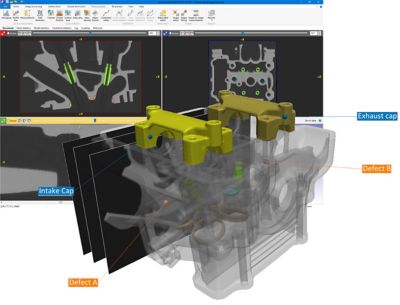
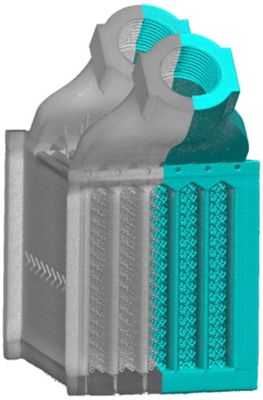
Left: Running industrial computed tomography (CT) image-based simulations requires reliable integration between imaging and simulation platforms. Right: Simpleware software provides advanced model validation to ensure that CT-derived FEA and computational fluid dynamics (CFD) models maintain their accuracy and are optimized for simulation.
The obtained mesh can be used in CFD simulations to refine design variables, such as vane count, angles, and thickness, and meet hydraulic targets. The resulting design and pressure data are used in FEA to assess stress and fatigue, which supports material selection and early design decisions. This enables efficient, durable pump designs before prototyping, saving time and cost.
OEMs can integrate Ansys CFD or FEA solvers with Ansys optiSLang process integration and design optimization software to explore pump designs running closest to the best efficiency point (BEP). To determine BEP, engineering teams run simulations to assess fluid height, known as head capacity, and obtain the flow rate. After constructing a design database, these designs can be used in the Ansys SimAI cloud-enabled AI platform to build a physics-based generative model, enabling the creation of new designs more quickly.
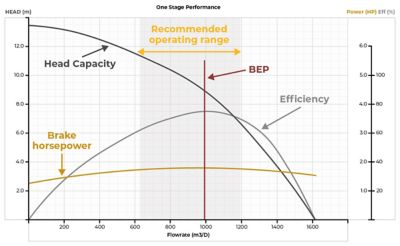
During centrifugal pump design, the best efficiency point (BEP) is determined by assessing fluid height, known as head capacity, and obtaining the flow rate, the rate at which fluid is received measured by brake horsepower. Source: ESP Pump Performance Curves and Effect of axial forces.
Observe the Tools in Action
Let’s walk through a sample workflow featuring a practical application by a major OEM that needed to upgrade its pump line for compliance with new European Union (EU) Energy-related Products (ErP) regulations. The regulations mandate a minimum efficiency index (MEI) of 0.4 or higher, leading to 40% of models being eliminated due to low efficiency, according to the European Commission.
The OEM needed a 4% efficiency improvement at BEP to satisfy the MEI requirement with a margin, but pump casing changes were not possible due to tooling costs, and the manufacturing process needed to remain the same. Therefore, the OEM focused on optimizing the impeller. The approach involved 3D scanning the manufactured part to create a CFD mesh, running CFD simulations, and adjusting the turbulence model until the results matched test data in the desired range.
This enabled the OEM to explore and optimize design features, such as impeller exit angle, vane count, and vane thickness, without needing tooling changes. In the CFD-optiSLang interface, these features serve as inputs while outputs depend on design goals, such as maximizing the BEP, keeping the head within 3% of the target, and reducing the net positive suction head (NPSH) required. NPSH is the pressure needed at the pump’s inlet to stop the liquid from boiling and prevent cavitation. It’s found by subtracting the vapor pressure from the inlet pressure. Cavitation causes pitting and damage to the internal surface of the pump. The pressure fluctuations from the CFD cavitation analysis can also be used as an input for a structural simulation and to assess the components for stress and durability hot spots.
Reduced-order modeling is a key feature of optiSLang software, enabling metamodeling for faster and efficient design analysis. The software’s automatic machine learning (AutoML) algorithms, including the metamodel of optimal prognosis (MOP) and adaptive metamodel of optimal prognosis (AMOP), automatically search for the most robust design configuration. After the initial design of experiments (DOE), AMOP identifies areas for improvement and runs additional simulations to enhance the model. As a result, the software’s DOE analysis provides information to train a data‑driven AI surrogate modeling platform, such as the SimAI platform, and test designs in minutes rather than weeks. With this workflow, an extensive analysis is done just once and can be reused indefinitely.
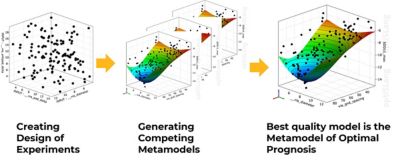
The metamodel of optimal prognosis (MOP) automatic machine learning (AutoML) algorithm in Ansys optiSLang process integration and design optimization software finds the best metamodeling approach and prepares its settings.
In addition, the part-level pump simulations can be used as reduced-order models (ROMs) within complete system-level simulations to verify pump sizing alongside motor and piping data, accounting for losses. The simulations also predict water hammer, a pressure spike from sudden flow changes, which may damage pipes and equipment.
Maximize the Value of Simulation
The use case described above demonstrates several benefits of the Ansys simulation workflow, including the advantages of multiphysics solvers, optimization techniques, and AI-powered platforms.
For structures, solvers such as Ansys Mechanical structural FEA software analyze ultimate stress, strains, fatigue life, gasket contact pressure, bolt stress, flange gap, natural vibration frequencies, and topology optimization.
CFD insights from tools like Ansys Fluent fluid simulation software include hydraulic efficiency, head-flow curves, NPSH, pressure pulsation, flow separation, and blade passing frequency noise. Electromagnetic (EM) analysis involves EM forces, bearing currents, and electrical discharge machining (EDM) damage.
Like optiSLang software, the SimAI platform accelerates access to simulation insights, enabling users to explore design alternatives and assess performance trends more efficiently. With intuitive tools and built‑in AI algorithms, users can quickly evaluate non-parametric workflows prepared with flagship solvers and perform fast what‑if analyses based on physics‑based generative models.
Essentially, the SimAI workflow consists of three simple steps: upload data, train the generative model, and predict. The SimAI solution is a physics-agnostic, flexible AI platform that lets you train a physics-based generative model using previously generated data from Ansys products or other sources and assess the performance of a new design in minutes. The application combines the predictive accuracy of Ansys simulation with the speed of generative AI via the cloud or on your desktop — a combination that boosts model performance by 10-300X across all design phases for computation-heavy projects.
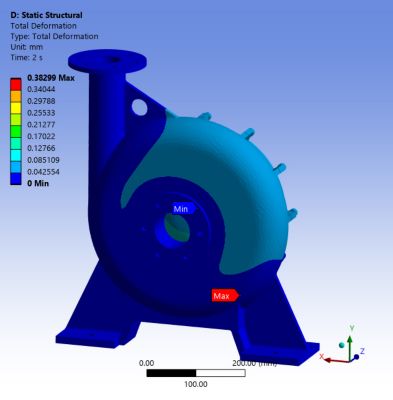
A structural analysis of a pump casing in Ansys Mechanical software helps determine deformation.
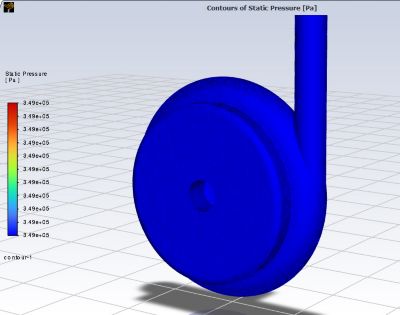
Static pressure analysis in Ansys Fluent fluid simulation software provides critical insights for centrifugal pump design that help increase efficiency and prevent pump cavitation and overheating.
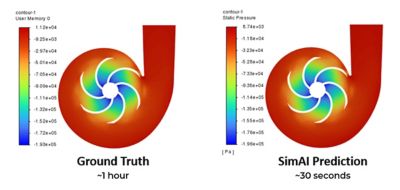
The Ansys SimAI cloud-enabled artificial intelligence (AI) platform speeds up computational fluid dynamics (CFD) simulations and pressure analysis while remaining predictively accurate. In one example, it produced reliable pressure and velocity results in 30 seconds versus an hour using Fluent software on 32 cores.
Additional tools to support this workflow include the Twin Builder simulation-based digital twin platform and ModelCenter model-based systems engineering (MBSE) software. Twin Builder software integrates AI techniques and enables you to deploy FEA and CFD as ROMs for system-level validation and operational health monitoring applications. The ModelCenter platform, which is part of the Ansys Connect product family of digital engineering enablement solutions, automates workflows and tracks changes across the product design cycle, helping OEMs mitigate cost impacts.
Insights from simulation and other digital engineering solutions empower OEMs to make early and crucial design decisions by accounting for as much uncertainty as possible from individual parts to system-level performance. This reduces late-stage surprises, tooling changes, and motor sizing issues. Additionally, by verifying workflows throughout the product development cycle, OEMs can more easily validate products for certification and accelerate time to market.
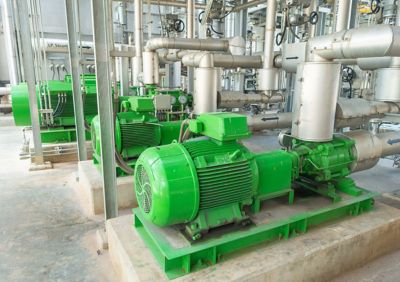
Ansys, part of Synopsys, offers solutions that combine multiphysics simulation, optimization, and AI to overcome centrifugal pump design challenges and increase efficiency.
Upgrade Your Pump Designs Today
OEMs struggle with cost, time, and reliability in the design of centrifugal pumps. Ansys tools use advanced simulation, optimization, and AI to improve performance while reducing expenses and development time. These solutions address uncertainties early, improving efficiency, and accelerating market readiness.
Find tools to support your pump designs at Industrial Processes and Equipment Simulation Software Solutions from Ansys.
To discover optiSLang optimization software firsthand, request a free trial.

Just for you. We have some additional resources you may enjoy.
Learn More
- Find tools to support your pump designs at Industrial Processes and Equipment Simulation Software Solutions from Ansys.
- To discover optiSLang optimization software firsthand, request a free trial.
The Advantage Blog
The Ansys Advantage blog, featuring contributions from Ansys and other technology experts, keeps you updated on how Ansys simulation is powering innovation that drives human advancement.