Synopsys and Ansys power the future of innovation—connecting silicon to systems.
-
-
Accédez au logiciel étudiant gratuit
Ansys donne les moyens à la prochaine génération d'ingénieurs
Les étudiants ont accès gratuitement à un logiciel de simulation de classe mondiale.
-
Connectez-vous avec Ansys maintenant !
Concevez votre avenir
Connectez-vous à Ansys pour découvrir comment la simulation peut alimenter votre prochaine percée.
Espace client
Support
Communautés partenaires
Contacter le service commercial
Pour les États-Unis et le Canada
S'inscrire
Essais gratuits
Produits & Services
Apprendre
À propos d'Ansys
Back
Produits & Services
Back
Apprendre
Ansys donne les moyens à la prochaine génération d'ingénieurs
Les étudiants ont accès gratuitement à un logiciel de simulation de classe mondiale.
Back
À propos d'Ansys
Concevez votre avenir
Connectez-vous à Ansys pour découvrir comment la simulation peut alimenter votre prochaine percée.
Espace client
Support
Communautés partenaires
Contacter le service commercial
Pour les États-Unis et le Canada
S'inscrire
Essais gratuits

You’ve probably heard the proverb that necessity is the mother of invention, but the world is in need of a great many things. Who decides what inventions are necessary for society as a whole? We could pour our time and energy into artificial intelligence (AI) to produce funnier videos to share on social media, fill out our expense reports, clean our homes, or cure cancer, among other possibilities. But in 10 years, how will we describe the results of the inventions we created?
“The pervasive use of physical intelligence that will dramatically change and improve human lives,” predicted Synopsys President and CEO Sassine Ghazi when asked that question while participating in a 2026 World Economic Forum panel in Davos, Switzerland.
Ghazi joined Abdullah AlSwaha, minister of communications and information technology for Saudi Arabia; Laura D’Andrea Tyson, distinguished professor at the graduate school Haas School of Business, University of California, Berkeley; and Vimal Kapur, chairman and CEO, Honeywell, in the panel discussion: “How Can We Unlock New Sources of Growth? Converging Technologies To Win.”
“I think perhaps the dominant conversation this year at Davos has been exactly the subject of our panel today, which is converging with technology to win,” said panel moderator Andrew McAfee as he introduced the panel. McAfee is a scientist at Massachusetts Institute of Technology (MIT) who co-founded the MIT Initiative on the Digital Economy and Workhelix. “This is the topic at Davos 2026.”
What Is a Winning Technology?
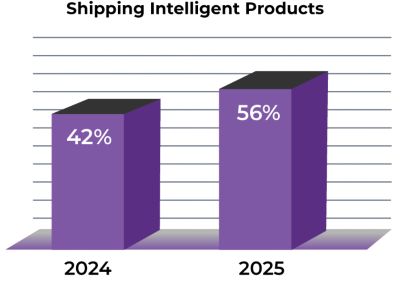
Globally, over half of engineers (56%) said they have incorporated AI into designed products and solutions they are shipping to customers, a significant increase from last year. Source: “The Reality of Artificial Intelligence: Engineers get behind AI, despite its challenges,” Avnet Insights Survey of 1,200 engineers, January 2026.
The direction of our collective technological ambition is not a question that can be answered by economic supply and demand alone. Breakthroughs require risk-takers. Some innovations have immediate market value; others require long-term investment, regulatory approval, and societal changes to come to fruition.
To change the world with the next big thing requires the convergence of innovators in business, government, academia, and civil society to share their time and talents with one another. Much like systems engineering, this ecosystem provides insights into how innovations are interrelated — just on a much larger scale. For example, if the energy sector invests in AI to help conserve commercial power or produce it more efficiently, that might yield an energy surplus that can then be applied to government-funded academic research into healthcare. Understanding those priorities and trade-offs can help both businesses and society thrive.
Just as different aspects of society cannot meet the challenges and promises of AI alone, multiple technology providers are needed to fully capitalize on future possibilities. That’s why an open ecosystem is key.
Engineers know a thing or two about trade-offs. Despite the seemingly limitless possibilities for applying AI to society’s challenges, there are constraints. AI requires purpose-built semiconductors and energy to turn those inventive AI models into useful products and services that customers are willing to buy.
“That’s the beauty of constraining the problem,” said Ghazi during the panel discussion. “Engineering comes to life when you constrain the problem.”
Accelerate Your Ambitions With Confidence
Two of those age-old constraints — complexity versus speed — aren’t going anywhere in the age of AI. AI and the accelerated computing technologies it relies on are obviously a driver of efficiency. AI is also a source of complexity. It’s a paradox that engineers increasingly encounter as they integrate AI efficiencies into their workflows while creating AI-enabled products. Those intelligent products add complexity to engineering, which then demands even greater AI efficiencies.
Just as different aspects of society cannot meet the challenges and promises of AI alone, multiple technology providers are needed to fully capitalize on future possibilities. That’s why an open ecosystem is key. Individual tool efficiencies will get you only so far without integrations to connect them up and down the tech stack.
With the integration of Ansys, Synopsys is equipping you with unparalleled solutions to revolutionize how you design and build products — from silicon to systems. With Ansys and Synopsys as one company, you will gain access to both an expanded partner ecosystem and solutions to help you optimize even the most complex workflows, eliminate inefficiencies, and provide you with a cohesive means to innovate at an accelerated pace that meets tomorrow’s needs without sacrificing quality.
Moreover, the integration of simulation-powered digital engineering into your workflow fosters better collaboration across engineering teams. With insights shared in real time, stakeholders can align on design objectives, helping you deliver innovative products faster. You’re empowered to tackle challenges with clarity and confidence, knowing that you have access to a forward-thinking partner that helps you meet the demands of today’s competitive landscape.
We’re Just Getting Started
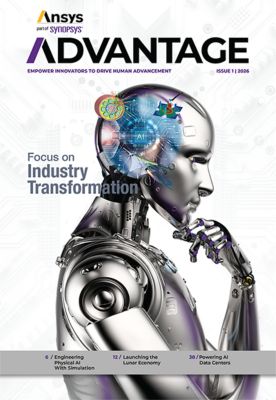
The articles in this issue of Ansys Advantage magazine illustrate how industries are already being transformed by technological convergence — from software-defined vehicles and data centers to robotics and more. These intelligent systems are silicon-powered, software-defined, and AI-infused. Our customers continue to amaze us with how they use our solutions to push the limits of what is possible.
But this is just the beginning of what a silicon-to-systems ecosystem will provide. The future of innovation is defined by your ability to create intelligent products and systems that learn, adapt, and enhance human experiences in ways that we once thought were unattainable. If you’re engineering for the pervasive use of physical AI that will dramatically change and improve human lives, you need the tools to transform groundbreaking ideas into solutions that improve society, streamline industries, and push technology forward.
The Ansys 2026 release one (R1) delivers a major step forward in system-to-silicon engineering design by unifying physics accuracy, enabling intelligent acceleration, and delivering real-world performance insight. As products become more software-defined, densely integrated, and multidisciplinary, engineers need visibility across mechanical, electrical, thermal, and fluid domains.
The latest release strengthens system-aware multiphysics simulation to enable faster design cycles and reduced program risk. AI, graphics processing units (GPUs), high-performance computing (HPC), and cloud technologies accelerate innovation — turning complexity into speed, scalability, and real-time design exploration. Finally, new capabilities in multiphysics digital twins provide a deeper understanding of how products behave in the field, enabling teams to optimize performance, reliability, and efficiency long before hardware exists. Together, these advancements help organizations move confidently forward with greater agility and engineering insight.
Read the latest issue of Ansys Advantage magazine to learn how industries are being transformed by intelligent systems.

Just for you. We have some additional resources you may enjoy.



The Advantage Blog
The Ansys Advantage blog, featuring contributions from Ansys and other technology experts, keeps you updated on how Ansys simulation is powering innovation that drives human advancement.