Synopsys and Ansys power the future of innovation—connecting silicon to systems.
-
-
Accédez au logiciel étudiant gratuit
Ansys donne les moyens à la prochaine génération d'ingénieurs
Les étudiants ont accès gratuitement à un logiciel de simulation de classe mondiale.
-
Connectez-vous avec Ansys maintenant !
Concevez votre avenir
Connectez-vous à Ansys pour découvrir comment la simulation peut alimenter votre prochaine percée.
Espace client
Support
Communautés partenaires
Contacter le service commercial
Pour les États-Unis et le Canada
S'inscrire
Essais gratuits
Produits & Services
Apprendre
À propos d'Ansys
Back
Produits & Services
Back
Apprendre
Ansys donne les moyens à la prochaine génération d'ingénieurs
Les étudiants ont accès gratuitement à un logiciel de simulation de classe mondiale.
Back
À propos d'Ansys
Concevez votre avenir
Connectez-vous à Ansys pour découvrir comment la simulation peut alimenter votre prochaine percée.
Espace client
Support
Communautés partenaires
Contacter le service commercial
Pour les États-Unis et le Canada
S'inscrire
Essais gratuits

As systems grow in complexity, traditional document-centric systems engineering approaches are no longer sufficient. These approaches often fragment system architecture, requirements verification, and simulation analysis across disconnected tools and teams. Managing complexity, ensuring requirement satisfaction, and enabling informed decision-making demand a more connected, model-centric approach to identify issues earlier and significantly reduce downstream risk. That is precisely where model-based systems engineering (MBSE) — and the SysML v2 language — play a transformative role.
The first 2026 release of the Ansys System Architecture Modeler (SAM) capability takes another significant step forward with SysML v2 enhancement innovations and reinforces its position as the system architecture backbone: connecting architecture definition, requirement verification, execution, and external engineering analysis in a unified digital engineering workflow.
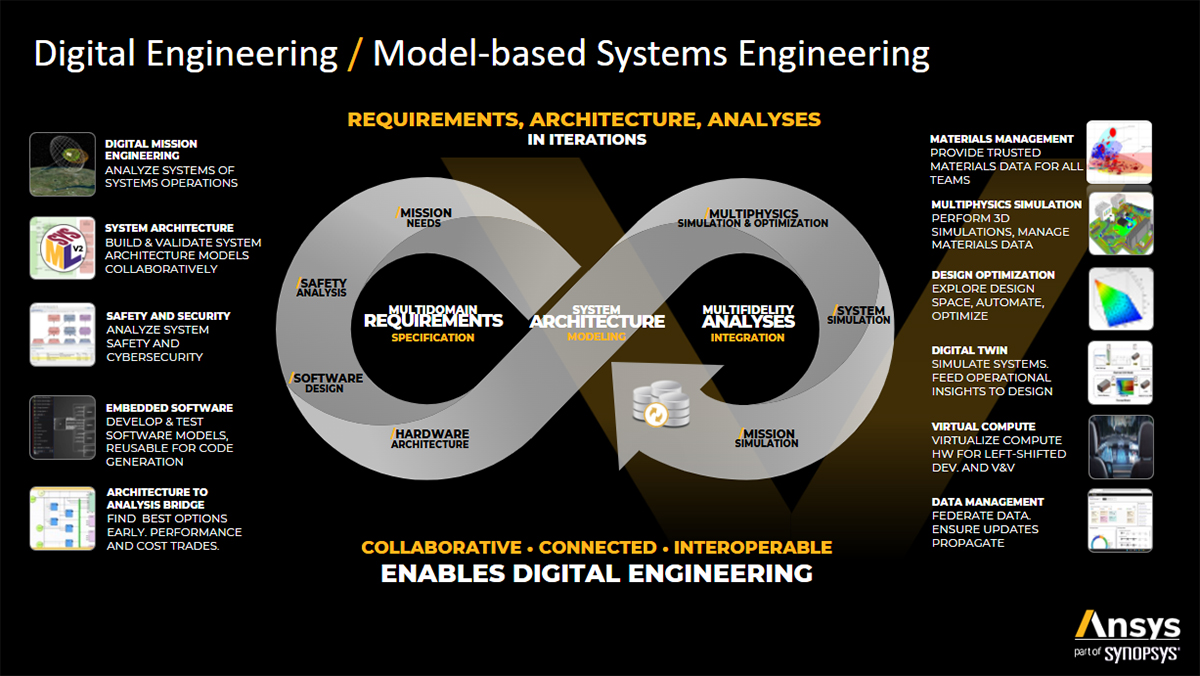
System architecture modeling as an enabler of digital engineering and model-based systems engineering (MBSE)
A major highlight of this release is the seamless integration with Ansys ModelCenter MBSE software, connecting system requirements to engineering analysis to combine SysML v2 expressions defined in the system model with external analysis. This unified workflow enables systems engineers to efficiently manage, track, and trace requirement verification status directly in the system architecture context. This exemplifies how the SAM capability continues to evolve as the central enabler of MBSE, bridging system architecture and engineering analysis for better-informed decisions.
The Importance of SysML v2 in MBSE
SysML v2 was designed explicitly to increase both the adoption and effectiveness of MBSE. Compared with SysML v1, it is not simply a refinement but a fundamental evolution.
SysML v2 introduces a more expressive language capable of capturing richer systems engineering concepts while enabling stronger consistency and integration across system architecture, behavior, requirements, and analysis. Central to this increased precision and reduced ambiguity are expressions, which permit engineers to formally describe quantitative, logical, and behavioral relationships directly in the system model.
While SysML v2 expressions are powerful, real‑world systems often require external, high‑fidelity analyses, such as simulation, optimization, and multidisciplinary trade studies. Aligned with this need, the first 2026 release enhances the integration between the SAM capability and ModelCenter software, enabling automatic evaluation of SysML v2 expressions — across AttributeUsage, Requirements, etc. — directly from the ModelCenter interface, eliminating the need for scripting during requirement verification. Verification results are seamlessly returned to the SAM capability and visualized in the user interface (UI), providing requirement verification status in tables. This provides end-to-end traceability among requirements, analysis cases, and architecture elements.
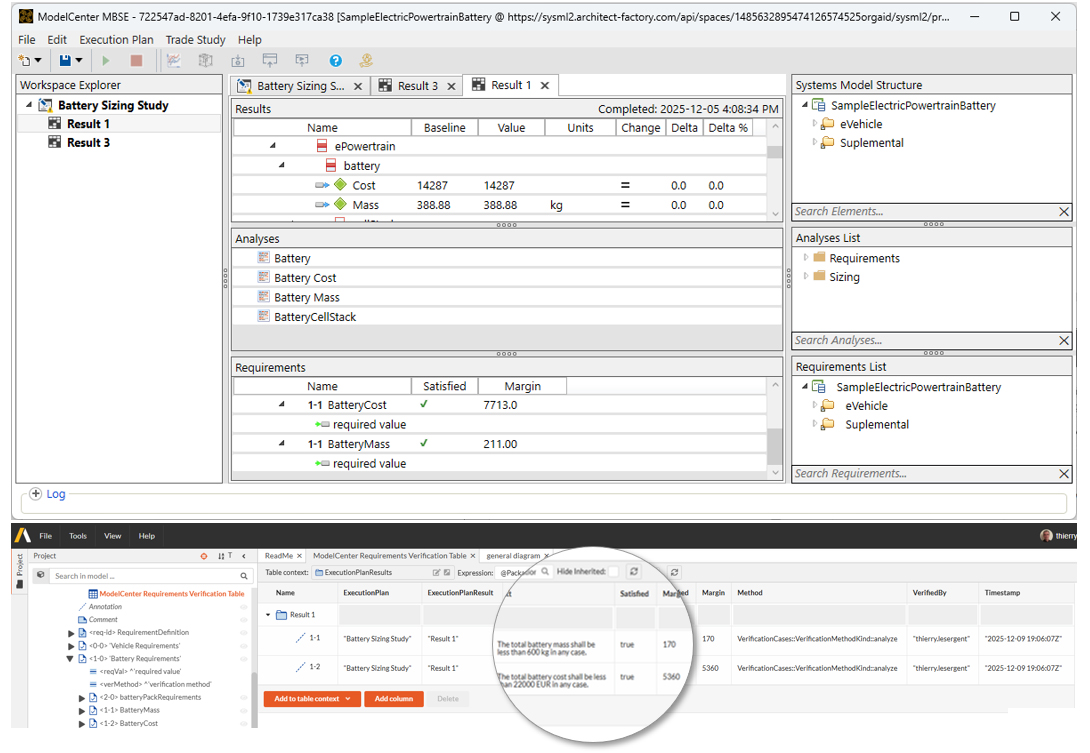
Ansys ModelCenter MBSE software requirements validation results displayed on the Ansys System Architecture Modeler (SAM) capability user interface (UI)
This unified workflow enables systems engineers to:
- Formally specify requirements using SysML v2 expressions
- Extend verification beyond native language capabilities by invoking external analyses
- Automatically combine expression evaluation with ModelCenter software-driven results
- Verify requirements early and continuously in the system architecture context
Auto-evaluation of SysML v2 expressions in ModelCenter software and requirements verification status in the SAM capability
By keeping requirements synchronized across tools and eliminating manual updates, this approach reduces errors, improves transparency, and enables a scalable, automated, and traceable verification process.
Other Capabilities Introduced in SAM 2026 R1
Beyond the integration of SysML v2 expressions with external analysis, SAM 2026 R1 introduces a broad set of enhancements that further strengthen its role as a cornerstone for MBSE and digital engineering. These capabilities are designed to reduce modeling effort, improve correctness and consistency, and extend openness and connectivity across the engineering ecosystem while staying fully aligned with the evolving SysML v2 standard.
Extended SysML v2 Language Support
SAM 2026 R1 continues to deepen its alignment with the official SysML v2 specification, enabling teams to model systems more naturally and with greater confidence. Expanded language coverage includes new support for VerificationCase and AnalysisCase, enabling more formal, traceable verification and analysis directly in the system model. Additional constructs, such as Objective requirements, Occurrence, and Reference subsets, enable engineers to express intent, variation, and reuse more precisely.
New sequence diagram support and a live textual format display further enhance how users interact with their models.
Engineers can seamlessly move between graphical and textual representations, accommodating different modeling preferences and levels of expertise. By automating much of the diagram setup and enforcing SysML v2 semantics, the SAM capability reduces manual effort, minimizes errors, and improves overall model correctness and consistency.
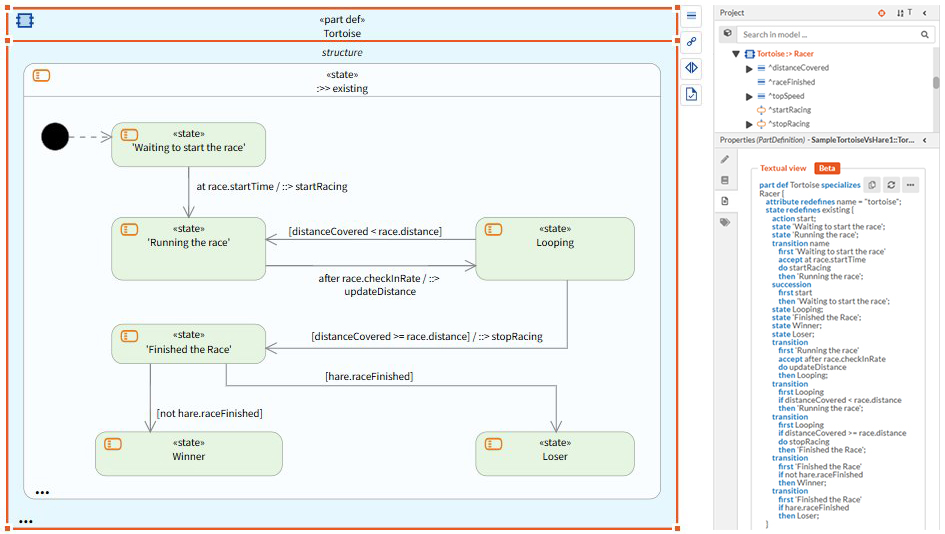
A live display of the corresponding SysML v2 textual format from any model element selection
Enhanced Openness and Connectivity
A core pillar of MBSE is interoperability, and SAM 2026 R1 significantly advances this through enhanced openness and programmability. The PySAM capability, delivered as an open-source PyAnsys library, makes working with SysML v2 models in Python easier and faster. With static Python classes and accurate autocompletion in modern IDEs, users can write automation and integration scripts more confidently and efficiently.
To strengthen its integration with engineering workflows, the improved Ansys Scade One model-based embedded software development solution SysML v2 import from the SAM capability is now more customizable and fully programmatic through Python, enabling optimized import logic tailored to each customer’s context.
This release expands the SAM capability’s open ecosystem with bidirectional requirements exchange for DOORS NG and Codebeamer.
At the platform level, the SysML v2 REST API has been extended to support team and folder management, as well as SVG export of SAM capability diagrams, making it easier to integrate system architecture content into downstream workflows and documentation.
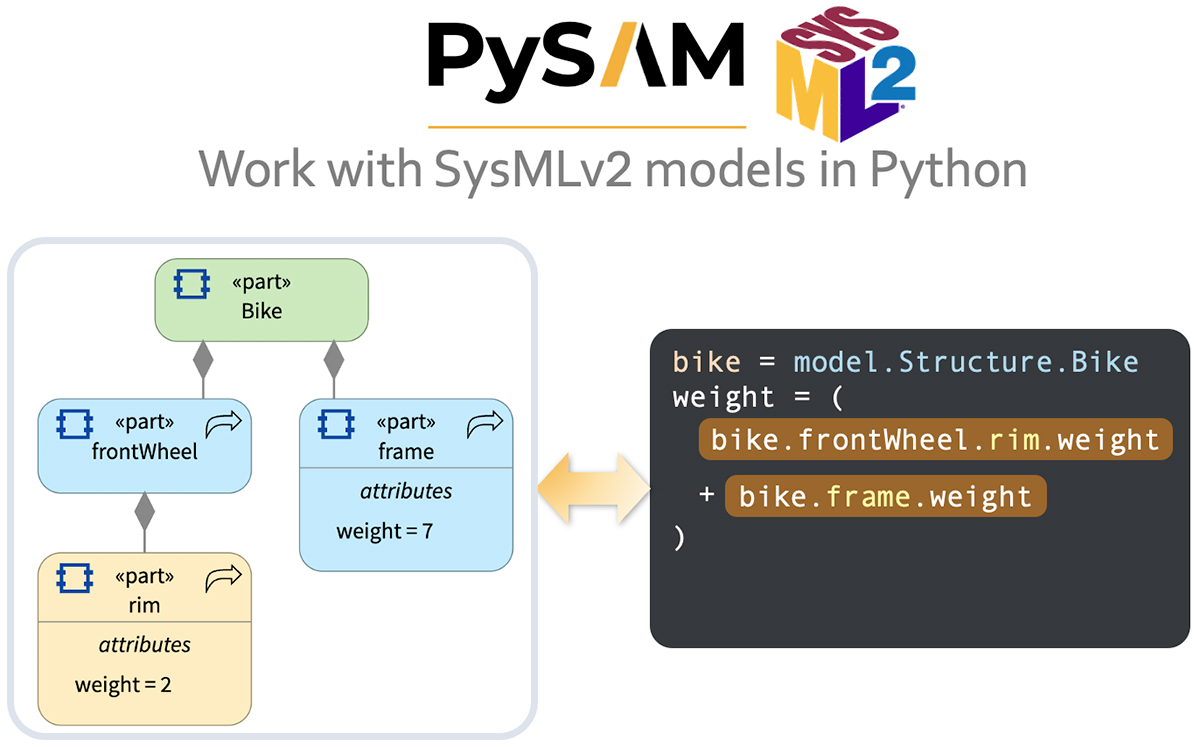
The Python library extended with static Python classes
Executing SysML v2 Models With Confidence
SAM 2026 R1 also advances the ability to execute system models, enabling engineers to move from architecture definition to behavioral validation with minimal setup. Semantically correct SysML v2 execution ensures that models behave as intended, faithfully reflecting system logic and timing.
Execution can be visualized through animated SVG diagrams, making behavior easier to understand and communicate. Interactive execution controls — such as pause, step, continue, and diagram breakpoints — permit engineers to debug behavior incrementally and identify issues earlier.
The ability to co-execute models with other tools, such as Ansys Systems Tool Kit (STK) digital mission engineering software, enables more realistic, connected system studies that span multiple domains and simulation environments.
Behavior execution/co-execution with Ansys Systems Tool Kit (STK) digital mission engineering software
Platform and Digital Engineering Enhancements
At the engineering platform level, SAM 2026 R1 introduces enhancements that support scalability, governance, and collaboration across growing teams and programs. Hierarchical folders help organize models as projects expand while model archive downloads make it easy to share complete models — including all required libraries — in an organization.
New model impact analysis reports provide visibility into the effects of changes before they are applied, helping teams manage upgrades and rollbacks, with the option to stop changes before they affect models.
Personal access token (PAT) management enables secure programmatic access without repeated authentication, supporting automation and integration scenarios. Audit trails based on the OpenTelemetry standard improve accountability and traceability by recording key system and user actions across the life cycle. Additional digital engineering methodology examples provide hands-on guidance and accelerate adoption of best practices.
User Enablement and Support
To ensure that teams can take full advantage of these capabilities, SAM 2026 R1 places strong emphasis on usability and enablement. A common Ansys installer simplifies the deployment of the SAM capability and its companion desktop tools — Behavior Execution Engine, ModelCenter software, Ansys medini analyze system-oriented safety analysis software, and the Scade One solution — while sample models let users quickly exercise key workflows, such as model execution, requirement verification in ModelCenter software, and model import as operators in the Scade One solution for software prototyping.
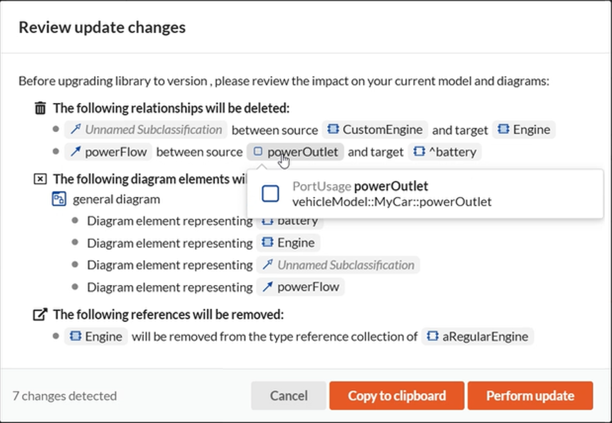
Safely manage upgrades and rollbacks with model impact analysis reports.
Direct access to Ansys Engineering Copilot with GPT from the SAM capability’s help menu permits users to interact with user manuals and quickly find answers to common questions, with direct access to Ansys Learning Hub courses reducing onboarding time and helping teams stay productive as they adopt SysML v2-driven MBSE workflows.
Bringing It All Together
With 2026 R1, the SAM capability strengthens its role as the central hub for MBSE, fully aligned with SysML v2 and tightly connected to external analysis workflows.
Together, these capabilities reflect a broader transformation in how Ansys, part of Synopsys, approaches systems engineering — shifting from isolated modeling activities to connected, verification-driven digital engineering workflows.
By placing the system architecture model at the center and connecting it seamlessly with analysis, execution, and collaboration, the SAM capability enables organizations to move faster, verify earlier, and make decisions with greater confidence. The first 2026 release builds directly on this vision, extending SysML v2 adoption and reinforcing the SAM capability as the foundation for scalable, standards-based MBSE.
Next Step
Join us April 22, 2026, at 11 a.m. EST to discover what’s new in SAM 2026 R1.

Just for you. We have some additional resources you may enjoy.


The Advantage Blog
The Ansys Advantage blog, featuring contributions from Ansys and other technology experts, keeps you updated on how Ansys simulation is powering innovation that drives human advancement.