Synopsys and Ansys power the future of innovation—connecting silicon to systems.
-
-
Accédez au logiciel étudiant gratuit
Ansys donne les moyens à la prochaine génération d'ingénieurs
Les étudiants ont accès gratuitement à un logiciel de simulation de classe mondiale.
-
Connectez-vous avec Ansys maintenant !
Concevez votre avenir
Connectez-vous à Ansys pour découvrir comment la simulation peut alimenter votre prochaine percée.
Espace client
Support
Communautés partenaires
Contacter le service commercial
Pour les États-Unis et le Canada
S'inscrire
Essais gratuits
Produits & Services
Apprendre
À propos d'Ansys
Back
Produits & Services
Back
Apprendre
Ansys donne les moyens à la prochaine génération d'ingénieurs
Les étudiants ont accès gratuitement à un logiciel de simulation de classe mondiale.
Back
À propos d'Ansys
Concevez votre avenir
Connectez-vous à Ansys pour découvrir comment la simulation peut alimenter votre prochaine percée.
Espace client
Support
Communautés partenaires
Contacter le service commercial
Pour les États-Unis et le Canada
S'inscrire
Essais gratuits

The heart is an intricate organ that combines fluid dynamics, tissue mechanics, and electrophysiological behavior. These fluid-structure-electrophysiology interactions (FSEI) are essential for understanding conditions such as heart failure, arrhythmias, valve diseases, and how medical devices and pharmaceuticals affect the heart’s behavior.
Medical device manufacturers use computational modeling and simulation (CM&S) to better understand these behaviors and create life-saving devices for some of the world’s most common diseases. However, replicating these interactions in a simulation requires deep technical expertise and tools capable of handling the heart's dynamic characteristics. Despite advancements in imaging and computational methods, transforming this data into meaningful simulations remains a technically challenging and resource-intensive process.
To make this process easier for both simulation experts and nonexperts alike, Ansys, part of Synopsys, created the PyAnsys-Heart pythonic interface platform. By combining the strengths of artificial intelligence (AI) and advanced simulation technologies, it enables users to replicate critical heart functions — such as electrical activation, tissue contraction, and blood flow — within Ansys LS-DYNA nonlinear dynamics structural simulation software. Engineered to support diverse user needs, the PyAnsys-Heart platform offers a modular framework to build simple to highly complex heart models.
From Weeks to Minutes: Heart Modeling All in One Place
The PyAnsys-Heart platform can be combined with AI technologies, including natural language processing and agentic AI — which can act independently and make decisions on its own — to automate the Python scripts needed to model the different physics of the heart. This AI-driven automation simplifies the creation of detailed heart models, dramatically reducing the time required to extract geometries, generate meshes, and process patient-specific data. Instead of manually executing complex scripts or relying on multiple software tools, engineers can now use the PyAnsys-Heart platform to streamline these steps.
“We wanted to give people the tools to build any heart they want,” says Mark Palmer, lead chief technologist of healthcare at Ansys. “But more than that, we wanted to give them the tools to build a model of any tissue in the body, from active tissue like muscle to passive tissue like skin and bone. And all these material models and their coupled, multiphysics interactions are now available in LS-DYNA software.”
This advancement is very important in handling the intricate processes involved in heart modeling, such as defining muscle fiber orientation and simulating electrical conduction patterns. By bringing these elements together, all aspects of heart function can be simulated and analyzed simultaneously, which enhances the model's utility and precision. By simulating these interconnected processes in a single environment, users can achieve more accurate and cohesive insights into cardiovascular behavior and device interactions.
“Traditionally, you would need different solvers to simulate the different physics, which is clunky and time-consuming,” says Dr. Palmer. “With PyAnsys-Heart, you don’t have to pass the model from one tool to another. You can build a very detailed electrical model, couple it to a mechanical model, and then couple it to a fluids model, all without changing the geometry and all within the same solver.”
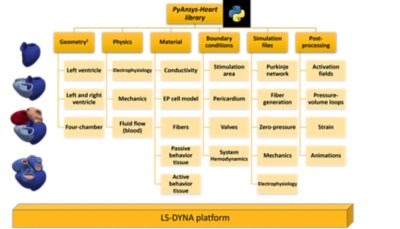
A visualization of the different Python scripts available in the PyAnsys-Heart pythonic interface platform. Each light yellow box represents a Python script. Scripts are open source and can be edited and adapted by end users.
The NVIDIA NIM AI-enabled chatbot system with agentic AI enables the coupling of the PyAnsys-Heart platform to AI. Users prompt the chatbot with specific queries, and the appropriate PyAnsys-Heart code is automatically executed.
This easy-to-use chatbot interface enables industry experts without extensive simulation training to bypass the complex system of tools needed for immersive cardiovascular system analysis. Users can build on this workflow to visualize patient-specific anatomies and pathologies, medical devices in their working environment, and much more.
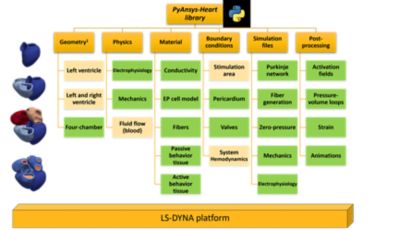
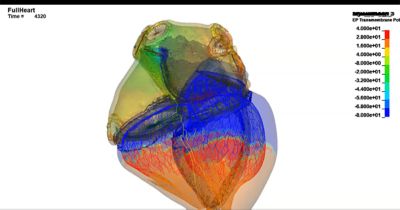
(Left) A visualization of the different Python scripts needed to create a four-chamber electromechanical heart model. Each green box represents the Python scripts that automatically run to create the model. (Right) The simulation output in Ansys LS-DYNA nonlinear dynamics structural simulation software.
Additionally, the platform uses AI to simplify the extraction of 3D geometries from clinical images. Its AI-driven automated segmentation tools enable users to generate patient-specific models more efficiently, helping cut down on preparation time and reducing the need for extensive expertise.
“Processing clinical imagery to extract the 3D geometry used to take weeks — now it takes minutes,” says Palmer. “Measurements take seconds instead of days or hours.” The workflow also incorporates advanced tools that help tailor models to specific needs. Users can modify or replace standard components with their own data or add their own device designs, which is invaluable in creating highly customized simulations. This flexibility is essential for addressing specific cardiac diseases or meeting product development goals. With this level of control, the PyAnsys-Heart platform empowers users to develop and validate innovative medical devices with greater confidence.
By simplifying complex processes, the PyAnsys-Heart platform enables medical device manufacturers to refine their designs and explore novel treatment options. This capability is especially valuable for researchers and manufacturers aiming to create innovative cardiovascular technologies while maintaining accuracy and efficiency. Further, the platform’s use of patient-specific anatomical and physiological details helps ensure that simulations closely align with real-world scenarios.
Whether evaluating potential risks, refining product designs, or simulating disease states, the PyAnsys-Heart platform gives users the precision and flexibility to address complex challenges in cardiovascular modeling, leading to greater innovation in the development of medical devices and therapies.
Learn more about the PyAnsys-Heart platform and explore simulation solutions in healthcare.

Just for you. We have some additional resources you may enjoy.
“We wanted to give people the tools to build any heart they want. But more than that, we wanted to give them the tools to build a model of any tissue in the body, from active tissue like muscle to passive tissue like skin and bone.”
— Mark Palmer, lead chief technologist of healthcare, Ansys, part of Synopsys


The Advantage Blog
The Ansys Advantage blog, featuring contributions from Ansys and other technology experts, keeps you updated on how Ansys simulation is powering innovation that drives human advancement.