Skip to Main Content

Ansys SimAI
Predict at the Speed of AI

SimAI is a user-friendly artificial intelligence platform that combines the predictive accuracy of Ansys simulations with the power of AI.

LESS TIME WAITING, MORE TIME INNOVATING

SimAI Predicts New Design Behavior in Minutes, Using Past Simulations

SimAI cloud-enabled artificial intelligence platform provides data-driven insights rapidly and reliably by learning from your legacy simulation data. The user experience prioritizes simplicity; no coding or data science expertise is required. Just upload your data, select relevant design outputs, and generate your AI model. Once it is ready, explore the performance of your most complex designs at lightning speed, without needing any simulation expertise.

  • Check icon outline
    Fast and reliable data-driven insights
  • Check icon outline
    Flexible deployment options
  • Check icon outline
    Intuitive and simple workflow
  • Check icon outline
    Expansive design space exploration

Product Specs

Ansys SimAI enables you to rapidly test many design alternatives without the computation constraints and complexity of traditional solvers. Boost your productivity by eliminating long waits for results and focusing on creativity and innovation. 

  • All Physics Supported
  • Non-Parametric
  • Mesh independent Results
  • Autogenerated Model Evaluation Report
  • Single AI algorithm for all physics problems
  • Intuitive web-app interface
  • PySimAI: Python SDK
  • Steady state and Transient Analysis
  • Prediction Across Topology Variations

July 2025

What's New

Ansys SimAI 2025 R2 introduces a suite of powerful enhancements designed to elevate user experience, streamline model development, and refine data handling.

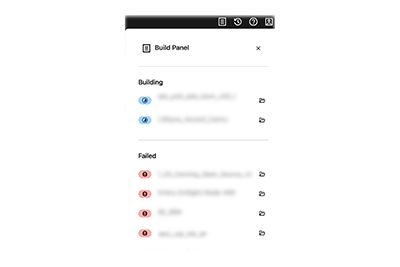
2025 R2 SimAI model build
Model Build and Post-processing

In model build and post-processing, users benefit from the intuitive “predict as learned” surface post-processing, a refined “build on top” UX, and the return of the much-requested surface evolution feature.

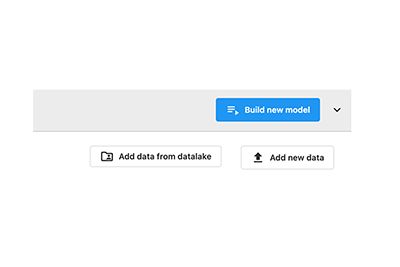
2025 R2 SimAI training data
Training Data handling

The model evaluation report enhances transparency with build duration presets. Improved management of training datasets addresses NaN values, allowing real-time updates. A centralized error view simplifies troubleshooting, and CSV exports now indicate datasets used in MER plots.

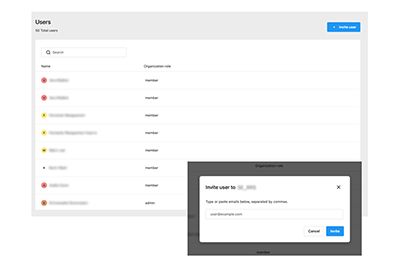
2025 R2 SimAI UI UX improvements
UI/UX Improvements

The UI/UX experience has improved with accessible release notes, member counts, and expiration dates in the organization menu, along with new interface elements like banners and upload toasters, enhancing workflow and providing more information to users.

FAQs

Typically 30 to 100 simulation results are required to produce a model with sufficient accuracy. The model has been tuned so that 2 days of training will address most use cases. The training time can be adjusted between 1 and 5 days as needed.

The secure handling of data is a key principle for Ansys AI, taking steps to ensure user privacy and no crossover between customer data. A customer is provided with a workspace that only individuals from their company can access. All new models are started from scratch and fully initialized so there is no data contamination across customers.  This does not prevent customers from re-training their own models with additional training data. 

SimAI is useful for customers working across all phases of the product development process, across all physics domains, and all industrial sectors. As SimAI is usable with simulation data for any vendor, it gives the opportunity to target non-Ansys customers. It does not require simulation expertise, and this opens the possibility of using simulation insights to evaluate new designs for new users like design engineers, project managers, and system engineers. SimAI also makes simulation useful where it was not practical before because it runs orders of magnitude faster than full fidelity simulation with comparable accuracy.

SimAI will always generate a result. There is a confidence level reported with each result that tells the user if the result can be trusted or if the design is too far away from the training data. If the geometry is too far out, then there is an option to retrain the model with the new geometry.

Contact an Ansys sales representative to enquire about licensing and pricing options.

Anytime you are doing design exploration with high fidelity simulation, it is likely that SimAI will produce drastic productivity gains. Application examples include Automotive crash, wire forming manufacturing, crystal plasticity for additive manufacturing, generative design, design optimization, external aerodynamics, battery thermal management concept design, power inverter cooling, antenna design and integration, antenna array systems, optical systems.

Both tools target early design stages, to achieve effective design evaluation and exploration. Yet, they can be relevant according to your needs. If you have a legacy dataset of simulation results in a design space and want to rapidly predict the performance of similar new designs, AI is an effective method. Once your AI model is trained for an application, it doesn’t require setting up a simulation scenario. Ansys Discovery can be used for exploring a novel design or new load case. Discovery is used for fast and accurate insights for your everyday mechanical designs. You can use it for any CAD and benefit from fault-tolerant meshing and GPU-accelerated computing on the desktop or in the cloud.

More Comprehensive Design Exploration Enabled by Artificial Intelligence

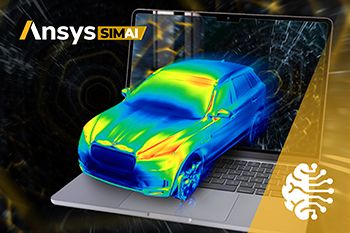
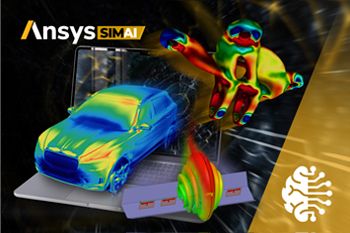
Our artificial intelligence platform for simulation enables you to train AI models directly with simulation results and geometry input, predicting performance for new designs in a continuous 3D physical field. 

sim-ai-thumbnail-capabilities-1.jpg


Key Features

Unlock Lightning-Fast Simulations

SimAI drastically speeds up model performance prediction with accuracy comparable to full-fidelity simulations. As a result of being able to predict performance in seconds instead of hours or days, SimAI reduces the overall design cycle by 10-100X and enables more product innovation.

Each result is reported with a confidence level indicating whether it can be trusted or if the design is too far away from the training data. If the geometry is too far out, then there is an option to retrain the model with the new geometry.

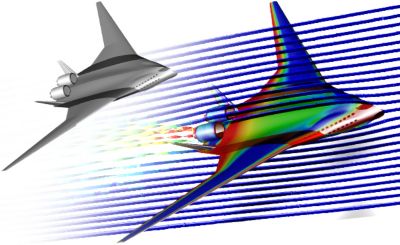
SimAI covers all physics domains from fluid mechanics to electromagnetics across various industries. Applications range from external aerodynamics for automotive to electromagnetic signature analysis for antennas in aerospace and telecommunication.

No coding skills or deep learning expertise are needed, facilitating easy AI model training via the web app. Engineers and designers can efficiently use the platform to evaluate designs without relying on simulation experts.

Our SaaS deployment is hosted on a state-of-the-art cloud infrastructure to ensure that user data is secure and kept private. We ensure user data security across our customer accounts, and models are trained from scratch, containing no prior knowledge.

pySimAI provides the ability to build and leverage AI models on the SimAI platform from within custom apps and scripts. 

Customers can train the AI using previously generated Ansys or non-Ansys data. 

SIMAI RESOURCES & EVENTS

Featured Webinars

Webinar on Demand
sim-ai-webinar-intro.jpg
Introduction to SimAI

Discover SimAI, the AI-augmented simulation technology

Webinar Series
sim-ai-webinar-accelerate.jpg
Accelerate Your Simulation with AI

Learn how SimAI is used across different disciplines


White Papers & Articles

2021-09-ansys-og.jpg

Ansys SimAI Software Predicts Fully Transient Vehicle Crash Outcomes

In this white paper, we show how the SimAI cloud-based software can be applied to highly nonlinear, transient structural simulations, such as automobile crashes.


Videos


Blogs

Ansys SimAI
BY : MAZEN EL HOUT

The Intersection of AI and Simulation

AI-enhanced simulations speed up design and optimization across industries, especially those in which accuracy and efficiency are critical, such as automotive, aerospace, electronics, and materials science.

Ansys software is accessible

It's vital to Ansys that all users, including those with disabilities, can access our products. As such, we endeavor to follow accessibility requirements based on the US Access Board (Section 508), Web Content Accessibility Guidelines (WCAG), and the current format of the Voluntary Product Accessibility Template (VPAT).