Synopsys and Ansys power the future of innovation—connecting silicon to systems.
-
-
Access Free Student Software
Ansys empowers the next generation of engineers
Students get free access to world-class simulation software.
-
Connect with Ansys Now!
Design your future
Connect with Ansys to explore how simulation can power your next breakthrough.
Free Trials
Products & Services
Learn
About
Back
Products & Services
Back
Learn
Ansys empowers the next generation of engineers
Students get free access to world-class simulation software.
Back
About
Design your future
Connect with Ansys to explore how simulation can power your next breakthrough.
Free Trials

Catching up with Ansys Simpleware Medical software users helps us understand how our software is making a real-world impact. In this interview, Dr. Alessandro Borghi of the University College London (UCL) Great Ormond Street Institute of Child Health explains the benefits of Simpleware software to explore craniosynostosis and how surgical processes can improve planning of complex pediatric surgeries.
Can you tell us about your career to date?
I graduated from Politecnico di Milano with a master’s in biomedical engineering. I then pursued a doctorate in bioengineering at the department of chemical engineering of Imperial College London, under the supervision of professor Xiao Yun Xu. After a short spell in industry, I went back to academia and accepted a postdoc position at the Institute of Biomedical Engineering of Imperial College London. Since 2013, I have been senior research associate at the Great Ormond Street Institute of Child Health. From October 2022, I will join Durham University as assistant professor.

Dr. Alessandro Borghi University College London Great Ormond Street Institute of Child Health
What are the main themes of your research?
My main area of expertise is biomechanics, but I have a particular interest in medical devices. I have carried out cardiovascular research in the past, such asmass transfer in drug eluting stents, biomechanics of aneurysm wall, and heart valve mechanics, and since joining UCL I have focused on the study of craniosynostosis, which isa congenital cranial anomaly which affects growth and development of pediatric skulls and face, from the biomechanical point of view.
Where do you see your research having the most impact?
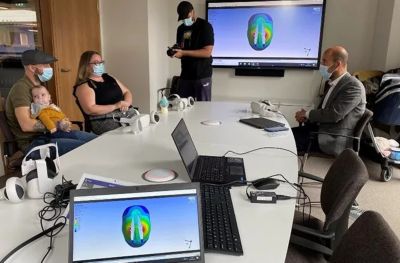
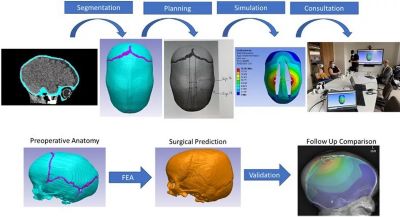
The aim of my research is to understand the effect of craniosynostosis on the cranial and facial development of children and the surgical procedures used to correct this anomaly. I have been the first to develop a computational method to predict the outcome of spring cranioplasty, a minimally invasive procedure adopted in Great Ormond Street Hospital for Children to treat babies affected by scaphocephaly, a long and narrow head due to premature ossification of the sagittal suture, which has been used to carry out preoperative planning as well as patient and parent consenting.
When did you first start using Simpleware software, and what does the software help you to achieve?
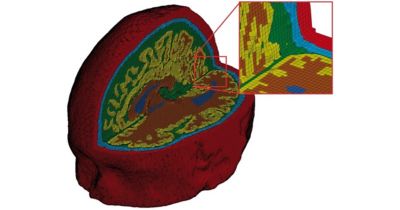
I have been using Simpleware since 2017. I mostly use it to carry out image segmentation of medical datasets, to create 3D anatomical models for visualization, analysis, and simulation. I used these datasets to simulate surgical treatment of craniosynostosis, predict the surgical outcome and provide directions to surgeons on how to optimize the treatment. Simpleware allows me to process CT images and helped me create a framework to produce high fidelity 3D anatomical models directly suitable for finite element analysis.
Where do you see your research heading over the next few years?
I am planning to continue my research in cranio-maxillofacial surgery, to expand the use of my numerical models for the prediction of other minimally invasive techniques for the treatment of craniosynostosis. I am planning to expand my research in the field of calvarial micro-morphology to understand calvarial maturation in the new-born by means of high resolution synchrotron tomography, with the aim of identifying the optimal time for reshaping surgery.
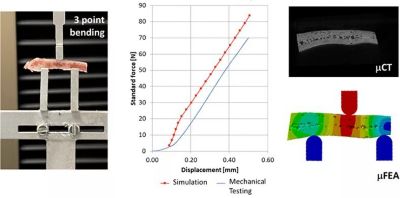
Mechanical testing and simulation.
What type of challenges do you expect to face with your research?
The availability of preoperative medical imaging is very important in my work. I am working to adapt my modeling framework to use non-ionizing imaging to produce anatomical models suitable for preoperative planning of scaphocephaly correction.
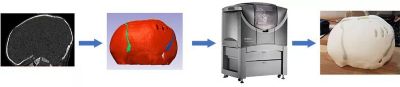
3D printing of skull for craniosynostosis.
Learn more about Ansys Simpleware Medical software.

The Advantage Blog
The Ansys Advantage blog, featuring contributions from Ansys and other technology experts, keeps you updated on how Ansys simulation is powering innovation that drives human advancement.