Synopsys and Ansys power the future of innovation—connecting silicon to systems.
-
-
Access Free Student Software
Ansys empowers the next generation of engineers
Students get free access to world-class simulation software.
-
Connect with Ansys Now!
Design your future
Connect with Ansys to explore how simulation can power your next breakthrough.
Free Trials
Products & Services
Learn
About
Back
Products & Services
Back
Learn
Ansys empowers the next generation of engineers
Students get free access to world-class simulation software.
Back
About
Design your future
Connect with Ansys to explore how simulation can power your next breakthrough.
Free Trials

N95 masks have been in much demand during the COVID-19 pandemic, due to being breathable and highly effective at protecting the public, while also reducing environmental waste by being reusable. 3D printed N95 mask filters are also antimicrobial or sterilizable and suitable for flexible design. However, these filters have a slow production rate, something that is being tackled through a workflow involving binder-jet 3D printing, micro-CT scanning, 3D image processing, and computational fluid dynamic (CFD) simulation. Researchers at the University of Pittsburgh, ExOne, Ansys, and Synopsys have worked on developing an efficient digital prototyping process to save time and resources when manufacturing 3D-printed copper and stainless-steel mask filters.

Example of a N95 mask with a filter valve.
Optimizing 3D Printed Filters
Different approaches came together to create the filter workflow:
- Different filter samples were created by ExOne using binder-jet printing and sintering, and experimental data acquired.
- The samples were scanned on a Bruker SkyScan 12972 uCT machine.
- Ansys Simpleware software was used to import image data for segmentation of the porous structure, and for generation of simulation-ready CFD meshes
- Ansys Fluent software was used to analyze the behavior of N95 masks in normal operation, including porous resistance, with simulations run on Simpleware software meshes refined for different conditions to predict which metal powder/sintering combinations met acceptable filtration standards.
- Results showed improved filtration efficiency for 5 µm particles against 1 µm particles, and how studying high and low flow regions helps provide insights into mask design to improve performance.
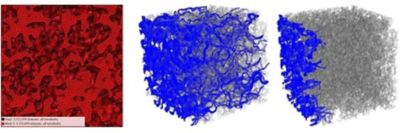
CFD mesh created in Simpleware software (left), and particle flow simulation in Ansys Fluent software: 1 µm particles (58% efficiency) (middle) and 5 µm particles (97% efficiency) (right).
Future Impact
Given the continued demand for N95 face masks and efficient manufacturing of filters, this combination of binder-jet 3D printing and iterative optimization of printing and post-processing parameters shows promise for increasing the reusability of sterilizable metal N95 filters. In addition, design optimization through digital prototyping only takes about four days on average, compared to approximately 21 days with physical methods, and also reduces material waste.
We were excited to take part in this project, especially given the ways this method can be adapted to study other characteristics and improve our understanding of pore behavior, with the benefit of mitigating against large-scale disposal of single-use PPE.
Learn more about Ansys Simpleware software.


The Advantage Blog
The Ansys Advantage blog, featuring contributions from Ansys and other technology experts, keeps you updated on how Ansys simulation is powering innovation that drives human advancement.