Synopsys and Ansys power the future of innovation—connecting silicon to systems.
-
-
Access Free Student Software
Ansys empowers the next generation of engineers
Students get free access to world-class simulation software.
-
Connect with Ansys Now!
Design your future
Connect with Ansys to explore how simulation can power your next breakthrough.
Free Trials
Products & Services
Learn
About
Back
Products & Services
Back
Learn
Ansys empowers the next generation of engineers
Students get free access to world-class simulation software.
Back
About
Design your future
Connect with Ansys to explore how simulation can power your next breakthrough.
Free Trials
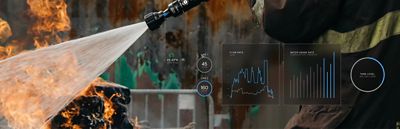
Discover how the Ansys Startup Program helped a young company improve fire defense in California and beyond.
According to NASA satellite data, extreme wildfire activity has more than doubled globally in the past two decades. In the U.S., California is one of the most impacted areas. The California Department of Forestry and Fire Protection, also known as CAL FIRE, reported more than 7,800 wildfires in 2025, spanning over half a million acres in its jurisdiction alone, which includes 36 of the state’s 58 counties.
In this installment of the Ansys Startup Program’s “Where Are They Now?” series celebrating the program’s 10-year anniversary, we’re shining a spotlight on HEN Technologies. Based in Alameda County, California, HEN Technologies leads innovation in fire suppression trusted by fire professionals worldwide.
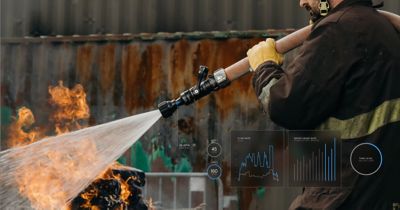
California-based HEN Technologies develops innovative fire suppression technologies using multiphysics simulation from Ansys, part of Synopsys.
Drawing on his background in materials science, local resident Sunny Sethi launched HEN Technologies in 2020 to make firefighting resources more efficient, particularly in areas with limited water supplies. Ever since, multiphysics simulation from Ansys, part of Synopsys, has been an essential part of HEN Technologies’ product development and business success.
With initial access to the software through the Ansys Startup Program, HEN Technologies continues to integrate Ansys solutions with support from Rand Simulation, an Ansys Elite Channel Partner.
To learn more about this journey, Ansys caught up with Sethi to discuss simulation’s impact on his company’s past, present, and future.
HEN Technologies uses computational fluid dynamics (CFD) to design nozzles that maximize water resources.

Sunny Sethi
Starting Up Things With Simulation
Question: Congratulations, HEN Technologies is approaching its sixth year in business. Why was simulation crucial for your endeavor in 2020, and how did you discover the Ansys Startup Program?
Sunny Sethi, founder and chief officer at HEN Technologies: I cannot change the chemistry of water, but I can change its flow, velocity, and coverage, for example. However, it’s very complicated with environmental factors like wind and equipment factors like pressure. Empirically guessing the flow rate, droplet size, or pattern is almost impossible.
The only way to solve it is through physics-based models, and Ansys has some of the best physics-based models with Ansys CFX computational fluid dynamics (CFD) software and Ansys Fluent fluid simulation software. In 2021, I reached out to Ansys and explained that I would like to use simulation but needed affordable options as a new company. They connected us with the team at Rand Simulation, who helped us integrate discounted software through the Ansys Startup Program.
How does CFD help you maximize water and develop HEN Technologies’ signature nozzle features, including long reach, wide coverage, and wind-stable large droplets?
Sethi: We started looking at the problem from the ground up: I have a fire — what is the least amount of water I can put on it to suppress it?
Quick example: You have a small BBQ fire. If you put 1,000 gallons on it, it will go out in one second. If you put 100 gallons on it, it'll go out in one second. How about 1 gallon? Maybe not. That was a starting point.
Then we looked at environmental factors. Most wildland fires occur in very windy conditions, so we need a certain momentum because small droplets get blown away. Another problem is that these fires span a very large area — think thousands of acres — but existing nozzles had a very tight pattern.
We used this data and customer input to simulate the nozzle structure, internal flow pathways, and things like that. We did a lot of design of experiments (DOEs) with Ansys software, and then we 3D-printed those parts. We validated our model using real-life physical models and confirmed its accuracy then began optimizing it further.
Did You Know?
HEN Technologies’ fire defense ecosystem incorporates suppression, deployment, and data collection to accurately predict the amount of water required. This involves in-depth design and simulation analyses of nozzles, pump controls, and valves.
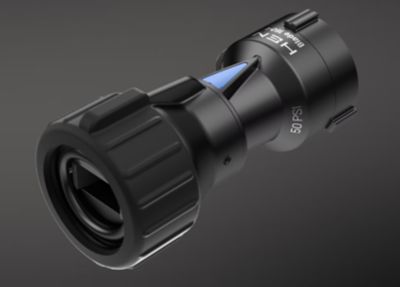
The HEN BLADE nozzle is one of eight models designed by the HEN Technologies team, whose nozzles are known for wind-stable large droplets, long reach, and wide coverage.
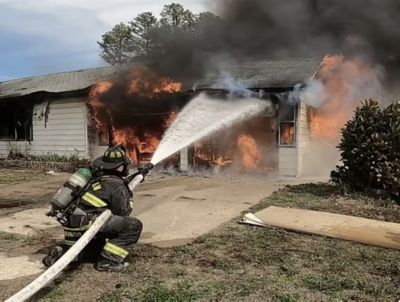
More than 1,000 fire departments worldwide use HEN Technologies’ fire suppression equipment.
Making a Broad Impact
Are fire departments in California or elsewhere using this equipment?
Sethi: We have over 1,000 departments that have already adopted HEN Technologies, including some of the biggest departments in the world, such as the U.S. military.
The Maui Fire Department is an interesting case study for us because, after the very tragic Lahaina fires, they did an analysis of different types of nozzles and found that HEN Technologies’ nozzles help suppress fires faster and save water.
We also had an order from the U.S. Marine Corps. We have several orders with Air Force bases, the Army, and the U.S. Navy, as well as large departments, such as CAL FIRE and the city of Sacramento, and hundreds of smaller departments in the U.S. and Canada.
Are there any other real-life applications of the technology?
Sethi: People have started reaching out to us for non-fire suppression applications like de-icing. When an airplane is at the airport and has ice on it, it’s very risky. They have to use de-icing fluid to remove everything and make sure it’s completely clean. You want to use as much fluid as possible. You also want to reduce gate time and delays.
Alaska Airlines approached us last year to test our technology for de-icing, and after promising results in Seattle, additional tests in Philadelphia with a major de-icing vendor exceeded expectations.
We have another customer asking us to test the technology for mining applications. There is so much dust generated in mining that they want a sheet of water with large enough droplets to clear it.
These applications are not even related to fire suppression.
Increasing Safety, Sustainability, and Savings With Simulation
What benefits or savings have you achieved by using Ansys simulation?
Sethi: 3D printing for prototypes is affordable but takes two to three days per item. Printing hundreds could take 200 days to a year, and you can’t see the internal process — only the end result. But you can 3D-print one object to validate your model. Models can be wrong. You have to do some experiments to validate your model. So, maybe you need to 3D-print three or four models before your DOE, which can now be done in a month instead of a year, using a better, more controlled approach and deeper analysis.
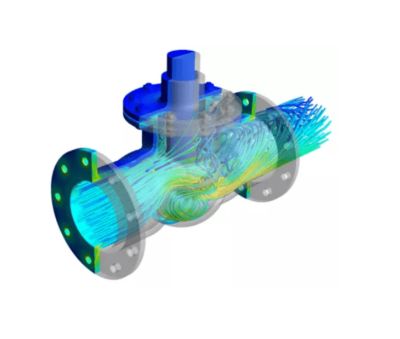
HEN Technologies advances firefighting with improved water flow, velocity, and coverage using computational fluid dynamics (CFD) simulation.
Combining simulations with 3D printing before creating metal prototypes saves both time and cost. Let’s say a metal prototype costs $1,000 for a machine. If I have to produce 100 of those machines before I have the final design, you can estimate the cost at $100,000. Even if you have to do 10, that’s $10,000.
There’s been a shift toward digitalization across the industrial equipment and manufacturing industries, commonly driven by a desire to increase efficiency. What motivates HEN Technologies to embrace digital engineering, including simulation?
Sethi: For us, sustainability, 100%. The prototype example I gave is just one type of product, but if we have to 3D-print and metal-print eight different types of products, the amount of waste generated increases, negatively impacting sustainability, as well as time and cost.
Also, when you are trying to create a very disruptive change, like 20 PSI pressure drops without turbulence, you have to be able to look inside the flows, and that is not even possible with the physical product. You have to do simulations because there are factors you may not consider, like why is that feature creating turbulence? But when you look into it, you see a certain boundary condition and realize something is happening there.
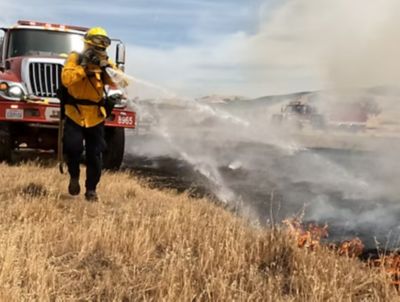
HEN Technologies’ nozzles use less water and suppress fires faster, from structural units to wildlands.
Will simulation continue to play a role in HEN Technologies’ growth and development?
Sethi: The nozzle is just the tip of the spear in fire suppression. There are shut-off valves and pressure devices, and then you go into the engine, where there’s a pump powering multiple hoses, plus the mounted nozzles. You cannot estimate the exact flow rate that passes through each nozzle, and there are forces you cannot estimate empirically.
Say 10 firefighters have the hose on, and then three of them close it. There’s a backward pressure that could be dangerous. Some of those things we have to simulate and figure out, and it’s a multiphysics model. Again, this is what Ansys software is really good at: multiphysics models. We definitely want to continue leveraging the power of simulation. It helps us accelerate our timeline, save costs, and do things that are not even possible with just physical prototyping.
Grow Your Business With Simulation
Ansys is dedicated to advancing industrial processes and equipment with innovative solutions. To learn how Ansys can support your early-to-mid-stage business, visit the Ansys Startup Program.

Just for you. We have some additional resources you may enjoy.
To learn how Ansys can support your early-to-mid-stage business, visit the Ansys Startup Program.
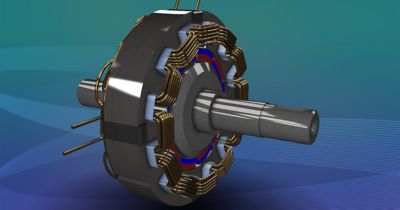
The Advantage Blog
The Ansys Advantage blog, featuring contributions from Ansys and other technology experts, keeps you updated on how Ansys simulation is powering innovation that drives human advancement.