Case Study
Synopsys and Ansys power the future of innovation—connecting silicon to systems.
-
-
Access Free Student Software
Ansys empowers the next generation of engineers
Students get free access to world-class simulation software.
-
Connect with Ansys Now!
Design your future
Connect with Ansys to explore how simulation can power your next breakthrough.
Free Trials
Products & Services
Learn
About
Back
Products & Services
Back
Learn
Ansys empowers the next generation of engineers
Students get free access to world-class simulation software.
Back
About
Design your future
Connect with Ansys to explore how simulation can power your next breakthrough.
Free Trials
“Ansys tools have been a game changer in advancing our work in rocketry. With Ansys Fluent software, we conducted high-fidelity simulations that bridged the gap between theoretical analysis and experimental testing. The comprehensive documentation, case studies, and theoretical resources were invaluable in helping us fully grasp the software’s capabilities. In rocketry, mitigating failure and managing risk begins with a deep understanding of vehicle behavior, and Ansys made that possible for us.”
— Félix Pobeda
Head of Simulations / TopAéro
For a student team such as TopAéro, from Sorbonne University in Paris, France, reusability and cost-effectiveness are essential. Each new rocket iteration builds upon previously validated subsystems. This includes structural modules, avionics, and aerodynamic components, which the team continuously refines while pursuing new mission objectives. When introducing control surfaces such as airbrakes, it is vital to verify their aerodynamic influence on the overall stability and performance of the rocket.
Physical testing alone would be prohibitively expensive and time-consuming for a student organization. Engineering simulation with Ansys Fluent software provides a decisive advantage by enabling the team to predict aerodynamic behavior, assess stability margins, and optimize geometry prior to manufacturing. Through simulation, TopAéro can identify potential instabilities, reduce design risks, and accelerate the development process.
Challenges
TopAéro’s objective was to evaluate the aerodynamic stability of a supersonic rocket equipped with four passive stabilizing fins and a three-airbrake module. The airbrakes, which were initially designed for another project, introduced asymmetric flow interactions that can partially mask the fins once deployed. Understanding how this configuration affects static stability and aerodynamic balance was therefore a central challenge.
The team also aimed to quantify the drag increase produced by each airbrake deployment phase to optimize activation timing during flight. They chose to rely on simulation because it enabled them to precisely resolve the flow field around the rocket, extract aerodynamic coefficients, and evaluate stability derivatives under controlled conditions.
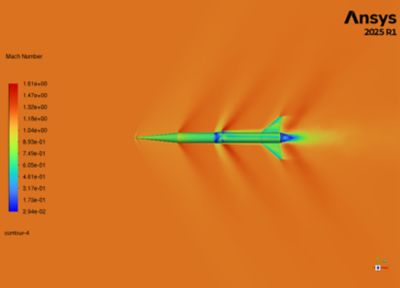
Mach number distribution in the XY-plane around the Ætherion rocket at Mach 1.2, showing the supersonic flow features and shock patterns forming near the body
Engineering Solutions
The Ansys DesignModeler tool was employed to generate the computational domain and prepare the geometry for analysis. The Ansys Meshing application was then used to create the spatial discretization with localized refinement near critical aerodynamic features. Finally, Fluent software served as the main solver for flow simulations.
Prior to running the simulations, TopAéro had limited information regarding the extent of fin masking caused by the deployed airbrakes. By extracting the pressure coefficient distribution on each fin, determining the center of pressure, and performing sensitivity analyses with respect to Mach number and angle of attack, they were able to assess whether the rocket would maintain nominal aerodynamic stability.
The versatility of the tools available in the Fluent Results tab proved invaluable. These features enabled the team to explore and visualize multiple physical parameters simultaneously to gain an understanding of their respective contributions within a single set of simulations.
Key features and capabilities included:
- Surface and contour plotting of aerodynamic variables, such as pressure coefficient, wall shear stress, and Mach number
- Force, moment, and center of pressure reports
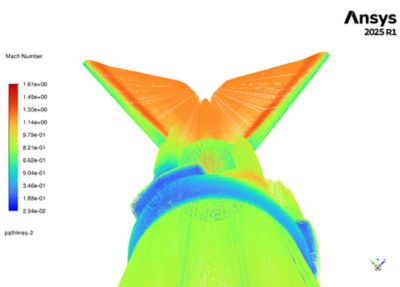
Pathlines colored by Mach number near the Ætherion rocket, highlighting flow disturbances around the fins due to airbrake effects
Benefits
The team was able to validate aerodynamic stability prior to manufacturing, thereby avoiding costly and time-consuming physical testing.
- Design iteration time was reduced by approximately 30%, as multiple configurations could be assessed virtually.
- Optimal airbrake deployment ranges were identified, ensuring effective drag modulation without compromising stability
- The team’s understanding of aerodynamic interactions was improved, including concepts such as fin masking and asymmetric pressure distribution, thereby strengthening members’ capability to design control surfaces for future rockets.
- The team gained experience with computational fluid dynamics (CFD) workflows, turbulence modeling, and post-processing techniques in alignment with industry standards.
- Decision-making during the design phase was enhanced, as quantitative simulation results informed design reviews and mission planning.
The results obtained through engineering simulation gave the team the confidence necessary to validate the aerodynamic configuration prior to fabrication and flight testing. The rocket is scheduled for launch in July 2026 during a French intercollegiate rocketry competition, and the team’s simulation outcomes confirmed that it can safely operate under this configuration.
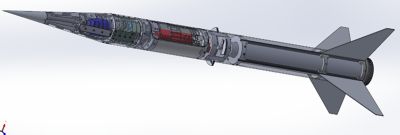
Final model of the Ætherion rocket with integrated fins, airbrake system, and all modules
Let’s Get Started
If you're facing engineering challenges, our team is here to assist. With a wealth of experience and a commitment to innovation, we invite you to reach out to us. Let's collaborate to turn your engineering obstacles into opportunities for growth and success. Contact us today to start the conversation.