Case Study
Synopsys and Ansys power the future of innovation—connecting silicon to systems.
-
-
Access Free Student Software
Ansys empowers the next generation of engineers
Students get free access to world-class simulation software.
-
Connect with Ansys Now!
Design your future
Connect with Ansys to explore how simulation can power your next breakthrough.
Free Trials
Products & Services
Learn
About
Back
Products & Services
Back
Learn
Ansys empowers the next generation of engineers
Students get free access to world-class simulation software.
Back
About
Design your future
Connect with Ansys to explore how simulation can power your next breakthrough.
Free Trials
“Using Ansys solutions allowed us to iterate our humanoid robot’s design with confidence. The ability to simulate mechanical stresses, actuator loads, and kinematic behavior before building helped us catch design flaws early. It accelerated our progress, saved material costs, and made us stronger engineers.”
-Abhinav Swarup, President, Triton Droids
At Triton Droids, a student team from the University of California, San Diego, students set out to build a life-size humanoid robot capable of complex motion and stability. Humanoid robots represent the future of robotics, and building one gives students invaluable hands-on experience in an emerging field that bridges mechanical design, control systems, and artificial intelligence (AI).
To meet strict mechanical and power constraints, the team turned to engineering simulation. Ansys software enabled the team to validate and optimize structural integrity and actuator dynamics before physical prototyping, saving valuable time and resources.
Challenges
Designing a humanoid robot involves complex mechanical linkages and multiple degrees of freedom. Balancing weight, strength, and agility while ensuring efficient motor and joint operation proved to be a significant challenge. Calculating joint torques in the leg was difficult, as each joint’s required torque depends on both the motor specifications and the weight of components further down the chain. As a result, simulation became essential for accurately predicting performance under load, reducing overall weight, and minimizing the risk of mechanical failure.
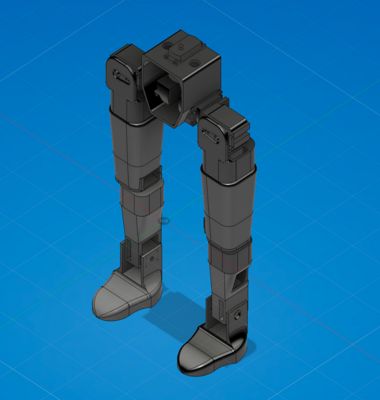
Computed-aided engineering (CAD) model of Triton Droids’ five degrees of freedom (DOF) humanoid leg with modular joints for the hip, knee, and ankle
Engineering Solutions
- Ansys Mechanical software helped the team simulate the load on the robot’s joints and frame to ensure structural integrity.
- Ansys Motion software helped optimize actuator and linkage dynamics, especially for walking and balance.
- With Ansys solutions, the team was able to analyze material stress and deformation during dynamic actions like standing, walking, and object manipulation.
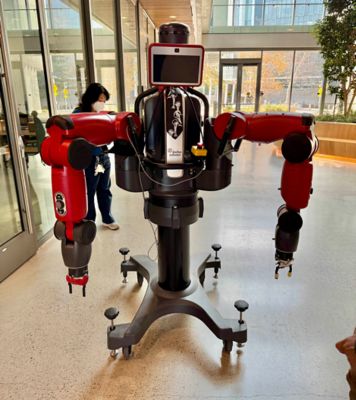
Baxter industrial robot donated by the team’s advisor, which was used for manipulation and perception research
Benefits
Using Ansys software drastically reduced trial-and-error cycles. Students identified and corrected weak points before manufacturing, which saved time and reduced costs. It also accelerated learning: by comparing simulation data with real-world testing, the team gained a deeper understanding of force transmission, balance, and system dynamics in robotics.
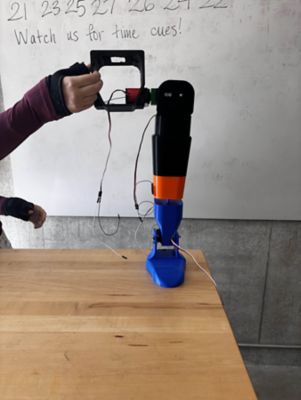
Demonstration of the leg prototype featuring three DOF at the hip, one DOF at the knee, and one DOF at the ankle
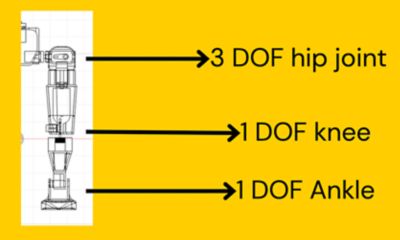
Joint layout of the humanoid leg with degrees of freedom depicted
Let’s Get Started
If you're facing engineering challenges, our team is here to assist. With a wealth of experience and a commitment to innovation, we invite you to reach out to us. Let's collaborate to turn your engineering obstacles into opportunities for growth and success. Contact us today to start the conversation.