-
-
Access Free Student Software
Ansys empowers the next generation of engineers
Students get free access to world-class simulation software.
-
Connect with Ansys Now!
Design your future
Connect with Ansys to explore how simulation can power your next breakthrough.
Countries & Regions
Free Trials
Products & Services
Learn
About
Back
Products & Services
Back
Learn
Ansys empowers the next generation of engineers
Students get free access to world-class simulation software.
Back
About
Design your future
Connect with Ansys to explore how simulation can power your next breakthrough.
Free Trials
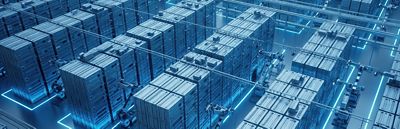
ADI, Synopsys, and NVIDIA demonstrate robotics cable management benchmarks for data center applications at NVIDIA GTC.
If data is the new oil, then cables are the pipelines. The demand for AI-based services has led to an explosion of hyperscale data centers — facilities designed support thousands of servers that can handle enormous computing, storage, and networking demands. These facilities can encompass tens of thousands of square feet and miles of connecting cables.
At that scale, small inefficiencies quickly add up to big losses. That’s where industrial robotics come into play. However, cables are notoriously challenging to handle — just ask anyone trying to untangle their wired headphone cord before an important call. Even tasks that are second nature to humans, such as plugging in an RJ45 Ethernet cable, are incredibly nuanced when training a robot to do so.
“Nothing is second nature to a robot,” says Kishor Ramaswamy, director of application engineering for Ansys, part of Synopsys. “Which jack should it be plugged into? How should the plug be lined up to the interface? How hard should the cable be held or the connector be pressed to ensure it’s plugged in but not so hard it breaks? What if the cable is caught on something?”
Now scale those connections to thousands of servers in environments that are affected by heat and high-voltage areas, and you’ll get an idea of the challenges faced by robotics companies tackling the cabling conundrum. The explosion of data centers requires physical AI solutions that only simulation can provide. To meet demand, there isn’t time to train robots in the real world, or for multiple rounds of physical prototypes. Robots need to be trained on synthetic data against standard benchmarks that create a level playing field for evaluating robotic performance. Such physical and virtual benchmarks will help get high-quality products to market in time to capitalize on the groundswell of data center construction.
Analog Devices Inc. (ADI) is up to the challenge. The company is a global semiconductor leader that bridges the physical and digital worlds. Its industrial robotics innovations span motion control, functional safety, advanced sensing, time of flight (ToF), machine learning, high-speed Ethernet communications, and system-level design.

Simulation Provides Speed and Accuracy
ADI is using Ansys Mechanical finite element analysis software to augment the fidelity of cables and connector models in the NVIDIA Isaac Sim environment for training and validating various robotic policies for cable management. Isaac Sim is an open-source robotics simulation framework that enables developers to simulate and test AI-driven robotics solutions in physically based virtual environments.
Ansys Mechanical software provides high-fidelity physics to reduce the “simulation-to-real” (Sim2real) gap. Mechanical software is used to compute the parameters in order to tune the engines and models in Isaac Sim that are needed to make the connections — such as angle limits, break forces, and elasticity — which are then packaged into Universal Scene Description (OpenUSD) assets to be incorporated into the Isaac Sim environment at ADI.
“The physics around cables and connectors are complex,” says Ramaswamy. “For example, the structural simulations have to take into account nonlinear deformations, compliance of materials under gripping loads, and friction.”
Beyond the Mechanical structural simulations, other Ansys simulation software can provide useful physics simulations for robotic cable management. For example, Ansys AVxcelerate Sensors autonomous sensor simulation software could be used to refine depth-sensing applications where time-of-flight (ToF) sensors are used.

A cable dexterity benchmarking rig
Benchmarking Robotic Dexterity
ADI plans to use the simulation results to advance its robotics solutions, including ToF sensors and tactile sensors, which provide precise force and torque sensing and measurement. However, the company is also sharing the knowledge it gains as a series of benchmarks to help advance the robotics industry as a whole.
“Synopsys’ multiphysics simulation is a critical enabler of realistic robotic test benches,” said Paul Golding, Vice President of Edge AI at ADI in a press release. “Together with NVIDIA, we’re using that fidelity to create benchmarks and digital twins that make sim‑to‑real transfer practical for real industrial dexterity.”
ADI will provide high-fidelity digital twins of these benchmarks, enabling customers to begin developing AI solutions immediately in NVIDIA Isaac Lab using their own robotic platforms — or by leveraging ADI’s reference design and its high-fidelity digital twin with ADI technology. NVIDIA Isaac Lab is an open-source, unified framework for robot learning. The framework covers everything from environment setup to policy training and supports both imitation and reinforcement learning methods.
ADI’s platform will enable early adopters, including Kawasaki Heavy Industries, to simulate robotic performance and generate synthetic data with greater predictive accuracy, reducing iterative physical testing cycles and accelerating innovation.
Synopsys’ booth at the NVIDIA GTC 2026 March 16-19 in San Jose, California will feature a demonstration of the ADI collaboration, including a bi-manual robotic arm setup with force, vision, and contact sensing, and a corresponding digital twin.


The Advantage Blog
The Ansys Advantage blog, featuring contributions from Ansys and other technology experts, keeps you updated on how Ansys simulation is powering innovation that drives human advancement.