Synopsys and Ansys power the future of innovation—connecting silicon to systems.
-
-
Access Free Student Software
Ansys empowers the next generation of engineers
Students get free access to world-class simulation software.
-
Connect with Ansys Now!
Design your future
Connect with Ansys to explore how simulation can power your next breakthrough.
Free Trials
Products & Services
Learn
About
Back
Products & Services
Back
Learn
Ansys empowers the next generation of engineers
Students get free access to world-class simulation software.
Back
About
Design your future
Connect with Ansys to explore how simulation can power your next breakthrough.
Free Trials
You can’t get from point A to point B if you don’t know where you’re headed. In the automotive industry, that means navigating a development roadmap shaped by rapid advancements in electrification, autonomy, and connectivity, among others.
In the continuation of our recent discussion, How Simulation Helps the Automotive Industry Capitalize on the Top Trends, we consider the impact of increasing vehicle complexity, the reprioritization of autonomous investments, and how simulation can help OEMs navigate these trends.
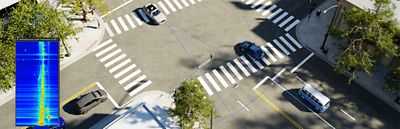
Real-time radar sensing in the Omniverse. Ansys Perceive EM processes multi-channel radar scattering against dynamic high resolution virtual environments, yielding drive-time insights into real-world sensor performance.
Increasing Vehicle Complexity
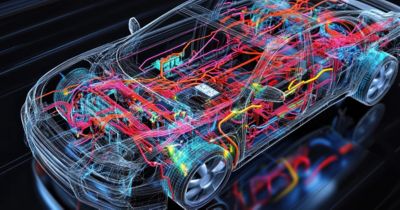
A collection of intricate systems of interdependent electronics and software is becoming foundational to the vehicles we drive, managing everything from engine efficiency to driver assistance, and more. Consider, for example, the growing interconnectivity of seat controls and infotainment systems, or the advanced driver assistance systems (ADAS) that are intrinsically tied to the integration of sensors and actuators.
The dramatically improved driving experience they provide comes at a cost in complexity. As these systems become increasingly advanced, the difficulty involved in designing and managing them exponentially increases. Therefore, building, maintaining, and repairing them requires a deeper understanding from both consumers and automakers alike.
All these systems must play well together in highly reliable environments. Complex electronics are increasingly integrated with a growing number of radio frequency (RF) applications involving a wider band of radio signals, thus presenting significant engineering challenges.
Today's automotive infotainment and sensor systems are enabled by a complex wireless environment designed into the vehicle. They must operate reliably in the presence of external wireless signals in the surrounding environment. In this scenario, minimizing interference and noise is a priority for engineers working on current and next-generation automotive electronics applications.
“These digital features involve more processing requiring the introduction of more complex digital elements,” says Wade Smith, director of application engineering at Ansys, part of Synopsys. “They are always noisy, and engineers are integrating them with radio frequency elements like antennas, filters, and amplifiers that thrive in a quiet environment. So essentially, what you're doing is putting the toddler in a library.”
If all of this sounds complicated, well, it really is. Thankfully, automotive engineers can turn to advanced simulation tools to ensure the reliability, efficiency, and safety of these automotive systems, despite the disruptions. Due to continued reductions in product turnaround time, they don't have the time to physically build, test, and repeatedly validate systems. The only way to get to the same level of confidence that these systems are going to work is to simulate them as much as possible, from many different angles. For example:
- Simulation of physical systems can help determine the operation of chips placed and interconnected on printed circuit boards (PCBs) within hostile environments.
- Automotive OEMs can obtain 3D models of components from their vendors and add them into their large systems to compare and contrast how they operate.
- Antennas can be placed around a vehicle and tested virtually to quantify potential interference and shielding effectiveness.
- Multiphysics simulations can be used to test the reliability of components and systems operating in different thermal and mechanically stressed environments.
In addition, a virtual model of a vehicle can be deployed into a virtual environment, using NVIDIA Omniverse libraries, for example, to test actual operation in real-world scenarios.
“By employing simulation, it’s possible to develop chips that specifically go into a vehicle and have some sort of AI aspect in terms of their utilization,” says Smith. “Analysis can begin at the chip level and can continue on to a virtual deployment of a car driving around a city being tracked by a 5G tower spraying automotive radar to detect people, vehicles, street signs — really anything else in the environment.”
Of course, this work is particularly valuable in the leveling up of autonomous systems.
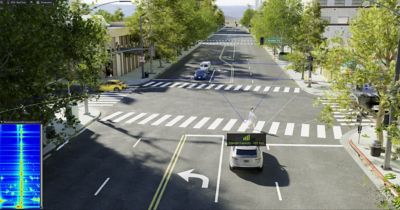
Rendering of downtown San Jose in NVIDIA Omniverse with 5 cm resolution.
Reprioritizing Autonomy Investments
Full autonomy remains a long-term goal for mass market passenger car manufacturers.
In the near term, automakers are focused on developing ADAS features that cater to consumer expectations for safety and convenience. These offer a practical bridge to achieving full autonomy, without the prohibitive costs and complexities inherent in the development of fully self-driving systems. As ADAS continues to evolve, automakers are investing in perception and localization technologies to enhance vehicle safety and automation.
Localization, or the process of pinpointing a vehicle’s position relative to its surroundings, depends, in part, on sensor technologies crucial to collecting data related to the movement and orientation of a vehicle in its environment. Anything that interferes with these activities on the road can lead to failure.
The perception market is focused on three types of sensing technologies: camera-, thermal camera-, radar-, and lidar-based. There is an emphasis on complementary sensing because the highest levels of perception are achievable by combining multiple modalities. Ultimately, it all comes down to robustness and safety.
Among the regulations responsible for automotive safety, one of the more complex is FM VSS 127, which tends to put significant constraints on carmakers. They must pivot to a multimodality strategy to satisfy regulatory requirements.
"Engineers are selecting the sensor suite necessary to ensure they detect, for example, an animal during nighttime conditions crossing the road," says Emmanuel Follin, senior manager product management at Ansys, part of Synopsys. "And this level of detection is too complex to be done without accurate camera plus lidar or thermal camera. It’s really all of those regulations that are pushing innovators in the direction of multimodality instead of only selecting one sensor to do everything."
HFSS 2025 R2 can plot current-density on the ray footprint when using SBR+ (Shooting-and-Bouncing-Rays with advanced diffraction). This technique is ideal for computing antenna radiation patterns on electrically large platforms. Visualizing the current-density footprint where rays strike surfaces helps engineers quickly diagnose multipath, scattering, and interference from surrounding objects — accelerating insight and improving design decisions for complex antenna integrations.
Accelerate Autonomous Development
It's practically impossible to physically drive and record all the data needed to validate autonomous functions because it involves literally thousands of use cases. Instead, OEMs can turn to synthetic data generation.
By integrating Omniverse libraries with AVxcelerate Sensors applications, engineers can build immersive, physically accurate models within the Ansys software interface, supporting real-time collaboration and improving communication of results. Moreover, PyAnsys, a family of Python packages that enable users to interact with Ansys products, automatically formats simulation data so simulation practitioners and developers can easily customize and automate simulations inside applications built with Omniverse libraries and OpenUSD.
NVIDIA Cosmos, a platform of world foundation models purpose-built for physical AI, is a key enabler for scaling synthetic data generation. The combination of these models and frameworks with Omniverse libraries helps developers to scale data generation, bring more diversity to their data sets, and accelerate the training of the AI-based algorithms that power self-driving vehicles.
“What is meant by data augmentation in this instance?” says Follin. “Let’s say you go on an AI program and ask it to take an image and make yourself beautiful, or to make the sun shine on you. In a sense, you are doing the same thing with multiphysics simulation and an enriched data set of images — video scenarios you can use to more accurately validate sensor perception and ADAS function. It’s essentially another level of simulations that add more variety and more diversity during training.”
Simulation Empowers Carmakers To Overcome Industry Challenges
Growing vehicle complexity, fueled by advanced technologies, regulations, and competition continues to exert downward pressure on engineering executives. Success in this market means that automakers must identify solutions that lead to faster decision-making and innovation through enhanced collaboration. Yet the integration and flow of decisions across teams remains a challenge, exposing significant operational risks.
For decades, simulation has been used to virtually test components and systems, reducing the need for costly physical prototypes. It’s a reliable way to validate software and hardware interactions early in the development process, reducing the risk of issues during production that can lead to launch delays. Simulation enables automakers to streamline workflows and optimize designs efficiently and precisely to maximize profitability.
Case in point: OEMs must comply with various global regulations. Many of these automotive regulatory bodies are permitting more virtual testing as a means of substantiation. Of course, virtual testing won't completely replace time behind the wheel. However, simulation can reduce the need for extensive physical testing, reduce time to market, and reduce the cost of discovering issues during physical testing.
"Historically, virtual testing of autonomous functionality was limited to OEM internal processes, to reduce development costs," says Follin. "Now, even regulatory bodies are encouraging it because the size of the regulation is so much larger. This is good news, given the current economic constraints of the automotive market, as some simulation engineering teams are tasked with reducing the cost of validation by a factor of three, without compromising on safety."
Ansys software solutions are central to re-enigneer how vehicles are being engineered, enabling automotive system complexity to be tackled in an open ecosystem that provides a structured, efficient, and integrated means of collaboration.
If you're attending CES, stop by booth 6701 in the Las Vegas Convention Center — West Hall to learn more about our automotive solutions. Not able to attend CES? Catch our Automotive Webinar Series to learn how to build better products faster and simultaneously reduce R&D and manufacturing costs.

Just for you. We have some additional resources you may enjoy.
“By employing simulation, it’s possible to develop chips that specifically go into a vehicle and have some sort of AI aspect in terms of their utilization.”
— Wade Smith, director of application engineering, Ansys, part of Synopsys
The Advantage Blog
The Ansys Advantage blog, featuring contributions from Ansys and other technology experts, keeps you updated on how Ansys simulation is powering innovation that drives human advancement.